


Ethereum $ETH has evolved from a pioneering smart-contract platform into the foundational settlement layer for decentralized applications, global finance, and institutional web3 infrastructure. As the network matures, discussions around Ethereum have shifted from its speculative potential to its consistency and stability.
In distributed systems, consistency refers to the guarantee that all nodes agree on the state of the ledger, while stability encompasses both technical resilience (uptime, security against attacks) and economic predictability (monetary policy, gas fee dynamics, and value retention). Examining Ethereum through these dual lenses reveals how protocol design choices secure its status as a reliable global compute and settlement engine.
Technical Consistency: The Mechanics of Proof-of-Stake
Achieving consistency in a decentralized, permissionless network requires a robust consensus mechanism. Ethereum’s transition from Proof-of-Work (PoW) to Proof-of-Stake (PoS)—completed during The Merge—fundamentally transformed how the network maintains ledger consistency.
1. Deterministic Finality and Epochs
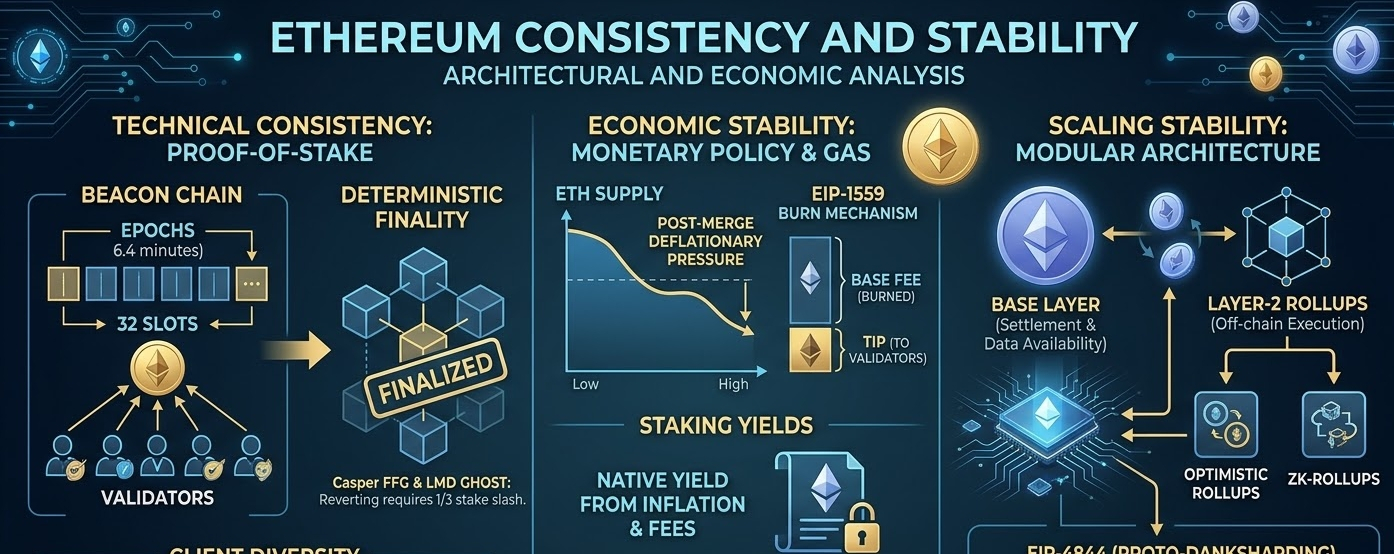
Under the Casper the Friendly Finality Gadget (FFG) and LMD GHOST consensus protocols, Ethereum organizes time into epochs (consisting of 32 slots, or 6.4 minutes each). Validators attest to blocks, and once two-thirds of the total stake votes for a checkpoint, blocks are finalized.
* Finality Guarantee: Once a block is finalized, it cannot be reverted without slashing at least one-third of the entire network's staked ether (worth tens of billions of dollars). This provides high economic finality compared to probabilistic finality models.
* Fault Tolerance: Ethereum can maintain liveness and safety even if a subset of validators go offline or attempt malicious forks, automatically penalizing bad actors through automated slashing protocols.
2. Client Diversity and Network Resilience
Consistency is not merely algorithmic; it is structural. Ethereum relies on multiple independent client implementations (such as Prysm, Lighthouse, Teku, and Nimbus for consensus execution; Geth, Nethermind, Besu, and Erigon for execution).
* Spreading validator nodes across multiple clients prevents a single software bug from taking down the entire network.
* Continuous community efforts prioritize client diversity to ensure that no single software monopoly threatens consensus stability.
Economic Stability: Monetary Policy and Gas Dynamics
While technical consistency ensures the ledger remains untampered, economic stability governs how the network handles value, user costs, and incentives. Ethereum’s economic design balances predictable security funding with deflationary pressures.
1. EIP-1559 and the Burn Mechanism
Introduced in 2021, EIP-1559 revolutionized Ethereum’s fee market by introducing a base fee that is burned (permanently removed from circulation) alongside a tip paid to validators.
* Supply Elasticity: Depending on network demand, the net issuance of Ether fluctuates. During periods of high activity, the amount of ETH burned can outpace new issuance, making the asset deflationary.
* Predictable Fee Estimation: Users no longer have to guess wildly high gas bids in an unmanaged auction format. The protocol sets a transparent base fee that adjusts block-by-block based on network congestion, smoothing out wild fee spikes.
2. Staking Yields and Capital Lock-up
Ethereum staking acts as the bedrock of its economic security. By locking up ETH to secure the network, stakers earn a native yield derived from inflation and transaction tips.
* The Staking Rate Equilibrium: As more ETH is staked, the marginal reward rate decreases, creating a natural economic balance that prevents runaway issuance while maintaining a strong incentive to secure the chain.
* Liquid Staking and Restaking: Innovations in liquid staking tokens (LSTs) and restaking protocols have added liquidity to staked assets, though they also introduce complex systemic dynamics that protocol developers actively monitor to prevent centralization risks.
Scaling Stability: The Layer-2 Modularity Shift
As adoption grew, maintaining consistency on the Ethereum base layer (Layer 1) while keeping transaction fees affordable became a primary engineering challenge. Ethereum solved this through a rollup-centric roadmap.
1. Offloading Execution to Layer-2 Networks
Networks like Arbitrum, Optimism, Base, and various Zero-Knowledge (ZK) rollups process transactions off-chain, batch them together, and post compressed cryptographic proofs back to Ethereum L1.
* Preserving L1 Security: Ethereum acts as the ultimate settlement and data availability layer. Rollups inherit Ethereum’s robust security and decentralization, ensuring that users do not have to trust a separate, less secure validator set.
* Reducing L1 Congestion: By moving high-frequency, low-value transactions to rollups, Ethereum L1 maintains structural stability and avoids the crippling gas spikes that historically priced out everyday users.
2. Proto-Danksharding (EIP-4844)
The integration of data blobs via EIP-4844 dramatically lowered the cost of data availability for rollups. This protocol upgrade ensured that Layer-2 scalability is economically sustainable, fostering long-term stability for the entire ecosystem.
Risks, Challenges, and Vulnerabilities
Despite its robust design, Ethereum faces ongoing challenges in maintaining absolute consistency and stability:
* Centralization Vectors: The concentration of staked ETH in large custodial staking pools or liquid staking protocols introduces potential single points of failure or governance capture.
* Smart Contract Risk: While Ethereum's base layer is exceptionally stable, the applications built on top of it (DeFi, bridges, lending markets) remain vulnerable to code bugs and exploits, which can create systemic shockwaves.
* Regulatory Scrutiny: As a globally distributed asset underpinning institutional finance, regulatory ambiguity across jurisdictions poses external pressures on node operators, stakers, and infrastructure providers.
Conclusion
Ethereum’s journey toward consistency and stability is a masterclass in distributed systems engineering. By combining rigorous Proof-of-Stake consensus, an adaptive monetary policy driven by EIP-1559, and a modular Layer-2 scaling architecture, Ethereum has built a resilient foundation for the decentralized web. While challenges such as centralization risks and smart contract vulnerabilities persist, the protocol's continuous upgrades demonstrate an unmatched capacity for adaptation.