

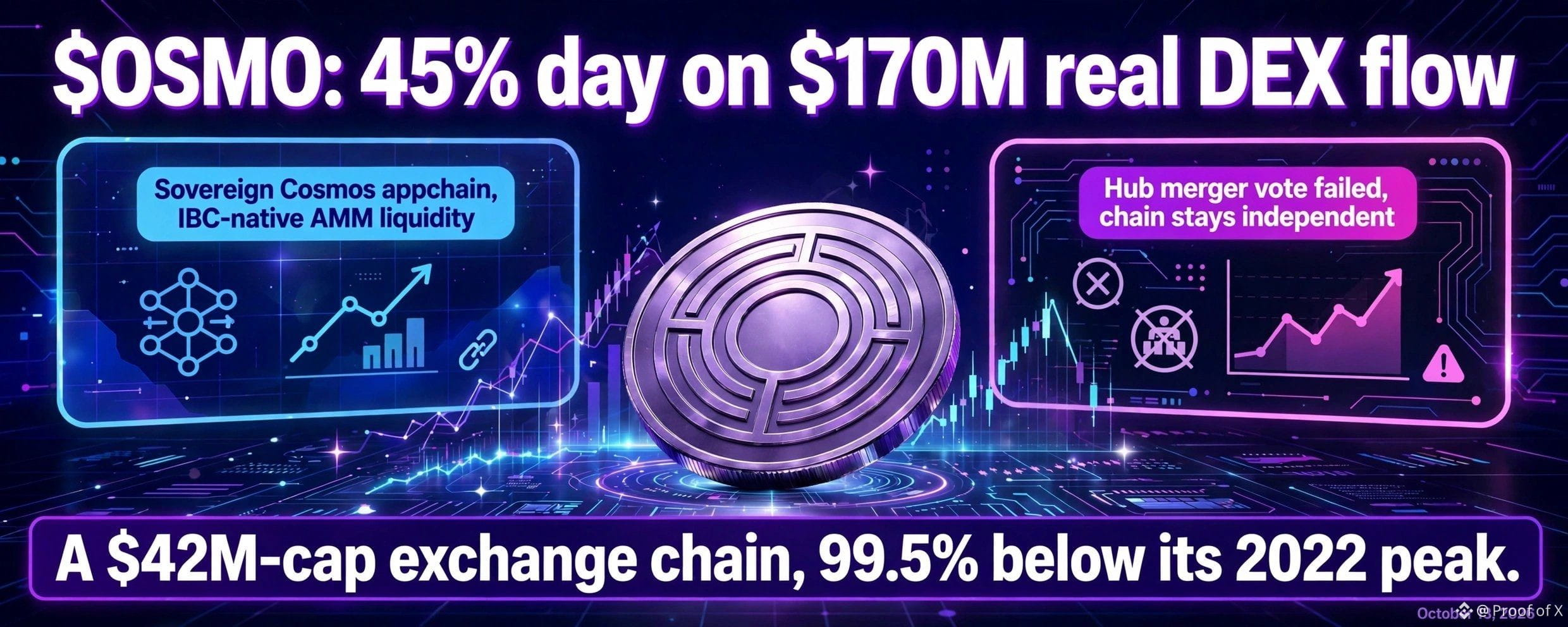
Six months after a Cosmos Hub governance vote to absorb Osmosis narrowly failed, the independent exchange chain just made the case for sovereignty itself: $OSMO printed a 45% single-day move while its own DEX processed roughly $170M in volume.
BUSINESS
Osmosis is a sovereign application-specific blockchain built on the Cosmos SDK, and its flagship product is the Osmosis automated market maker, the default liquidity venue for IBC-connected tokens across the Cosmos ecosystem.
Blockworks reported in 2021 that for the vast majority of its IBC assets, Osmosis was already the main liquidity venue.
The business model is exchange flow: swap fees from AMM trading, with $OSMO as the chain's native token for gas, governance, and staking to secure the network.
Through superfluid staking, liquidity providers can stake their LP tokens to earn staking rewards on top of swap fees, compounding both yields in one position.
After the failed merger vote, the Osmosis team confirmed the network continues to operate independently, with a stated focus on profitability and user security.
TECHNOLOGY
Unlike contract-based DEXs that live on someone else's chain, Osmosis is a full Cosmos SDK blockchain, so its governance can tune the AMM itself rather than lobbying a host chain.
Its signature technical feature is customizable liquidity pools: developers can build their own AMM curves with sovereign pool parameters instead of accepting one-size-fits-all pools.
It is IBC-native, so assets from any IBC-connected Cosmos chain can be deposited and traded without wrapped-bridge custody.
The protocol advertises instant block confirmation as a form of MEV resistance, aiming to prevent traders from cherry-picking transactions.
Superfluid staking lets LP tokens double as staked security, a mechanism only possible because the exchange is its own chain.
SECTOR
Osmosis sits in the DEX sector, where DeFiLlama tracked $4.71B in daily spot volume as of June 2026, with Uniswap holding about 20.6% of that total.
Within that sector, Osmosis owns the Cosmos lane: it is the default venue where IBC assets find liquidity.
The current backdrop is an altcoin rotation, with the Altcoin Season Index sitting around 51 on October 12, signaling mild capital movement from major assets into higher-beta tokens.
Mid-cap ecosystem DEX tokens are the natural beneficiaries of that rotation, and $OSMO is catching the bid.
COMPETITION
Uniswap ($UNI) is the sector leader by spot volume and the benchmark every DEX is measured against.
THORChain ($RUNE) is the other major cross-chain DEX, offering native-asset swaps across chains without wrapping.
Osmosis differs from both by being a full sovereign chain with its own validator set and governance-tunable AMM, rather than a set of smart contracts or a standalone swap protocol.
The trade-off is ecosystem breadth: Osmosis flow is concentrated in Cosmos IBC assets, while $UNI and $RUNE tap larger multi-chain volumes.
TOKENOMICS
CoinGecko reports $OSMO at a $41.9M market cap against a $50.7M fully diluted valuation.
Circulating supply is about 791.9M against a 1B maximum supply, so roughly 79% of the supply already circulates.
No dated unlock schedule could be verified this run, so the remaining emission path is stated only as that circulating-versus-maximum fact.
The all-time high of $11.25 was set in March 2022, leaving the token roughly 99.5% below its peak.
ON-CHAIN AND FUNDAMENTALS
On-chain data reported October 12 shows Osmosis DEX 24-hour volume spiking more than 7,000% to roughly $173.9M, per CoinGecko figures cited in crypto press.
DeFiLlama reports Osmosis DEX TVL at $11.4M, which means the single-day volume print was more than 15 times the venue's locked value.
That volume-to-TVL ratio is extreme: it signals the spike was driven by fast speculative flow through thin liquidity, not by deep organic order flow.
Binance $OSMO/USDT spot markets confirm the frenzy, with 24-hour quote volume of $5.7M on the token pair itself.
TEAM AND FUNDING
Osmosis was built by Osmosis Labs, cofounded by Sunny Aggarwal and Josh Lee, developers from the original Cosmos team.
The Osmosis Foundation closed a $21M token sale in October 2021, led by Paradigm.
Other participants included Robot Ventures, Nascent, Ethereal, and Figment.
Paradigm partner Charlie Noyes called it the firm's first AMM investment outside the Ethereum ecosystem.
RISKS
The honest bear case starts with the drawdown: $OSMO sits roughly 99.5% below its March 2022 peak, so nearly every long-term holder is underwater and rallies face overhead supply.
About 21% of the 1B maximum supply is not yet circulating, and liquidity incentives paid in $OSMO create ongoing structural sell pressure.
The failed Cosmos Hub merger removed a potential long-term structural upgrade path, and some participants viewed integration as the better outcome for Cosmos.
The volume spike is partly speculative: October 12 reporting attributes it to momentum strategies and altcoin rotation, and rotation-driven bids can reverse fast.
Osmosis flow is concentrated in the Cosmos IBC ecosystem, so any contraction in Cosmos activity hits the venue directly.
Not financial advice. DYOR.
$OSMO