

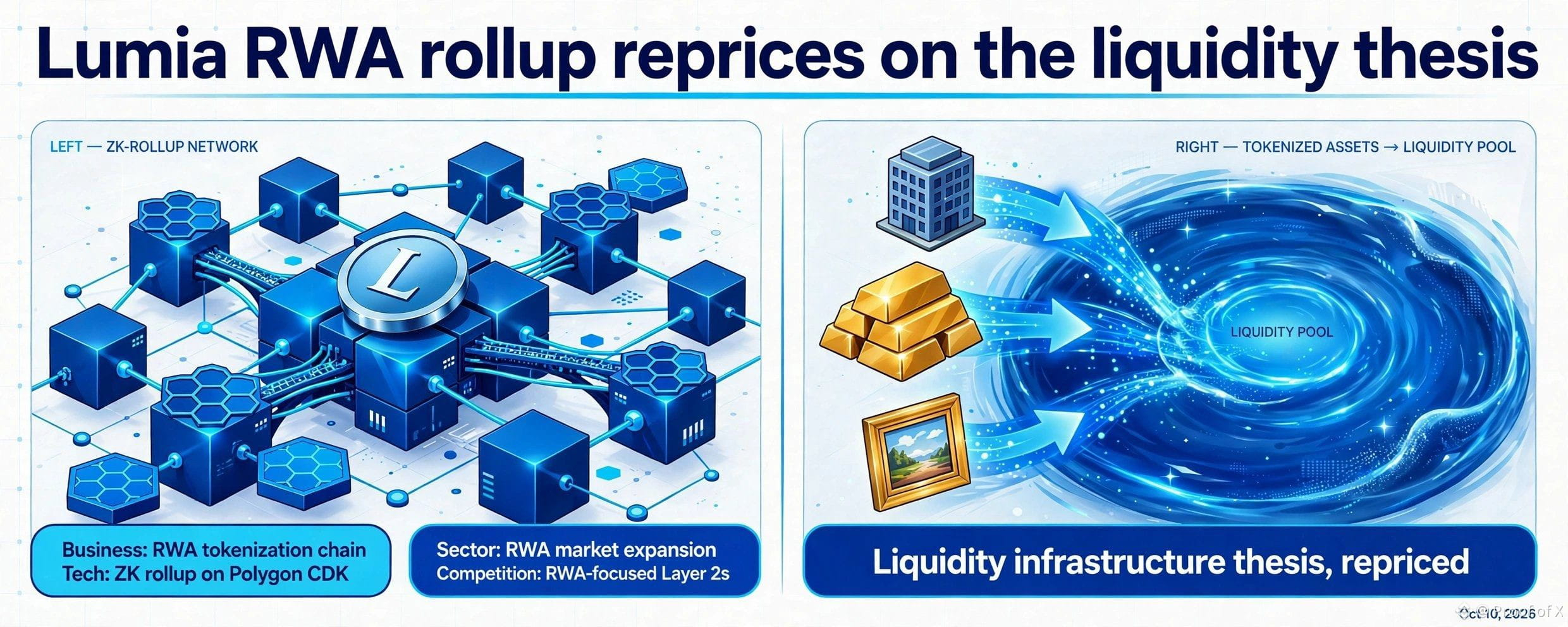

Most Layer 2s compete for DeFi users; Lumia competes for something harder: liquidity for tokenized real-world assets.
BUSINESS
Lumia is an RWA-focused Layer 2 network that lets businesses tokenize real estate, commodities, art, equities, and financial indexes.
The project began as an Ethereum-based aggregator of centralized and decentralized exchange liquidity, and rebranded to Lumia in 2023 to focus on the RWA niche.
At mainnet launch, the legacy token was swapped to $LUMIA, which now covers gas fees, node operations, staking, governance, and access to premium features.
Its Lumia Stream liquidity module aggregates the most liquid centralized and decentralized exchanges into a single decentralized source that DeFi protocols can tap for deep liquidity.
The project has claimed that Stream once settled $8 million in 1inch RFQ volume with less than $30,000 in deployed capital across 28 assets, an efficiency claim no independent source has verified this run.
Lumia raised $25 million in under 20 days through its RWA HyperNode sale, which it described as one of the largest node sales in Web3 history.
TECHNOLOGY
Lumia is a zero-knowledge rollup built with Polygon's Chain Development Kit (Polygon CDK), a modular zkEVM stack.
It integrates Polygon AggLayer, enabling near-instant cross-chain transactions settled with zero-knowledge proofs and faster loading times for users.
Lumia Stream is engineered to counter liquidity fragmentation by routing traders and protocols to pooled CEX and DEX depth instead of siloed order books.
SECTOR
Real-world asset tokenization remains one of crypto's most durable narratives, with institutional interest in on-chain treasuries, commodities, and indexes holding steady.
The persistent problem is liquidity: assets move on-chain but then sit idle without active markets to circulate in.
Lumia positions itself as the layer where tokenized assets actually trade, not just the layer where they are issued, which is the gap most RWA platforms leave open.
COMPETITION
The RWA lane is contested: Mantra ($OM) pursues a related chain-level thesis, while Ondo ($ONDO) competes as an asset issuer rather than as settlement infrastructure.
Lumia's differentiator is liquidity plumbing rather than token issuance, which puts it closer to aggregation infrastructure than to RWA tokenization platforms.
That focus is a genuine edge if RWA volume grows, and an exposed position if it does not.
TOKENOMICS
CoinGecko reports a market capitalization of approximately $29.8 million against a fully diluted valuation of approximately $29.8 million.
Circulating supply is 238.9 million $LUMIA against a maximum supply of 238.9 million, so the entire supply is unlocked.
$LUMIA has traded roughly 95 percent below its December 2024 all-time high of $2.49, leaving a deep drawdown even after the current bounce.
Not financial advice. DYOR. $LUMIA