

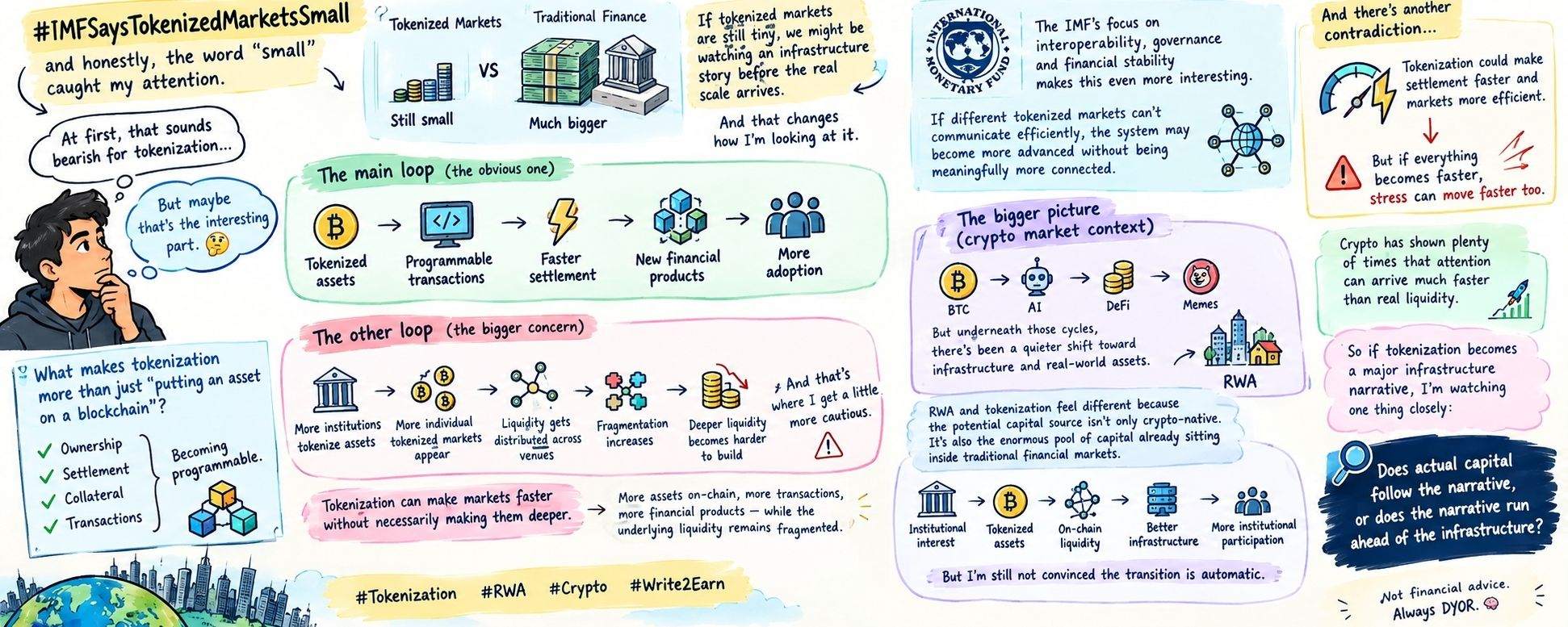

I’ve been looking at #IMFSaysTokenizedMarketsSmall, and honestly, the word “small” is what caught my attention.
At first, that sounds almost bearish for tokenization.
But the more I think about it, maybe that’s actually the interesting part. 🤔
If tokenized markets are still tiny compared with traditional finance, then we might be watching an infrastructure story before the real scale arrives.
And that changes how I’m looking at it.
The interesting part isn’t simply putting an asset on a blockchain.
It’s what happens when ownership, settlement, collateral and transactions start becoming programmable.
The loop I keep seeing is:
Tokenized assets → programmable transactions → faster settlement → new financial products → more adoption.
That sounds straightforward.
But I think there’s another loop underneath it that matters more.
More institutions tokenize assets → more individual tokenized markets appear → liquidity gets distributed across venues → fragmentation increases → deeper liquidity becomes harder to build.
And that’s where I get a little more cautious. 📉
Because tokenization can make markets faster without necessarily making them deeper.
You could end up with more assets on-chain, more transactions and more financial products — while the underlying liquidity remains fragmented.
That’s a strange possibility.
The IMF’s focus on interoperability, governance and financial stability makes this even more interesting to me.
If different tokenized markets can’t communicate efficiently, the system may become more technologically advanced without becoming meaningfully more connected.
And there’s another contradiction I can’t ignore.
Tokenization could make settlement faster and markets more efficient.
But if everything becomes faster, stress can move faster too.
So the question isn’t really whether tokenization grows.
I think it probably does.
The harder question is whether liquidity, interoperability and trust can grow faster than the fragmentation created by all these new tokenized markets.
And this is where I think the broader crypto market context gets interesting.
We’ve watched attention rotate through $BTC, AI, DeFi and speculative tokens, but underneath those cycles there’s been a quieter shift toward infrastructure and real-world assets.
RWA and tokenization feel different to me because the potential capital source isn’t only crypto-native money.
It’s also the enormous pool of capital already sitting inside traditional financial markets.
That creates another loop:
Institutional interest → tokenized assets → on-chain liquidity → better infrastructure → more institutional participation.
But I’m still not convinced the transition is automatic.
Crypto has shown plenty of times that attention can arrive much faster than real liquidity.
So if tokenization becomes a major infrastructure narrative, I’m watching one thing closely:
Does actual capital follow the narrative, or does the narrative run ahead of the infrastructure?
Not financial advice. Always DYOR.