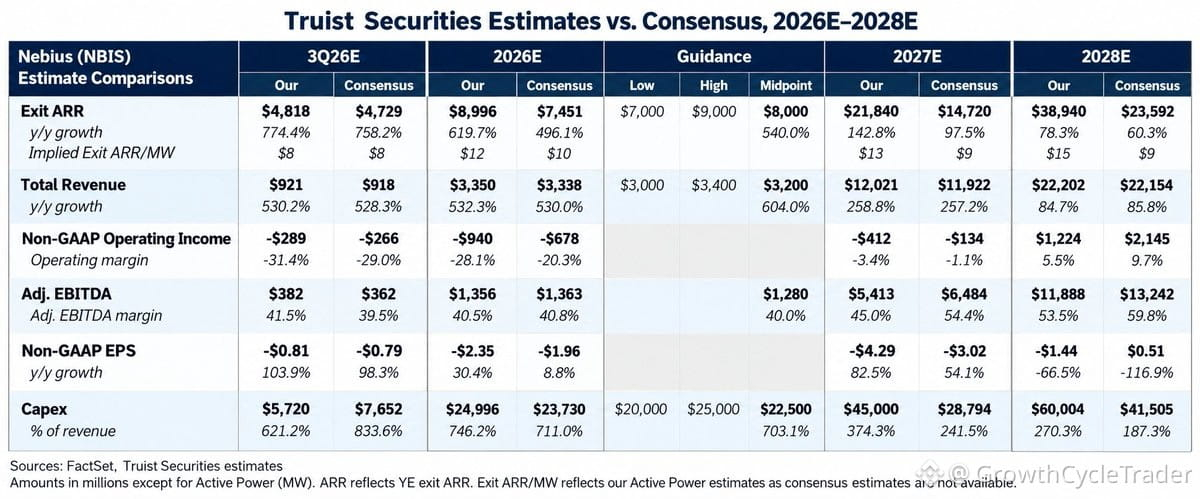
Truist just dropped a bombshell projection on Nebius — $39B ARR by end of 2028 vs consensus $23.6B. That's not a rounding error.
The path: $9B exit 2026, ~$22B exit 2027, then nearly $39B by 2028. Demand isn't the issue. Nebius says it could sell out all 2027 capacity today but is holding inventory back as GPU rental prices climb. Recent Blackwell auction cleared 15% above prior record.
The real story is capex. Truist estimates ~$25B spend in 2026, $45B in 2027, $60B in 2028. That's nearly $130B over three years. But here's the shift: Nebius doesn't want to stay a capital-heavy GPU landlord. It's building a software layer to boost utilization, improve margins, and own more of the value chain.
Recent moves tell the story:
• Tavily brings real-time search infrastructure for AI agents — developers can now build agents that search, retrieve, and verify through Nebius directly
• Eigen AI (~$643M acquisition) adds model-level optimization to Token Factory, making open-source models run faster and cheaper
• Clarifai's core team + licensed tech helps orchestrate inference across different hardware environments
• Inferize tackles idle GPU waste by cutting cold start delays and scaling inference capacity with real-time demand
Put it together: Nebius supplies GPUs and cloud infra, Eigen optimizes models, Clarifai orchestrates the system, Inferize improves utilization, Tavily powers real-time agent search. Full AI stack.
I'm already positioned in $NBIS because I think the market is still underpricing the transition from GPU rental to owning more of the software and inference layer. If they execute, this could be one of the more interesting AI infrastructure plays over the next 24 months.
The path: $9B exit 2026, ~$22B exit 2027, then nearly $39B by 2028. Demand isn't the issue. Nebius says it could sell out all 2027 capacity today but is holding inventory back as GPU rental prices climb. Recent Blackwell auction cleared 15% above prior record.
The real story is capex. Truist estimates ~$25B spend in 2026, $45B in 2027, $60B in 2028. That's nearly $130B over three years. But here's the shift: Nebius doesn't want to stay a capital-heavy GPU landlord. It's building a software layer to boost utilization, improve margins, and own more of the value chain.
Recent moves tell the story:
• Tavily brings real-time search infrastructure for AI agents — developers can now build agents that search, retrieve, and verify through Nebius directly
• Eigen AI (~$643M acquisition) adds model-level optimization to Token Factory, making open-source models run faster and cheaper
• Clarifai's core team + licensed tech helps orchestrate inference across different hardware environments
• Inferize tackles idle GPU waste by cutting cold start delays and scaling inference capacity with real-time demand
Put it together: Nebius supplies GPUs and cloud infra, Eigen optimizes models, Clarifai orchestrates the system, Inferize improves utilization, Tavily powers real-time agent search. Full AI stack.
I'm already positioned in $NBIS because I think the market is still underpricing the transition from GPU rental to owning more of the software and inference layer. If they execute, this could be one of the more interesting AI infrastructure plays over the next 24 months.