Solana DvP Is Here: Institutional Trades Aimed at Seconds, Not Days
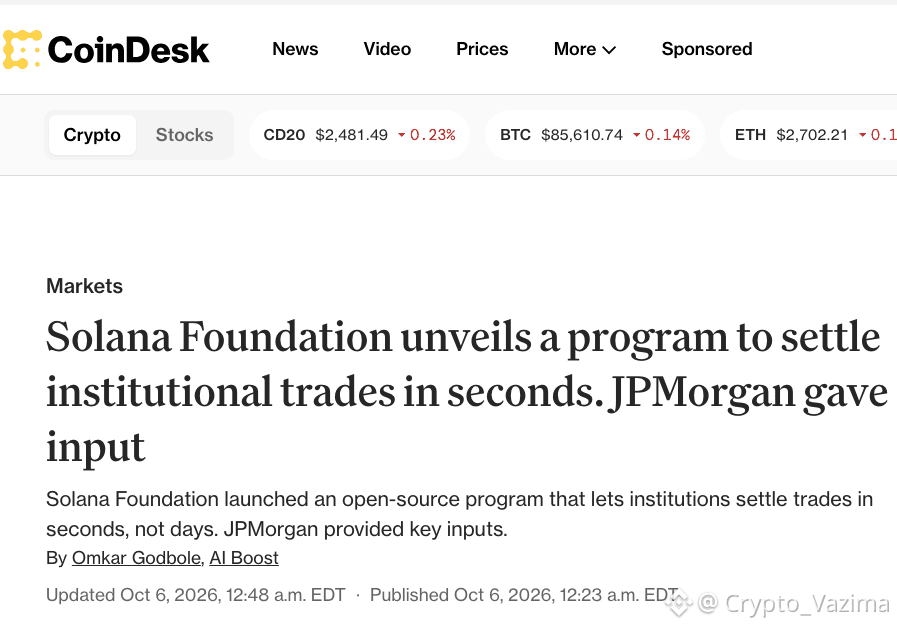
The Solana Foundation just unveiled Solana DvP on October 6, 2026. The open-source program is built to settle an institutional trade's asset leg and payment leg in the same atomic transaction on Solana, with finality in seconds rather than the one to two days of traditional markets.
⚡ Why the timing matters
In conventional markets, delivery-versus-payment often runs through clearinghouses, depositories, and custodians. Solana DvP compresses that into one on-chain step: both sides finish together, or neither does. The Foundation says that removes the counterparty risk of one party delivering while the other fails to pay.
🔧 What institutions actually get
- An MIT-licensed API and escrow standard, not a fresh custom contract for every deal.
- Isolated escrow and enforced deadlines.
- Support for SPL Token and Token-2022, including pausable tokens, transfer hooks, and permanent delegate.
- External security audits, with the program described as ready for real funds.
J.P. Morgan shaped requirements with decades of settlement input. Rhodel D'souza, head of markets digital assets at J.P. Morgan, called a shared open DvP standard the kind of infrastructure institutions need to scale without settlement risk. That input is not a launch, endorsement, or guarantee.
🧭 The fine print
Design partners and early participants are being welcomed ahead of the production release. Confidential settlement is on the roadmap, not live. The tool is meant for assets institutions can hold, and a bank, custodian, or exchange can act as settlement agent.
Would second-scale atomic settlement be enough for institutions you follow to test public-chain rails? 👇
Tell us which requirement still looks unresolved: privacy, production readiness, or token controls.
Not investment advice - research on your own! 🚀
$SOL
The Solana Foundation just unveiled Solana DvP on October 6, 2026. The open-source program is built to settle an institutional trade's asset leg and payment leg in the same atomic transaction on Solana, with finality in seconds rather than the one to two days of traditional markets.
⚡ Why the timing matters
In conventional markets, delivery-versus-payment often runs through clearinghouses, depositories, and custodians. Solana DvP compresses that into one on-chain step: both sides finish together, or neither does. The Foundation says that removes the counterparty risk of one party delivering while the other fails to pay.
🔧 What institutions actually get
- An MIT-licensed API and escrow standard, not a fresh custom contract for every deal.
- Isolated escrow and enforced deadlines.
- Support for SPL Token and Token-2022, including pausable tokens, transfer hooks, and permanent delegate.
- External security audits, with the program described as ready for real funds.
J.P. Morgan shaped requirements with decades of settlement input. Rhodel D'souza, head of markets digital assets at J.P. Morgan, called a shared open DvP standard the kind of infrastructure institutions need to scale without settlement risk. That input is not a launch, endorsement, or guarantee.
🧭 The fine print
Design partners and early participants are being welcomed ahead of the production release. Confidential settlement is on the roadmap, not live. The tool is meant for assets institutions can hold, and a bank, custodian, or exchange can act as settlement agent.
Would second-scale atomic settlement be enough for institutions you follow to test public-chain rails? 👇
Tell us which requirement still looks unresolved: privacy, production readiness, or token controls.
Not investment advice - research on your own! 🚀
$SOL