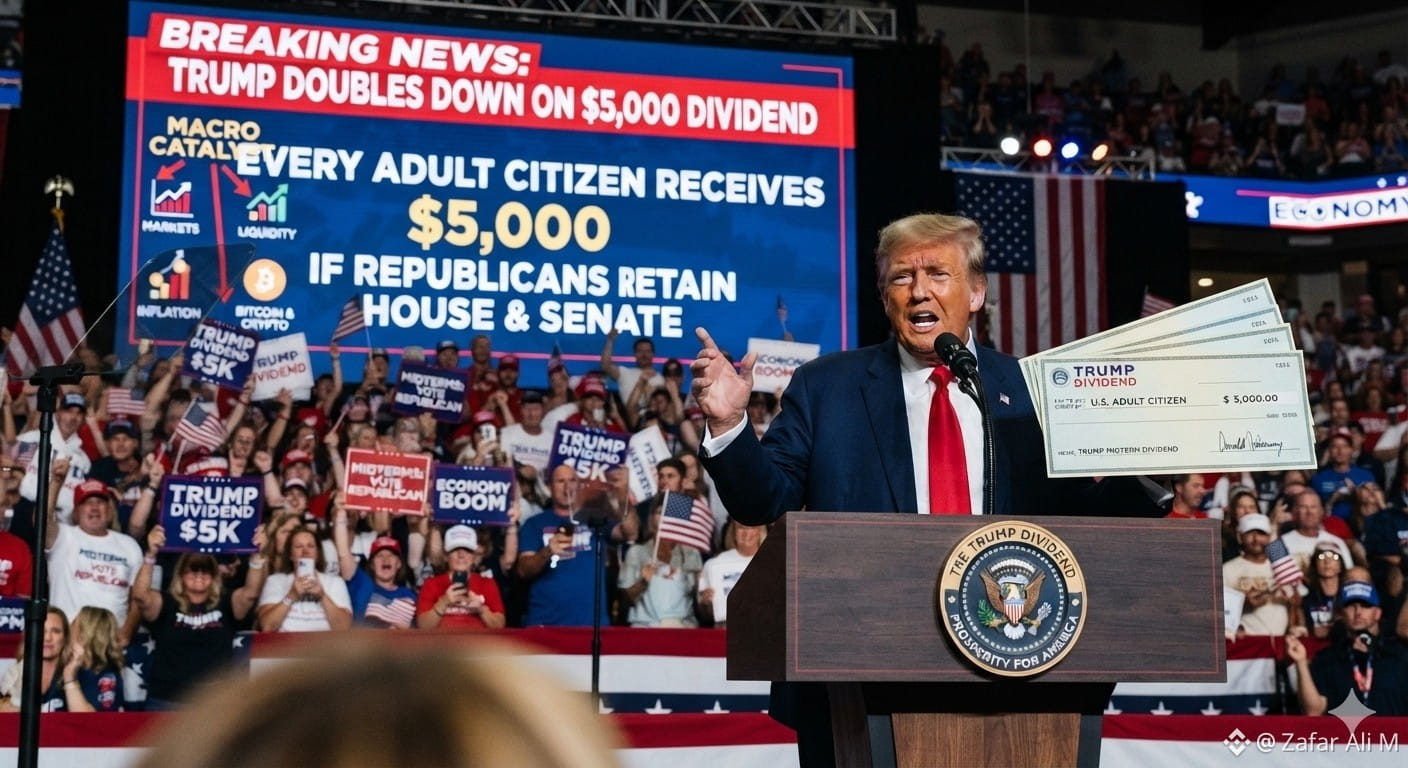
President Donald Trump doubled down on his campaign promise to give every adult U.S. citizen a $5,000 "#TrumpInPump Dividend" if Republicans retain or win control of both the House of Representatives and the Senate in the upcoming November 3, 2026 midterm elections. He repeated the pledge on October 3, 2026, via videos posted to Truth Social and X, declaring, "I look forward to signing those checks!" Total Cost: Depending on the specific adult citizen metric used (ranging from roughly 240 million eligible voters to 270 million total adults), independent estimates indicate the plan would cost between $1.2 trillion and $1.35 trillion.
Funding Uncertainty: President attributed the viability of the payout to the nation's "tremendous economic success", while Vice President JD Vance previously suggested it could be funded via tariffs and government cost-cutting. However, economists note that existing U.S. tariff revenues fall far short of a $1.2+ trillion requirement.
Potential Macro and Market Reactions
If a package approaching this scale were ever to achieve congressional passage, macroeconomic analysts and asset markets would react intensely to several factors:
Inflation & Liquidity: Injecting over $1.2 trillion directly into consumer hands could severely shock inflation expectations, potentially forcing the Federal Reserve to reconsider interest rate policies to combat a surge in consumer demand.
Bitcoin and Crypto Markets: Crypto analysts frequently note that massive liquidity injections (similar to the pandemic-era stimulus packages) historically drive significant capital inflows into risk-on assets, especially limited-supply instruments like Bitcoin and the broader cryptocurrency market.
Deficit Concerns: Adding over $1 trillion to the federal budget would dramatically worsen the current national debt trajectory, creating immediate volatility in bond markets and U.S. Treasury yields
Funding Uncertainty: President attributed the viability of the payout to the nation's "tremendous economic success", while Vice President JD Vance previously suggested it could be funded via tariffs and government cost-cutting. However, economists note that existing U.S. tariff revenues fall far short of a $1.2+ trillion requirement.
Potential Macro and Market Reactions
If a package approaching this scale were ever to achieve congressional passage, macroeconomic analysts and asset markets would react intensely to several factors:
Inflation & Liquidity: Injecting over $1.2 trillion directly into consumer hands could severely shock inflation expectations, potentially forcing the Federal Reserve to reconsider interest rate policies to combat a surge in consumer demand.
Bitcoin and Crypto Markets: Crypto analysts frequently note that massive liquidity injections (similar to the pandemic-era stimulus packages) historically drive significant capital inflows into risk-on assets, especially limited-supply instruments like Bitcoin and the broader cryptocurrency market.
Deficit Concerns: Adding over $1 trillion to the federal budget would dramatically worsen the current national debt trajectory, creating immediate volatility in bond markets and U.S. Treasury yields