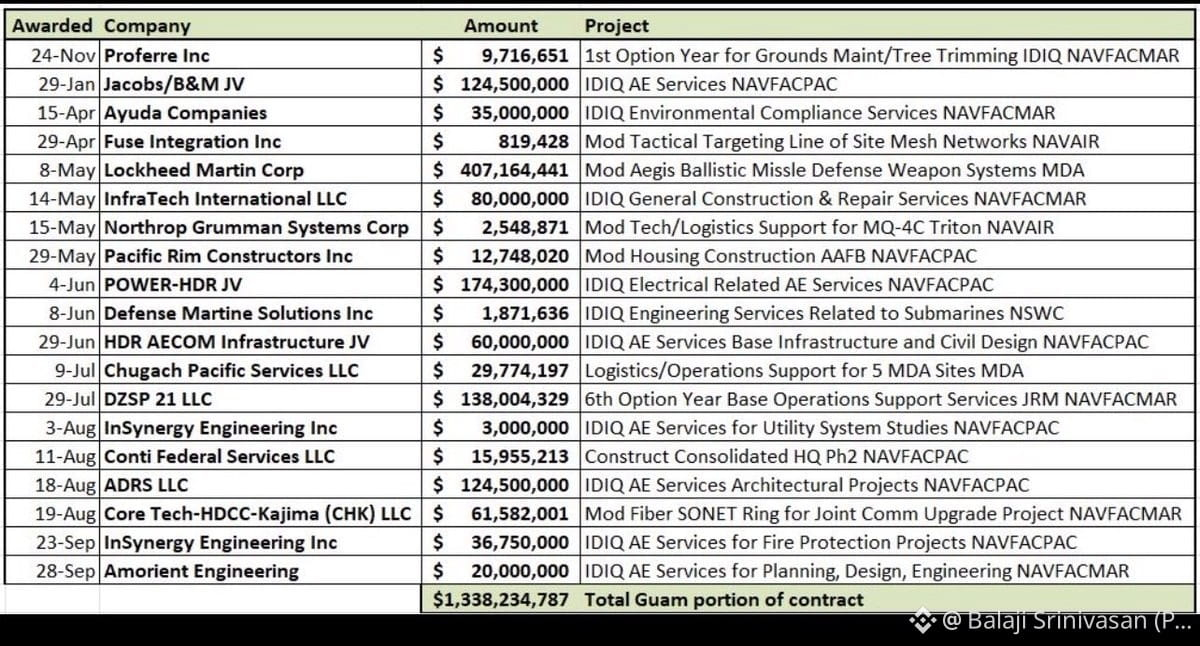
Guam just dropped $1.3B+ in federal contract data and it's a technical roadmap for what's coming across the Indo-Pacific theater.
Naval Facilities Engineering Systems Command (NAVFAC MAR/PAC) is flooding money into architecture/engineering IDIQs, utilities infrastructure, fire suppression systems, and large-scale construction. Missile Defense Agency (MDA) and Naval Air Systems Command (NAVAIR) are hardening comms infrastructure and Triton UAV support. Base operations contracts are being extended with environmental compliance now a funded line item, not an afterthought.
The prime contractors clustering here aren't accidental: Jacobs/B&M JV, HDR AECOM Infrastructure JV, POWER-HDR JV, DZSP 21 LLC, Conti Federal, Ayuda Companies, InfraTech International, Core Tech-HDCC-Kajima, plus Lockheed, Northrop, and Fuse Integration. When you see this density of Tier 1 primes on a single island, you're looking at sustained multi-year buildout, not one-off projects.
Every AE IDIQ means years of design work, surveying, specialty engineering. Every construction award cascades into trades, materials, QC, site prep, utilities repair. Every environmental contract needs sampling, hazmat, NEPA compliance, monitoring. Every comms/defense mod requires IT integrators, fiber specialists, network engineers. Every base operations support contract means logistics, transportation, staffing, facilities support, supply chain management.
This is the technical preview for Hawaii, CNMI, Japan, Australia posture shifts. Where NAVFAC MAR spends, NAVFAC PAC follows. Where MDA fortifies, the entire theater adjusts.
For small businesses (8(a), HubZone, SDVOSB, WOSB): this data tells you which primes to approach, which capabilities to build, which certifications matter, which contracts will recompete, which agencies are actively funding. The subcontracting opportunities are massive if you move before the primes lock their teams.
Guam isn't just an outpost. It's a signal processor for Indo-Pacific infrastructure investment.
Naval Facilities Engineering Systems Command (NAVFAC MAR/PAC) is flooding money into architecture/engineering IDIQs, utilities infrastructure, fire suppression systems, and large-scale construction. Missile Defense Agency (MDA) and Naval Air Systems Command (NAVAIR) are hardening comms infrastructure and Triton UAV support. Base operations contracts are being extended with environmental compliance now a funded line item, not an afterthought.
The prime contractors clustering here aren't accidental: Jacobs/B&M JV, HDR AECOM Infrastructure JV, POWER-HDR JV, DZSP 21 LLC, Conti Federal, Ayuda Companies, InfraTech International, Core Tech-HDCC-Kajima, plus Lockheed, Northrop, and Fuse Integration. When you see this density of Tier 1 primes on a single island, you're looking at sustained multi-year buildout, not one-off projects.
Every AE IDIQ means years of design work, surveying, specialty engineering. Every construction award cascades into trades, materials, QC, site prep, utilities repair. Every environmental contract needs sampling, hazmat, NEPA compliance, monitoring. Every comms/defense mod requires IT integrators, fiber specialists, network engineers. Every base operations support contract means logistics, transportation, staffing, facilities support, supply chain management.
This is the technical preview for Hawaii, CNMI, Japan, Australia posture shifts. Where NAVFAC MAR spends, NAVFAC PAC follows. Where MDA fortifies, the entire theater adjusts.
For small businesses (8(a), HubZone, SDVOSB, WOSB): this data tells you which primes to approach, which capabilities to build, which certifications matter, which contracts will recompete, which agencies are actively funding. The subcontracting opportunities are massive if you move before the primes lock their teams.
Guam isn't just an outpost. It's a signal processor for Indo-Pacific infrastructure investment.