#ethereumfoundationlauncheszkapionmainnet
Ethereum Just Built a Way to Pay for AI Without Revealing Who's Asking
The Ethereum Foundation just launched a system that lets you pay for AI services on-chain while keeping your identity completely separate from what you're actually asking the AI to do.
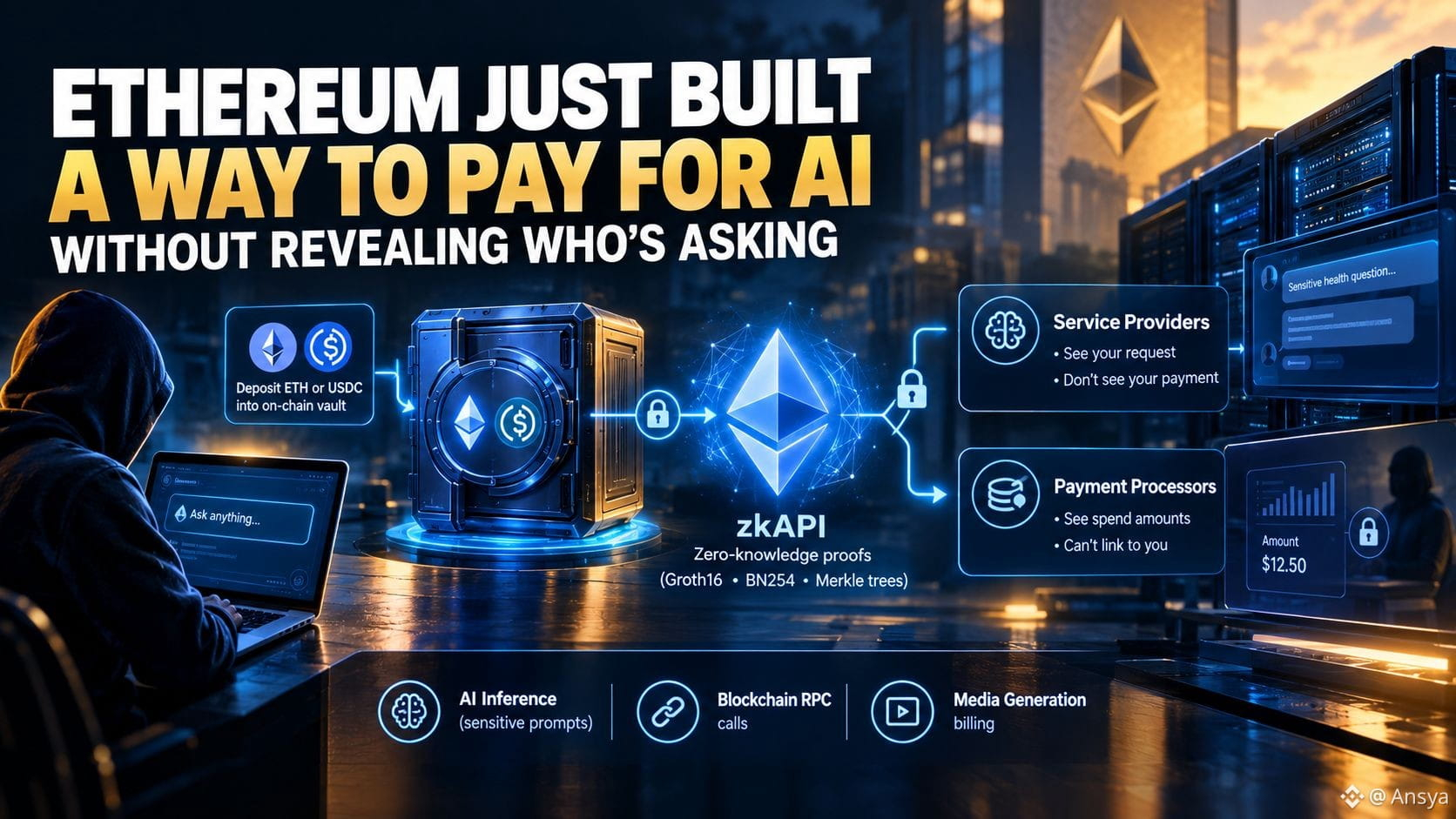
Here's what shipped: on October 1, the Ethereum Foundation, working with the Open Anonymity Project, deployed zkAPI on Ethereum mainnet — a privacy-preserving payment system built on a design co-authored by researcher Davide Crapis and Ethereum co-founder Vitalik Buterin. The mechanism works by having users deposit ETH or USDC into an on-chain vault, then generate zero-knowledge proofs to demonstrate they hold sufficient credit for an API request without revealing which specific deposit funds it. Service providers see the content of a request but never who's paying for it; payment processors see spend amounts but can't link them to individual users. Built using Groth16, BN254, and Merkle tree cryptography, the system initially targets AI inference — specifically protecting sensitive prompts involving health or financial topics — while also supporting blockchain RPC calls and media generation billing.
Why does this matter? As AI usage grows, so does the amount of sensitive information flowing through prompts tied directly to payment identities. A system that cryptographically separates "who paid" from "what was asked" addresses a privacy gap that's largely gone unaddressed as AI and blockchain payment rails increasingly intersect. It's also a concrete example of zero-knowledge proofs solving a practical, non-speculative problem rather than a purely theoretical one.
Whether this sees meaningful adoption beyond its initial AI-inference use case, or remains a niche privacy tool, will likely depend on how many service providers choose to integrate it.
Does separating payment identity from usage change how comfortable people feel using AI for sensitive tasks? 🤔
#Ethereum #zkAPI #Privacy #AI
$ETH $SAND $US
Ethereum Just Built a Way to Pay for AI Without Revealing Who's Asking
The Ethereum Foundation just launched a system that lets you pay for AI services on-chain while keeping your identity completely separate from what you're actually asking the AI to do.
Here's what shipped: on October 1, the Ethereum Foundation, working with the Open Anonymity Project, deployed zkAPI on Ethereum mainnet — a privacy-preserving payment system built on a design co-authored by researcher Davide Crapis and Ethereum co-founder Vitalik Buterin. The mechanism works by having users deposit ETH or USDC into an on-chain vault, then generate zero-knowledge proofs to demonstrate they hold sufficient credit for an API request without revealing which specific deposit funds it. Service providers see the content of a request but never who's paying for it; payment processors see spend amounts but can't link them to individual users. Built using Groth16, BN254, and Merkle tree cryptography, the system initially targets AI inference — specifically protecting sensitive prompts involving health or financial topics — while also supporting blockchain RPC calls and media generation billing.
Why does this matter? As AI usage grows, so does the amount of sensitive information flowing through prompts tied directly to payment identities. A system that cryptographically separates "who paid" from "what was asked" addresses a privacy gap that's largely gone unaddressed as AI and blockchain payment rails increasingly intersect. It's also a concrete example of zero-knowledge proofs solving a practical, non-speculative problem rather than a purely theoretical one.
Whether this sees meaningful adoption beyond its initial AI-inference use case, or remains a niche privacy tool, will likely depend on how many service providers choose to integrate it.
Does separating payment identity from usage change how comfortable people feel using AI for sensitive tasks? 🤔
#Ethereum #zkAPI #Privacy #AI
$ETH $SAND $US