The more I researched Tria, the less I cared about the card.
The real bet is whether a consumer crypto app can become the distribution layer for an infrastructure network.
Tria already lets users spend, trade, earn, use futures and move assets across chains.
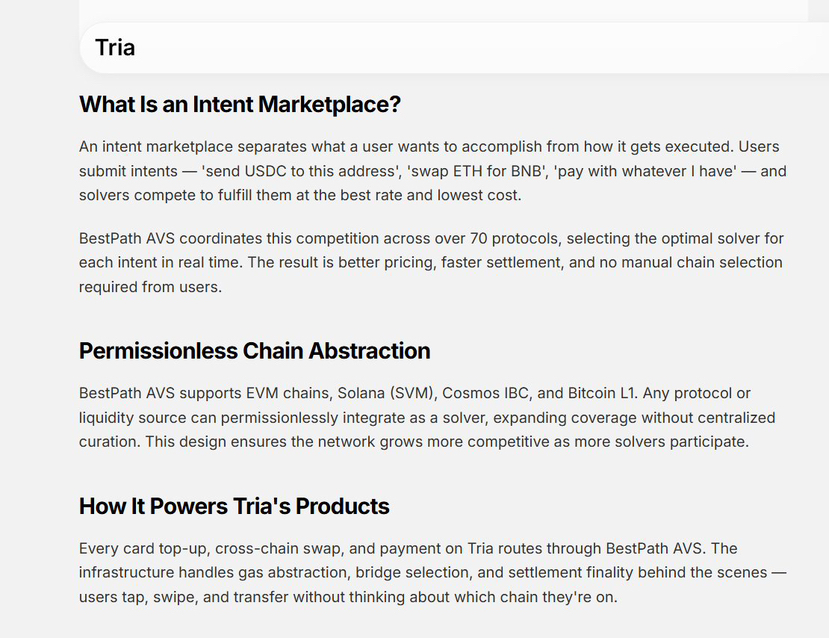
Underneath all of that sits BestPath, an intent-routing layer that Tria says coordinates execution across 70+ protocols.
Card top-ups, cross-chain swaps and payments can all become flows for the same infrastructure.
And that’s what makes Tria interesting to me.
Most infra projects build the rails first and then spend years looking for users.
Tria is trying the opposite.
Build the users first.
Let the consumer product generate demand for BestPath.
Then open that infrastructure to everyone else.
If that works, Tria is no longer just another crypto card or neobank.
It becomes a distribution engine sitting on top of a chain-agnostic financial network.
And the team is still shipping.
XRPL support went live on Sep 28.
Top Traders went live on Sep 29.
At KBW2026, Tria showed up as a Diamond Sponsor while Upbit was the Presenting Partner.
That is NOT an Upbit partnership or listing signal.
But it does tell me where Tria is trying to go next: Korea, institutions and third-party distribution.
Now comes the uncomfortable part.
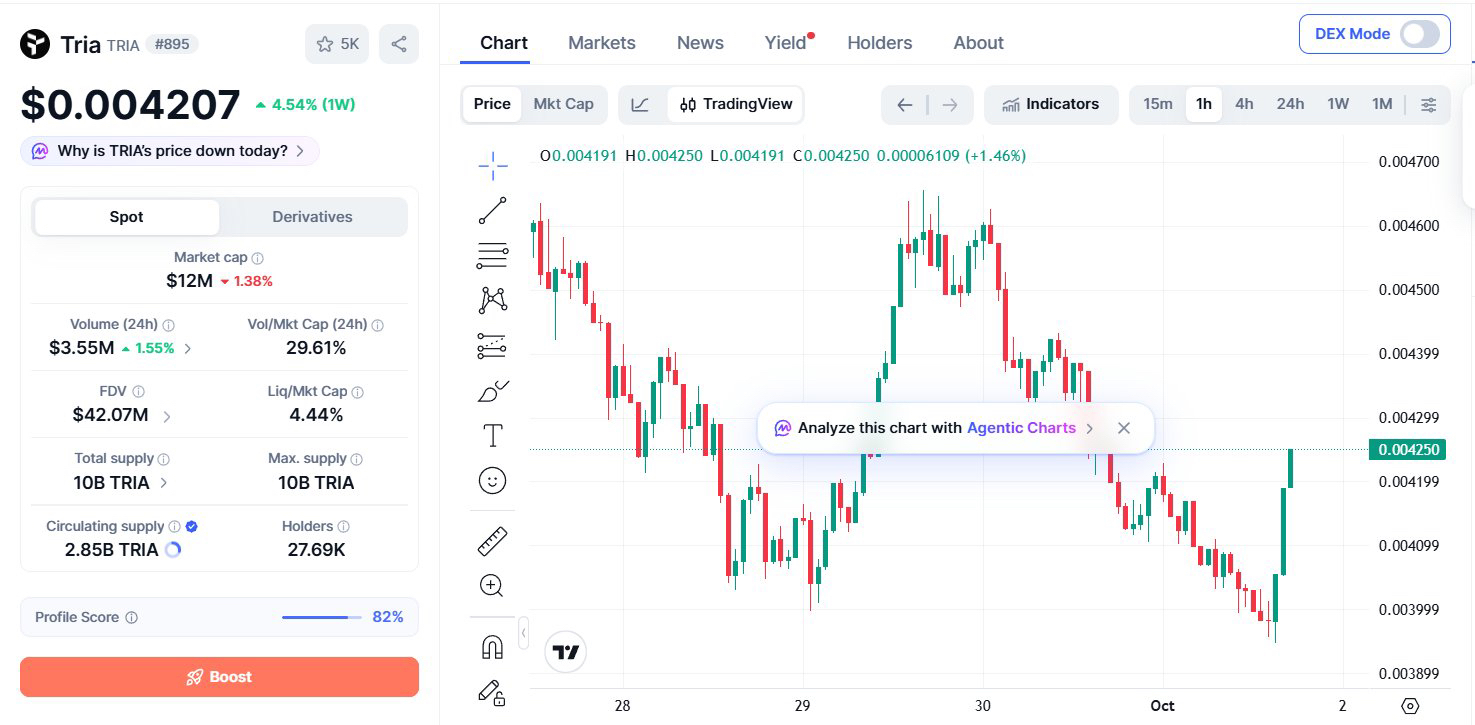
$TRIA is still roughly 92% below ATH.
CMC currently puts it around an $11.7M market cap and ~$40.9M FDV.
Tria publicly raised $12M.
At first glance that looks absurdly cheap.
I don’t think it’s that simple.
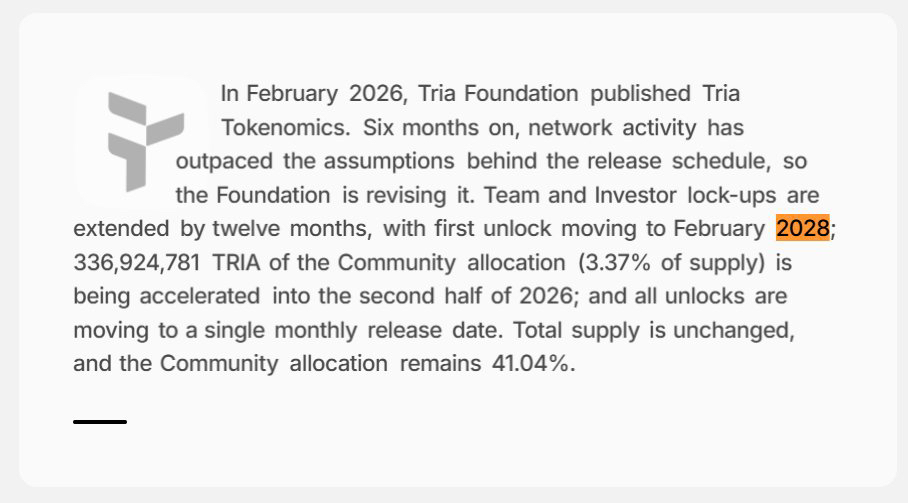
In August, Tria extended the Team and Investor cliff by another year.
Their first unlock is now February 2028.
That’s a good signal.
But at the same time, 336.9M Community TRIA was pulled forward from 2027-2028 into H2 2026.
233.5M TRIA was scheduled for release on Sep 30 alone.
And this is the anomaly I care about most.
Tria’s own revised schedule says supply remains at 54.47% until January 2028.
CMC currently counts only 28.54% as circulating.
That is a massive gap.
It could be reward reserves, treasury, staking, ecosystem contracts, liquidity inventory or tokens that are released but not actually liquid yet.
It does NOT automatically mean hidden sell pressure.
But until those wallets are reconciled, I won’t treat the $11M market cap as a clean picture of TRIA’s real float.
Then there is adoption.
Tria is aggressive with cashback, points, referrals, loyalty rewards and ecosystem incentives.
Again, that isn’t automatically bad.
Subsidizing growth is how many networks solve the cold-start problem.
The question is what remains when the subsidies fall.
Because there are two very different versions of the Tria story.
The bullish version:
Consumer users create real BestPath flow.
External apps start using the infrastructure.
Pathfinders, settlement and staking create real demand for TRIA.
Fees and network activity finally give the token measurable value capture.
The darker version:
Token incentives create activity.
Activity creates impressive metrics.
Those metrics create more attention.
But external BestPath demand stays weak and emissions remain the engine keeping growth alive.
That is the part the market has not answered yet.
My view today is pretty simple.
Tria the product is stronger than TRIA the token.
I think the team is building.
I think the consumer product is real.
I think BestPath is technically interesting.
And I think the current valuation is compressed enough to deserve serious research.
But I still need four things before raising conviction:
Clean supply reconciliation.
External BestPath adoption.
Organic retention after incentives.
Measurable value capture for $TRIA.
Research-worthiness: 8/10.
Token conviction: still around 6/10.
The interesting thesis isn’t:
“TRIA is down 92%, so it must be cheap.”
It’s this:
What if the market has priced the token like a failed project while the project itself is still trying to become something much bigger?
That’s the gap I’m watching.
NFA. Research first.