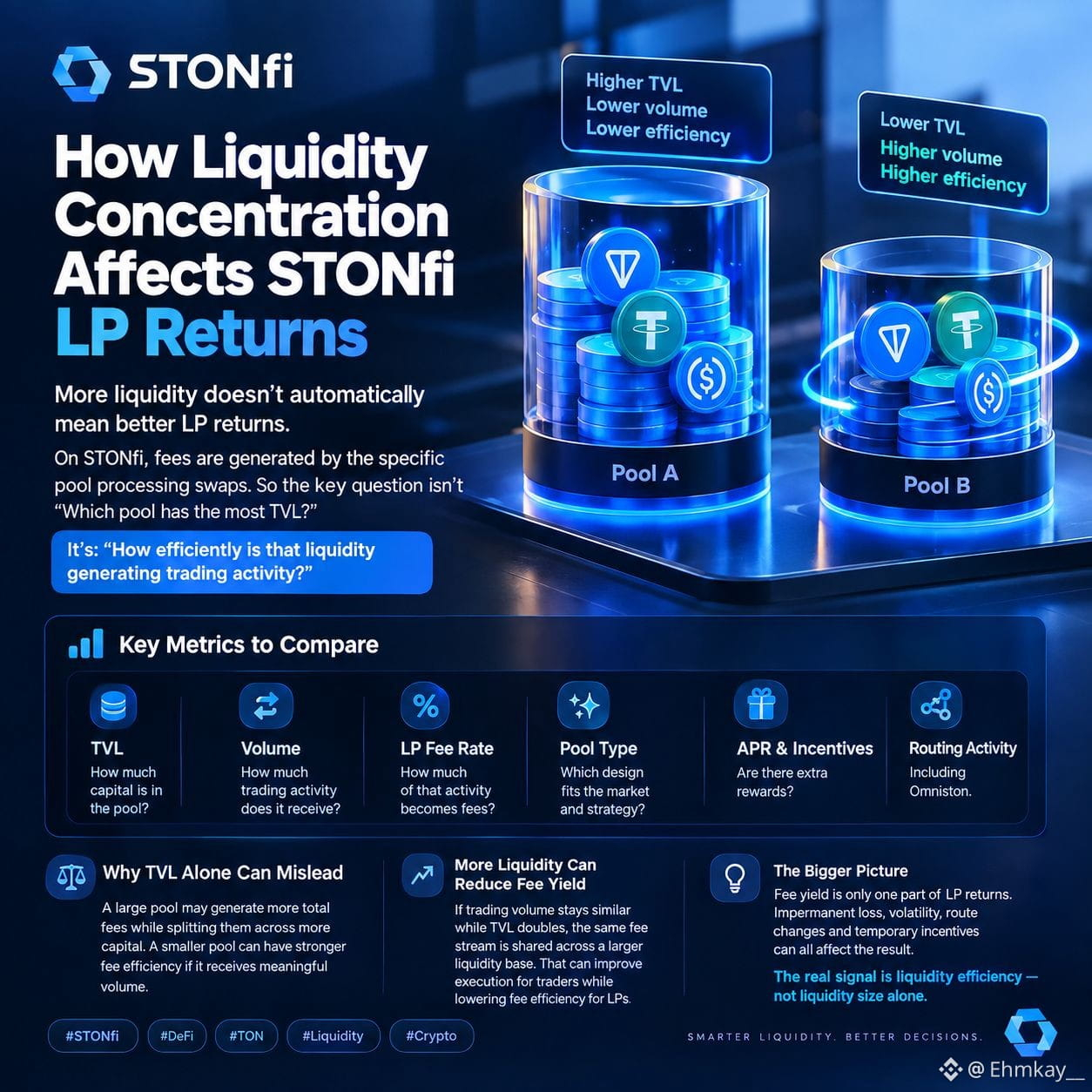
How Liquidity Concentration Impacts STONfi LP Returns
More liquidity doesn’t automatically translate into better returns for LPs.
On STONfi, fees come from the individual pool handling swaps. So the real question isn’t just:
“Which pool has the highest TVL?”
It’s:
“How effectively is that liquidity being used to generate trading activity?”
🔎 Four metrics are especially useful:
• TVL — How much capital is deposited in the pool?
• Volume — How much trading activity does the pool handle?
• LP fee rate — What portion of that activity becomes fees?
• Pool utilization — How much volume is produced compared with the liquidity available?
📊 Why TVL by itself can be misleading
Consider two pools:
Pool A holds a lot of TVL but sees relatively little trading volume.
Pool B has less TVL but regularly handles substantial volume.
Pool A could produce more fees in total, but those fees are spread across a larger amount of capital.
Pool B might offer better fee efficiency because its liquidity is being used more often. Honestly, that’s the part that matters for LP returns.
🧩 More liquidity can lower fee yield
If trading volume remains about the same while TVL doubles, the same fee revenue is effectively divided among a larger liquidity base.
That may improve execution for traders, but it can reduce fee efficiency for LPs.
💡 Before adding liquidity, take a look at:
1️⃣ TVL
2️⃣ Recent swap volume
3️⃣ LP fee rate
4️⃣ Pool type
5️⃣ APR and incentives
6️⃣ Routing activity, including Omniston
Fee yield alone doesn’t tell the full story.
Impermanent loss, volatility, shifting routes, and short-term incentives can all change how LPs perform.
Honestly, the better signal is liquidity efficiency—not size by itself.🚀🚀
#STONfi #TON #Liquidity #Crypto
$ZEC
More liquidity doesn’t automatically translate into better returns for LPs.
On STONfi, fees come from the individual pool handling swaps. So the real question isn’t just:
“Which pool has the highest TVL?”
It’s:
“How effectively is that liquidity being used to generate trading activity?”
🔎 Four metrics are especially useful:
• TVL — How much capital is deposited in the pool?
• Volume — How much trading activity does the pool handle?
• LP fee rate — What portion of that activity becomes fees?
• Pool utilization — How much volume is produced compared with the liquidity available?
📊 Why TVL by itself can be misleading
Consider two pools:
Pool A holds a lot of TVL but sees relatively little trading volume.
Pool B has less TVL but regularly handles substantial volume.
Pool A could produce more fees in total, but those fees are spread across a larger amount of capital.
Pool B might offer better fee efficiency because its liquidity is being used more often. Honestly, that’s the part that matters for LP returns.
🧩 More liquidity can lower fee yield
If trading volume remains about the same while TVL doubles, the same fee revenue is effectively divided among a larger liquidity base.
That may improve execution for traders, but it can reduce fee efficiency for LPs.
💡 Before adding liquidity, take a look at:
1️⃣ TVL
2️⃣ Recent swap volume
3️⃣ LP fee rate
4️⃣ Pool type
5️⃣ APR and incentives
6️⃣ Routing activity, including Omniston
Fee yield alone doesn’t tell the full story.
Impermanent loss, volatility, shifting routes, and short-term incentives can all change how LPs perform.
Honestly, the better signal is liquidity efficiency—not size by itself.🚀🚀
#STONfi #TON #Liquidity #Crypto
$ZEC