Bitcoin privacy may not need Bitcoin itself to change.
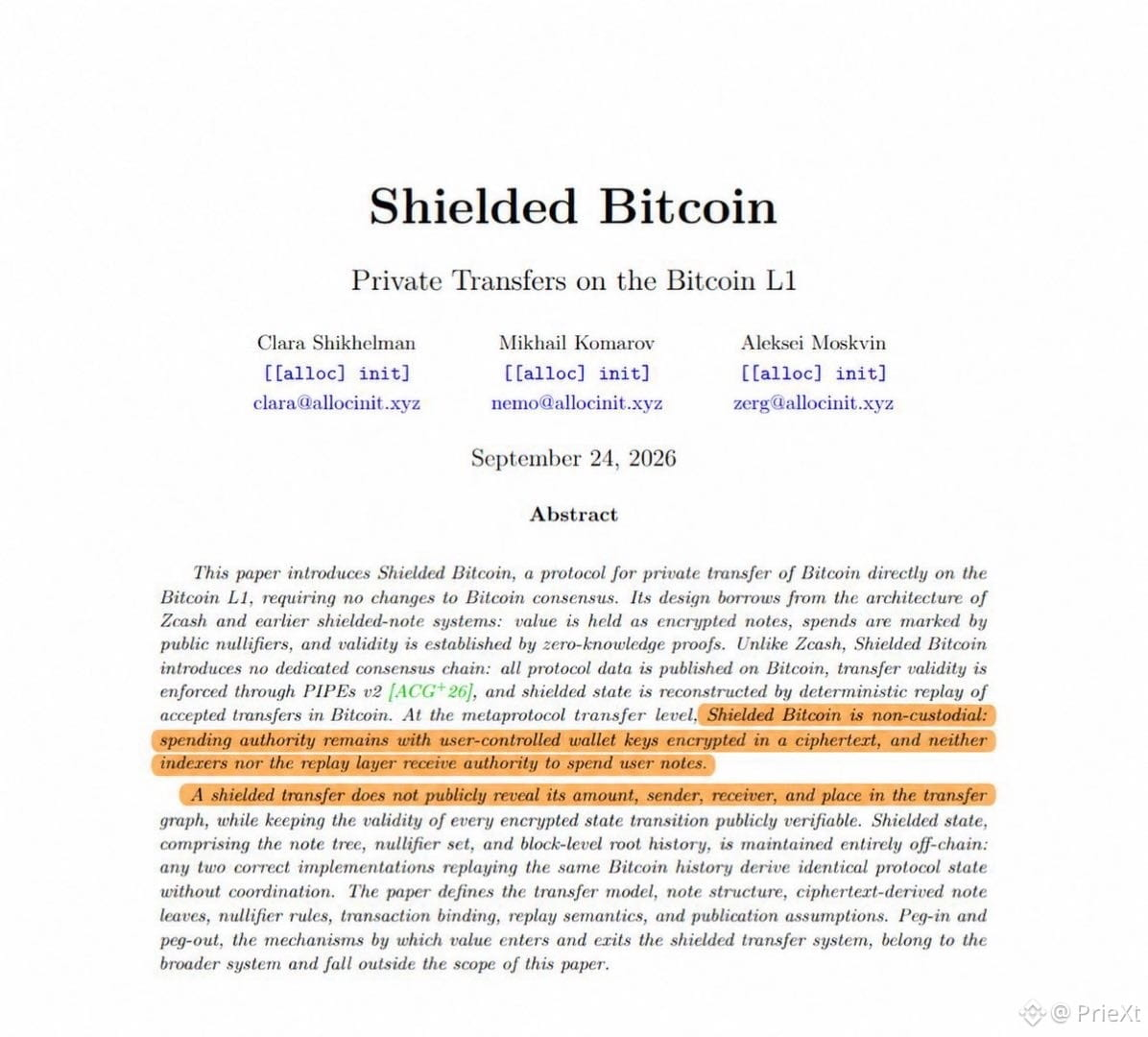
Researchers at [alloc] init have proposed Shielded $BTC , a metaprotocol that uses encrypted notes and zero-knowledge proofs to hide transaction amounts, senders, receivers and links between transactions.
The clever part is that Bitcoin itself doesn't need to enforce the privacy rules.
Bitcoin acts as the publication and ordering layer, while separate indexers verify the proofs and track the shielded state.
The design borrows heavily from Zcash, which also raises an obvious question:
Why build a new shielded pool instead of using Zcash?
One answer is Bitcoin's liquidity, security and existing network effects. But a new privacy pool also starts with a much smaller anonymity set, and researchers still have work to do around quantum resistance.
Interesting idea, but the cryptography is only half the battle.
Privacy also depends on how many people actually use it.
Researchers at [alloc] init have proposed Shielded $BTC , a metaprotocol that uses encrypted notes and zero-knowledge proofs to hide transaction amounts, senders, receivers and links between transactions.
The clever part is that Bitcoin itself doesn't need to enforce the privacy rules.
Bitcoin acts as the publication and ordering layer, while separate indexers verify the proofs and track the shielded state.
The design borrows heavily from Zcash, which also raises an obvious question:
Why build a new shielded pool instead of using Zcash?
One answer is Bitcoin's liquidity, security and existing network effects. But a new privacy pool also starts with a much smaller anonymity set, and researchers still have work to do around quantum resistance.
Interesting idea, but the cryptography is only half the battle.
Privacy also depends on how many people actually use it.