

After a few years in crypto, I've stopped caring much about the trading screen. Nearly every big platform looks polished, deposits are easy, and they all say they take security seriously.
The real differences show up later, when you ask harder questions: who regulates the company holding my assets, what actually backs my balance, what happens if something breaks, and how painful is it to get my money out?
I learned that last one the hard way.
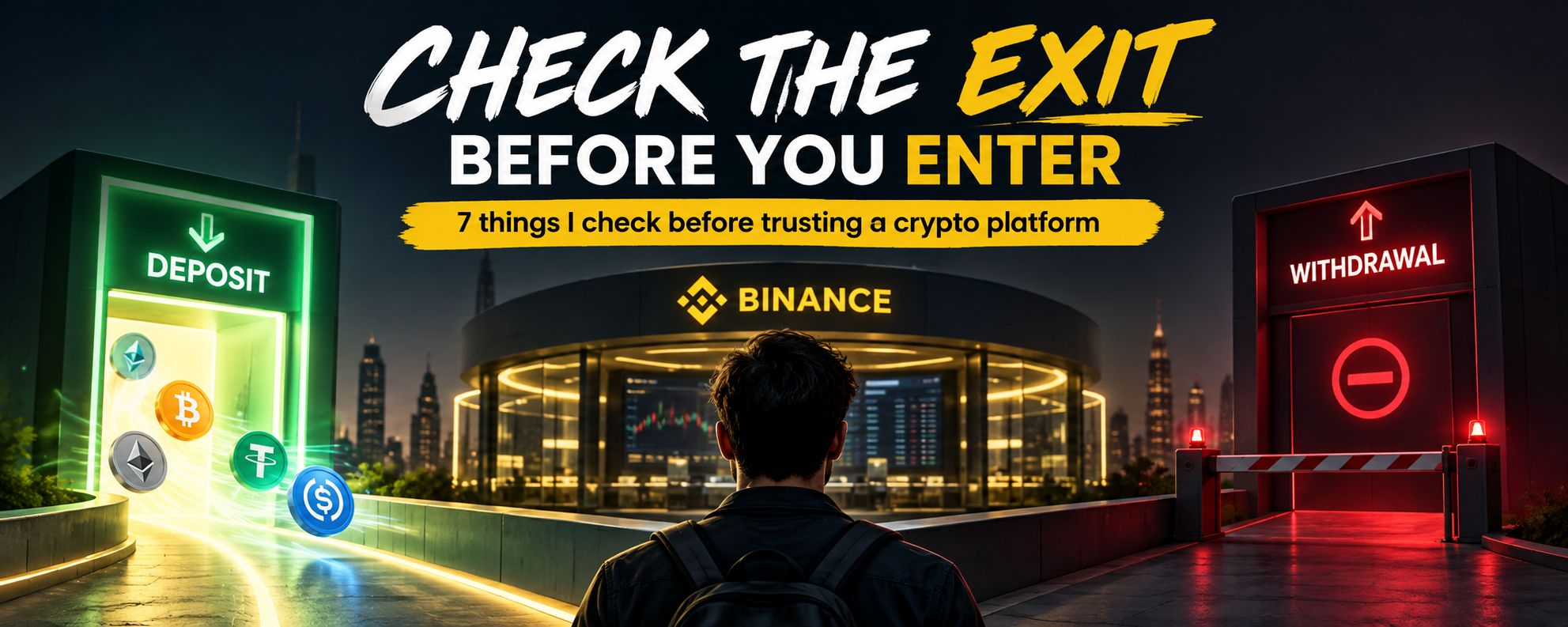
On one platform, I tried to withdraw my Bitcoin and couldn't. The option just wasn't available to me. The only way out was to sell the BTC inside the platform for USDT and withdraw that instead.
I got my money out, but at a price I didn't choose, at a moment I didn't choose. Nothing in the marketing had mentioned that possibility.
Since then, I check the exit before I look at anything else.
Here's the checklist I use.
1. "We're regulated." Where, exactly?
The word alone doesn't tell me much.
I want to find the legal entity serving me, the regulator behind it, and what it's actually authorized to do.
For UAE users, Binance FZE is licensed in Dubai by the Virtual Assets Regulatory Authority (VARA) as a Virtual Asset Service Provider under license VL/24/04/001, covering Exchange Services, Broker-Dealer Services, Lending and Borrowing Services, and VA Management and Investment Services.
I'd rather find that before depositing than after a problem.
2. What backs my balance?
Less exciting than new listings, but far more important.
Binance says assets covered by its Proof of Reserves are backed 1:1, with additional reserves on top.
That's a good start, but I wouldn't stop there.
3. Can I check it myself?
This is the part I find more useful.
Binance lets you verify that your own balance was included in a given Proof of Reserves snapshot, using Merkle Trees and zero-knowledge proofs without exposing individual account details.
There is a limitation: Proof of Reserves is a snapshot in time. It doesn't tell you everything about every other financial or operational risk a company carries.
Still, I prefer something I can verify over a page simply telling me my funds are safe.
4. And if something goes wrong?
Reserves answer one question. An emergency fund answers another.
Binance maintains the Secure Asset Fund for Users (SAFU) for emergency situations. Its current stated value is approximately $1 billion.
It isn't unlimited insurance, but when I'm looking at a platform, I want to know whether an emergency fund exists and whether I can easily find information about it.
5. Security beyond the password
Even the best infrastructure can't save you if you type your password and verification code into a phishing site.
Binance offers Passkeys, two-factor authentication (2FA), Anti-Phishing Codes and withdrawal address allowlisting.
They're useful protections.
But there's an obvious catch: they only help if you actually switch them on.
6. Ignore the "0%" banner, read the fee page
I want to see trading fees, spreads, deposit costs, withdrawal charges, and whether the advertised rate depends on volume or membership tier.
A fee isn't a red flag.
A fee that's hard to find before you sign up is.
7. Check the exit before the entrance
This is my simplest rule.
Before depositing, look at how withdrawals actually work: which methods are available, what the limits are, what they cost, how long they can take, what happens if one is delayed, and who you can contact.
It's also why I now look at which assets can actually be withdrawn, not just which ones can be traded.
Binance UAE provides support options for crypto and fiat withdrawal issues, account security and payment problems.
I hope you never need them.
But I want to know where they are.
So, is Binance safe?
I don't think "safe" is a yes-or-no label for any centralized platform.
What I can do is check things.
Binance FZE holds a VARA license in the UAE. Binance publishes Proof of Reserves that users can verify against their own accounts. It maintains the approximately $1 billion SAFU emergency fund and offers multiple account-level security protections.
None of that removes risk.
It just gives me more to verify before deciding how much risk I'm comfortable with.
And after several years in crypto, I've come to prefer things I can verify over things I'm asked to trust.
Quick FAQ
Is Binance regulated in the UAE?
Yes. Binance FZE is licensed by Dubai's Virtual Assets Regulatory Authority (VARA) as a Virtual Asset Service Provider under license VL/24/04/001 for specified virtual-asset activities.
How do I know if a platform is safe?
No single test does it. Check its regulatory status, reserves, security controls, withdrawal policies and emergency protections separately.
How does Binance protect customer assets?
Binance combines 1:1 asset backing and Proof of Reserves with the SAFU emergency fund and account-level protections such as 2FA, Passkeys, Anti-Phishing Codes and withdrawal address allowlisting.
What is Binance Proof of Reserves?
It's a system designed to show that reserves cover user balances for the assets included in its Proof of Reserves. Users can also verify that their own balances were included in a particular snapshot.
Disclosure: I volunteer as a Binance Angel.
Information checked in September 2026. Products, regulations and features may change. For educational purposes only, not financial advice.