
AbdullRauf
8.2k Публикации

AbdullRauf
 Square Verified
Отправить жалобу
Заблокировать пользователя
Hi Guys i am Spot trader specialist in Intra Daytrade, DCA and Swing trade. Follow me tostay updated about market and Binance reward Campaigns.
Открытая сделка

Владелец DUSK
Трейдер с регулярными сделками
1.4 г
1.1K+ подписок(и/а)
33.2K+ подписчиков(а)
29.4K+ понравилось
Посты
Портфель
Все
Цитирования
Видео
Активно
PINNED
·
--
Assalamu Alaikum, Square Family! 💐🧧🎉
Your support means everything to us. To show our heartfelt gratitude, we’re excited to launch a special giveaway — we’re giving away 2000 Giveaway!
🎁 How to Enter:
1. ✅ Follow our page
2. ✅ Share this post with your community
3. ✅ Comment “222!” below
Winners will be chosen randomly — don’t miss your chance to be one of them!
Thank you for being an amazing part of our journey. Let’s celebrate together! 🎊
Assalamu Alaikum, Square Family! 💐🧧🎉
Your support means everything to us. To show our heartfelt gratitude, we’re excited to launch a special giveaway — we’re giving away 2000 Giveaway!
🎁 How to Enter:
1. ✅ Follow our page
2. ✅ Share this post with your community
3. ✅ Comment “222!” below
Winners will be chosen randomly — don’t miss your chance to be one of them!
Thank you for being an amazing part of our journey. Let’s celebrate together! 🎊
Your support means everything to us. To show our heartfelt gratitude, we’re excited to launch a special giveaway — we’re giving away 2000 Giveaway!
🎁 How to Enter:
1. ✅ Follow our page
2. ✅ Share this post with your community
3. ✅ Comment “222!” below
Winners will be chosen randomly — don’t miss your chance to be one of them!
Thank you for being an amazing part of our journey. Let’s celebrate together! 🎊

1.4k
71
80
1.4k
PINNED
·
--
Статья
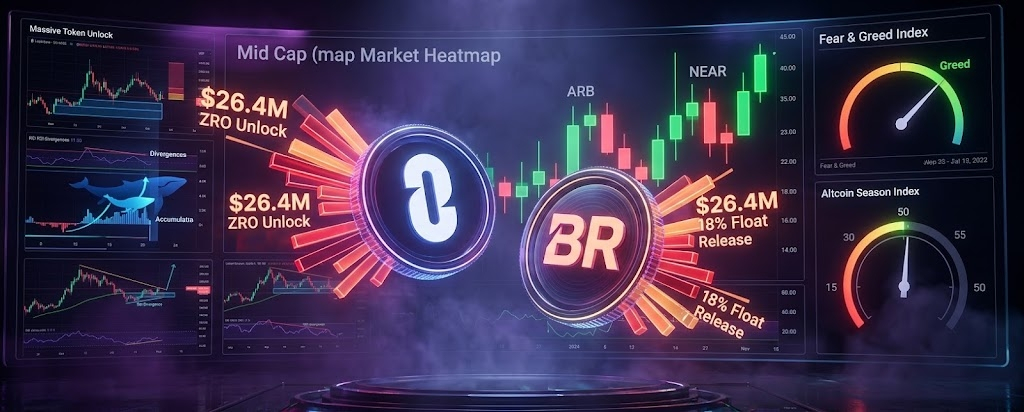
Unlock Day in a Greedy Tape: ZRO and Bedrock Put Float Under the MicroscopeScheduled unlocks rarely arrive at convenient times. Today’s cluster is no exception. LayerZero’s ZRO faces a roughly $26.4 million unlock, equal to about 4.22% of unlocked supply. Bedrock’s release is more aggressive relative to float, with an estimated 18% float impact. Fear & Greed is sitting in Greed territory. The altcoin season index is approaching 50. Mid-caps such as ARB and NEAR have already posted strong weekly moves. That is the backdrop: risk appetite is present, secondary names are active, and fresh supply is landing into the market anyway.
The important distinction is not the headline dollar amount. It is relative float. A $26 million unlock can be routine in a deep book and disruptive in a thin one. An 18% float release is a different category of event. Traders and holders are deciding whether current greed-driven flow is strong enough to absorb that supply—or whether the releases create a lasting overhang.
Why These Unlocks Matter Now
Unlock risk is always about timing and context. In a fearful market, even modest unlocks can accelerate downside because buyers are scarce. In a greedy market, the same unlocks can be absorbed if momentum and inflows are strong enough. The danger is assuming greed automatically solves supply. It often helps. It does not guarantee clearance.
What stands out here is the contrast between the two names. ZRO’s unlock is meaningful but still in a range the market has learned to process when conditions are supportive. Bedrock’s elevated float release is larger relative to what is already trading. Absolute value gets the social-media attention. Relative float usually decides the price path. That is the core angle for both pro traders and longer-term holders watching today’s session and the next several.
Supply Mechanics and Historical Pattern
Vesting events increase circulating supply by definition. The market impact depends on who receives the tokens, whether those recipients are structured sellers, and how quickly inventory reaches exchanges. Rising exchange reserves around an unlock window are the cleaner caution signal. Stable or declining reserves after the event suggest more of the supply is being held or routed carefully rather than dumped into the bid.
Historical patterns in similar FDV-heavy names are mixed but familiar. Markets often sell the rumor into the unlock, then stabilize if broader flow remains supportive. Sometimes the opposite happens: price holds into the event and weakens after, once the new float is actually available. The common mistake is treating the unlock timestamp as the only risk moment. Distribution can begin before and continue after. The window matters more than the single print.
For names with large fully diluted valuations relative to float, each unlock is also a referendum on whether earlier valuations still make sense once more tokens are free to trade. That pressure is structural. It does not require a change in narrative to matter.
On-Chain and Derivatives Context
Around unlock windows, whale behavior becomes more informative than usual. Accumulation into weakness can support the absorption case. Distribution into strength, especially if paired with rising exchange balances, argues for patience rather than aggressive buying. Active addresses and transfer volume often spike into these events. Some of that is noise—wallets repositioning, custodial moves, market-maker inventory. Some of it is real supply seeking liquidity.
On the derivatives side, positive funding around ZRO and related pairs complicates the picture. Positive funding means longs are paying to stay in. That can be sustainable in a strong tape. It becomes expensive and fragile if spot demand fades right as new tokens hit circulation. Open interest elevated into an unlock raises the odds of a fast move once the first wave of supply lands, because leveraged positioning and spot inventory interact. RSI divergences and order-block retests are the practical technical map for that process. If price loses key post-impulse supports while funding stays positive, the unwind can be disorderly. If the book absorbs the float and those supports hold, the unlock can pass as a digested event rather than a regime change.
Risks, Opportunities, and Positioning
The main risk is straightforward. New supply meets a market that has already rewarded mid-caps hard. Late longs financed by positive funding are vulnerable if absorption fails. For Bedrock, the relative float size makes that risk more acute. For ZRO, the risk is less about a single catastrophic percentage and more about whether repeated unlocks steadily cap upside.
There is also opportunity in the same structure. Greed-range conditions and active altcoin flow can clear inventory that would overwhelm a weaker tape. Markets that successfully absorb unlocks sometimes reset positioning and continue higher once forced or scheduled selling is out of the way. That outcome is possible. It should be earned by the order book, not assumed from the sentiment index.
For pro traders, the cleanest approach is event-based discipline: watch relative float, exchange-reserve direction, funding, and whether price can reclaim or hold the pre-unlock range. For longer-term investors, the question is whether these unlocks are ordinary vesting progress or the start of a multi-month supply ceiling. That answer depends less on today’s candle and more on recipient behavior over subsequent sessions.
Closing View
LayerZero and Bedrock are testing the same market quality from different angles. ZRO brings a sizable but more conventional unlock into a constructive sentiment regime. Bedrock brings a much heavier relative float release into the same regime. Altcoin momentum and greed readings improve the odds of absorption. They do not eliminate overhang risk.
What the setup suggests is a sorting event. If bids remain deep and exchange reserves do not persistently rise, these unlocks may be remembered as noise inside a broader mid-cap advance. If supply shows up faster than demand and technical supports give way under positive funding, the market will be reminded that float math still overrides narrative when inventory is large enough. Relative float, not the headline dollar figure, remains the variable to respect.
#BR #zro #Near #ARB
$BR
{future}(BRUSDT)
$ZRO
{spot}(ZROUSDT)
$ARB
{spot}(ARBUSDT)
Unlock Day in a Greedy Tape: ZRO and Bedrock Put Float Under the Microscope
Scheduled unlocks rarely arrive at convenient times. Today’s cluster is no exception. LayerZero’s ZRO faces a roughly $26.4 million unlock, equal to about 4.22% of unlocked supply. Bedrock’s release is more aggressive relative to float, with an estimated 18% float impact. Fear & Greed is sitting in Greed territory. The altcoin season index is approaching 50. Mid-caps such as ARB and NEAR have already posted strong weekly moves. That is the backdrop: risk appetite is present, secondary names are active, and fresh supply is landing into the market anyway.
The important distinction is not the headline dollar amount. It is relative float. A $26 million unlock can be routine in a deep book and disruptive in a thin one. An 18% float release is a different category of event. Traders and holders are deciding whether current greed-driven flow is strong enough to absorb that supply—or whether the releases create a lasting overhang.
Why These Unlocks Matter Now
Unlock risk is always about timing and context. In a fearful market, even modest unlocks can accelerate downside because buyers are scarce. In a greedy market, the same unlocks can be absorbed if momentum and inflows are strong enough. The danger is assuming greed automatically solves supply. It often helps. It does not guarantee clearance.
What stands out here is the contrast between the two names. ZRO’s unlock is meaningful but still in a range the market has learned to process when conditions are supportive. Bedrock’s elevated float release is larger relative to what is already trading. Absolute value gets the social-media attention. Relative float usually decides the price path. That is the core angle for both pro traders and longer-term holders watching today’s session and the next several.
Supply Mechanics and Historical Pattern
Vesting events increase circulating supply by definition. The market impact depends on who receives the tokens, whether those recipients are structured sellers, and how quickly inventory reaches exchanges. Rising exchange reserves around an unlock window are the cleaner caution signal. Stable or declining reserves after the event suggest more of the supply is being held or routed carefully rather than dumped into the bid.
Historical patterns in similar FDV-heavy names are mixed but familiar. Markets often sell the rumor into the unlock, then stabilize if broader flow remains supportive. Sometimes the opposite happens: price holds into the event and weakens after, once the new float is actually available. The common mistake is treating the unlock timestamp as the only risk moment. Distribution can begin before and continue after. The window matters more than the single print.
For names with large fully diluted valuations relative to float, each unlock is also a referendum on whether earlier valuations still make sense once more tokens are free to trade. That pressure is structural. It does not require a change in narrative to matter.
On-Chain and Derivatives Context
Around unlock windows, whale behavior becomes more informative than usual. Accumulation into weakness can support the absorption case. Distribution into strength, especially if paired with rising exchange balances, argues for patience rather than aggressive buying. Active addresses and transfer volume often spike into these events. Some of that is noise—wallets repositioning, custodial moves, market-maker inventory. Some of it is real supply seeking liquidity.
On the derivatives side, positive funding around ZRO and related pairs complicates the picture. Positive funding means longs are paying to stay in. That can be sustainable in a strong tape. It becomes expensive and fragile if spot demand fades right as new tokens hit circulation. Open interest elevated into an unlock raises the odds of a fast move once the first wave of supply lands, because leveraged positioning and spot inventory interact. RSI divergences and order-block retests are the practical technical map for that process. If price loses key post-impulse supports while funding stays positive, the unwind can be disorderly. If the book absorbs the float and those supports hold, the unlock can pass as a digested event rather than a regime change.
Risks, Opportunities, and Positioning
The main risk is straightforward. New supply meets a market that has already rewarded mid-caps hard. Late longs financed by positive funding are vulnerable if absorption fails. For Bedrock, the relative float size makes that risk more acute. For ZRO, the risk is less about a single catastrophic percentage and more about whether repeated unlocks steadily cap upside.
There is also opportunity in the same structure. Greed-range conditions and active altcoin flow can clear inventory that would overwhelm a weaker tape. Markets that successfully absorb unlocks sometimes reset positioning and continue higher once forced or scheduled selling is out of the way. That outcome is possible. It should be earned by the order book, not assumed from the sentiment index.
For pro traders, the cleanest approach is event-based discipline: watch relative float, exchange-reserve direction, funding, and whether price can reclaim or hold the pre-unlock range. For longer-term investors, the question is whether these unlocks are ordinary vesting progress or the start of a multi-month supply ceiling. That answer depends less on today’s candle and more on recipient behavior over subsequent sessions.
Closing View
LayerZero and Bedrock are testing the same market quality from different angles. ZRO brings a sizable but more conventional unlock into a constructive sentiment regime. Bedrock brings a much heavier relative float release into the same regime. Altcoin momentum and greed readings improve the odds of absorption. They do not eliminate overhang risk.
What the setup suggests is a sorting event. If bids remain deep and exchange reserves do not persistently rise, these unlocks may be remembered as noise inside a broader mid-cap advance. If supply shows up faster than demand and technical supports give way under positive funding, the market will be reminded that float math still overrides narrative when inventory is large enough. Relative float, not the headline dollar figure, remains the variable to respect.
#BR #zro #Near #ARB
$BR
$ZRO
$ARB
The important distinction is not the headline dollar amount. It is relative float. A $26 million unlock can be routine in a deep book and disruptive in a thin one. An 18% float release is a different category of event. Traders and holders are deciding whether current greed-driven flow is strong enough to absorb that supply—or whether the releases create a lasting overhang.
Why These Unlocks Matter Now
Unlock risk is always about timing and context. In a fearful market, even modest unlocks can accelerate downside because buyers are scarce. In a greedy market, the same unlocks can be absorbed if momentum and inflows are strong enough. The danger is assuming greed automatically solves supply. It often helps. It does not guarantee clearance.
What stands out here is the contrast between the two names. ZRO’s unlock is meaningful but still in a range the market has learned to process when conditions are supportive. Bedrock’s elevated float release is larger relative to what is already trading. Absolute value gets the social-media attention. Relative float usually decides the price path. That is the core angle for both pro traders and longer-term holders watching today’s session and the next several.
Supply Mechanics and Historical Pattern
Vesting events increase circulating supply by definition. The market impact depends on who receives the tokens, whether those recipients are structured sellers, and how quickly inventory reaches exchanges. Rising exchange reserves around an unlock window are the cleaner caution signal. Stable or declining reserves after the event suggest more of the supply is being held or routed carefully rather than dumped into the bid.
Historical patterns in similar FDV-heavy names are mixed but familiar. Markets often sell the rumor into the unlock, then stabilize if broader flow remains supportive. Sometimes the opposite happens: price holds into the event and weakens after, once the new float is actually available. The common mistake is treating the unlock timestamp as the only risk moment. Distribution can begin before and continue after. The window matters more than the single print.
For names with large fully diluted valuations relative to float, each unlock is also a referendum on whether earlier valuations still make sense once more tokens are free to trade. That pressure is structural. It does not require a change in narrative to matter.
On-Chain and Derivatives Context
Around unlock windows, whale behavior becomes more informative than usual. Accumulation into weakness can support the absorption case. Distribution into strength, especially if paired with rising exchange balances, argues for patience rather than aggressive buying. Active addresses and transfer volume often spike into these events. Some of that is noise—wallets repositioning, custodial moves, market-maker inventory. Some of it is real supply seeking liquidity.
On the derivatives side, positive funding around ZRO and related pairs complicates the picture. Positive funding means longs are paying to stay in. That can be sustainable in a strong tape. It becomes expensive and fragile if spot demand fades right as new tokens hit circulation. Open interest elevated into an unlock raises the odds of a fast move once the first wave of supply lands, because leveraged positioning and spot inventory interact. RSI divergences and order-block retests are the practical technical map for that process. If price loses key post-impulse supports while funding stays positive, the unwind can be disorderly. If the book absorbs the float and those supports hold, the unlock can pass as a digested event rather than a regime change.
Risks, Opportunities, and Positioning
The main risk is straightforward. New supply meets a market that has already rewarded mid-caps hard. Late longs financed by positive funding are vulnerable if absorption fails. For Bedrock, the relative float size makes that risk more acute. For ZRO, the risk is less about a single catastrophic percentage and more about whether repeated unlocks steadily cap upside.
There is also opportunity in the same structure. Greed-range conditions and active altcoin flow can clear inventory that would overwhelm a weaker tape. Markets that successfully absorb unlocks sometimes reset positioning and continue higher once forced or scheduled selling is out of the way. That outcome is possible. It should be earned by the order book, not assumed from the sentiment index.
For pro traders, the cleanest approach is event-based discipline: watch relative float, exchange-reserve direction, funding, and whether price can reclaim or hold the pre-unlock range. For longer-term investors, the question is whether these unlocks are ordinary vesting progress or the start of a multi-month supply ceiling. That answer depends less on today’s candle and more on recipient behavior over subsequent sessions.
Closing View
LayerZero and Bedrock are testing the same market quality from different angles. ZRO brings a sizable but more conventional unlock into a constructive sentiment regime. Bedrock brings a much heavier relative float release into the same regime. Altcoin momentum and greed readings improve the odds of absorption. They do not eliminate overhang risk.
What the setup suggests is a sorting event. If bids remain deep and exchange reserves do not persistently rise, these unlocks may be remembered as noise inside a broader mid-cap advance. If supply shows up faster than demand and technical supports give way under positive funding, the market will be reminded that float math still overrides narrative when inventory is large enough. Relative float, not the headline dollar figure, remains the variable to respect.
#BR #zro #Near #ARB
$BR
$ZRO
$ARB
1
920
·
--
go
go

伊尔凡 _ ALY
·
--
DON'T SCROLL❎️ FOCUS HERE👀
CLAIM YOUR SOLANA REWARD🎁🎁
1' LIKE
2' SHARE
3' REPOST
$SOL
CLAIM YOUR SOLANA REWARD🎁🎁
1' LIKE
2' SHARE
3' REPOST
$SOL

19
·
--
go
go

Bobbypk
·
--
РостCrypto’s total market cap shot past $3 trillion for a bit, mostly thanks to Bitcoin flirting with $86K and altcoins going wild. Perpetual open interest almost hit $160 billion that’s the highest we’ve seen since October 2025. Just on Monday, $920 million in shorts got wiped out. There’s a lot of leverage piling up really quickly. That’s exciting, but it can flip things upside down just as fast.
Bitcoin’s still the anchor. Everything else is just chasing the hype and momentum, especially the smaller coins.
When rallies hit this hard, crypto infrastructure gets stress-tested in real time. I’m curious when leverage drives wild swings, does confidential compliance actually hold up, or does the standard EVM transparency handle it better? What do you think?
#AIStocksWhatNext
#TokenizedStockPlatformsCouldLaunchNextQuarter
@Bitcoin
#MUBARAK
Bitcoin’s still the anchor. Everything else is just chasing the hype and momentum, especially the smaller coins.
When rallies hit this hard, crypto infrastructure gets stress-tested in real time. I’m curious when leverage drives wild swings, does confidential compliance actually hold up, or does the standard EVM transparency handle it better? What do you think?
#AIStocksWhatNext
#TokenizedStockPlatformsCouldLaunchNextQuarter
@Bitcoin
#MUBARAK

27


·
--
go
go

币圈现货小旋风
·
--
$ZEC 中东传来大消息!美方准备认真和伊朗谈判,双方都不想继续打下去。地缘紧张一下子降温,很多币圈朋友第一反应,是不是行情要变天?🔥
要知道之前一有中东冲突升级,资金就会恐慌出逃,大盘跟着承压。现在缓和信号出来,避险情绪直接回落。但大家千万别盲目乐观,谈判只是有苗头,变数还特别多,随时可能再生波折🔥。
放到币圈来看,短期会给市场一点情绪支撑,可光靠这一条消息,很难直接拉动大牛市。币价最终还是要看美联储政策、资金进场量。🔥
很多散户看到消息就着急冲进去,这是最容易踩坑的。消息面行情来得快、走得更快,千万别重仓赌消息。保持轻仓观望,盯紧后续谈判进展,守住本金永远排在第一位。🔥#日本央行加息至31年高位 #SOL涨约10%
要知道之前一有中东冲突升级,资金就会恐慌出逃,大盘跟着承压。现在缓和信号出来,避险情绪直接回落。但大家千万别盲目乐观,谈判只是有苗头,变数还特别多,随时可能再生波折🔥。
放到币圈来看,短期会给市场一点情绪支撑,可光靠这一条消息,很难直接拉动大牛市。币价最终还是要看美联储政策、资金进场量。🔥
很多散户看到消息就着急冲进去,这是最容易踩坑的。消息面行情来得快、走得更快,千万别重仓赌消息。保持轻仓观望,盯紧后续谈判进展,守住本金永远排在第一位。🔥#日本央行加息至31年高位 #SOL涨约10%

26
·
--
go
go

SNM Khan
·
--
Powered By $AKE The One Of More Green's Forever 💚🤍#SNM_Khan Click Here To Claim Reward Box 🎁


18
·
--
go
go

NAJAF_加密 143
·
--
‼️$XRP 🧧Reward is here ‼️
I’m sharing $XRP 🧧 rewards with the community as a Bigger thank-you.
✨ Just claim your reward and enjoy! ✨
Claim it. Get rewarded
@XRP $XRP #xrp
I’m sharing $XRP 🧧 rewards with the community as a Bigger thank-you.
✨ Just claim your reward and enjoy! ✨
Claim it. Get rewarded
@XRP $XRP #xrp

28
·
--
hi
hi

Syco 疯子
·
--
Have Patience
Take your time, be patient with yourself
Many people are anxious, restless, and eager to
make quick money
But most end up being taken advantage of
You need to be grounded and cultivate yourself
Adhere to long-termism
Only then can you reap the rewards
$BNB $BTC
Take your time, be patient with yourself
Many people are anxious, restless, and eager to
make quick money
But most end up being taken advantage of
You need to be grounded and cultivate yourself
Adhere to long-termism
Only then can you reap the rewards
$BNB $BTC

35
·
--
go
go

BLOCK Rayne
·
--
🎁🎁Reply today to receive the red envelope 🎁🎁$SOL
🌹Thank you for helping to share and spread the word THS🌹
🌹Thank you for helping to share and spread the word THS🌹

85
·
--
sheemm
sheemm

Sheemm
·
--
🎁🎁🎁🎁 GOOD AFTERNOON 🌄
LIKE REPOST COMMENT
AND CLAIM $BNB 🎁🎁🎁🎁
$PEPE
$DOGE
#Write2Earn
LIKE REPOST COMMENT
AND CLAIM $BNB 🎁🎁🎁🎁
$PEPE
$DOGE
#Write2Earn
72
·
--
go
go

Night King Official
·
--
Рост🚨 NO TIME TO THINK! 🚨
🎁 3,000 Red Packets are LIVE! 🧧
💬 Comment YES
✅ Follow
🔁 Repost
🎉 Claim your reward!
⏰ First come, first served!
🎁 3,000 Red Packets are LIVE! 🧧
💬 Comment YES
✅ Follow
🔁 Repost
🎉 Claim your reward!
⏰ First come, first served!

29
·
--
Emma
Emma

Emmaa alex02
·
--
$SOL fam, quick drop
for you 👀⚡😍
If you see it, claim it before it’s gone 🫶
#sol板块 #solana
for you 👀⚡😍
If you see it, claim it before it’s gone 🫶
#sol板块 #solana

60


·
--
Проверено
Статья
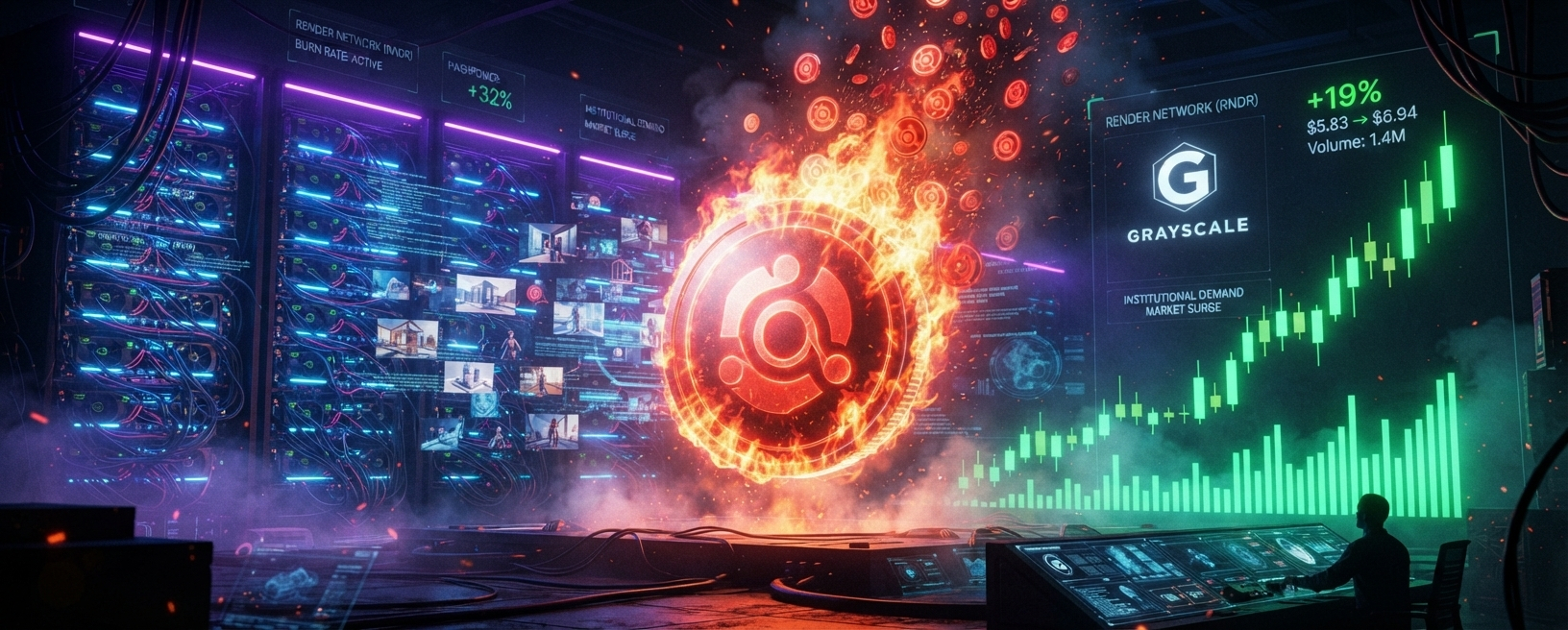
Render’s 19% Bid Puts Usage and Burns Back in the Same FrameAI tokens move for many reasons. Some move on narrative alone. Render’s latest advance came with a cleaner package. The token jumped about 19%, trading near $1.83, as broader AI-linked names stayed firm and Fear & Greed sat around 71. Volume was strong, near $162 million over 24 hours. Network activity reached roughly 77 million rendered frames. About 1.16 million RENDER were burned. Grayscale’s decentralized AI allocation still carries a notable position, around 21% of that fund.
That combination matters more than the percentage gain. Traders are not only asking whether AI beta is working. They are asking whether compute demand and token sinks can keep pace with the supply side of a DePIN network.
Why Render Is Back on the Desk
Risk appetite is clearly present. Greed-range sentiment and strong flows into AI-linked names create room for mid-cap infrastructure to re-rate quickly. Render sits in a more useful corner of that complex than pure story tokens. Its network converts GPU work into measurable output. Frames rendered and tokens burned give the market two numbers it can argue about. One speaks to usage. The other speaks to supply.
What stands out is the institutional overlay. A concentrated Grayscale position does not guarantee price support on any given day. It does show that at least one regulated product channel has treated RENDER as a core decentralized AI exposure rather than a peripheral bet. In a tape already favoring AI infrastructure, that kind of allocation can reinforce attention when on-chain activity is also rising.
Technical Tape and Sector Correlation
The breakout came with rising volume, which is the first filter worth applying. Advances on thin liquidity are easy to dismiss. A roughly 19% move with nine-figure volume forces a more serious read. Momentum is clearly extended. RSI risk is real after a move of this speed. That does not automatically invalidate the breakout. It does mean the next phase often depends on whether price can hold higher levels through a pause rather than needing constant new highs.
Sector correlation remains a central variable. Render still trades as part of the broader AI and DePIN basket. When that basket is in favor, idiosyncratic strength gets amplified. When the basket rotates out, even solid network prints can struggle to hold attention. Pro traders should treat RENDER’s relative strength against both Bitcoin and the wider AI token set as part of the setup, not as an afterthought. If the sector bid fades and Render loses the breakout zone on rising sell volume, the move starts to look like another high-beta spike. If the sector cools and Render holds up better than peers, the usage-and-burn story gains credibility.
On-Chain: Throughput, Burns, and Supply Reality
The burn of about 1.16 million RENDER is the cleanest tokenomic signal in the latest package. Burns only matter if they are recurring and linked to actual network demand rather than one-off events. In Render’s case, the more persuasive argument is the loop: work gets done on the network, activity is visible in frames rendered, and token sinks reduce circulating supply as that work is paid for. That is a different structure from AI tokens that rely mainly on emissions narratives or roadmap optionality.
Seventy-seven million rendered frames help anchor the discussion in throughput. No single print proves durable demand. Sustained utilization does. The market has become more skeptical of DePIN names that can show node counts without showing work. Render’s advantage, when it works, is that the product output is legible. GPU time goes in. Rendered frames come out. The token sits in the middle of that process.
Supply dynamics still deserve caution. Burns improve the marginal picture. They do not erase broader circulating supply or the possibility of distribution into strength. Exchange balances, holder concentration, and whether large wallets lean into or out of rallies remain part of any serious assessment.
Fundamentals, Risks, and Positioning
The fundamental case is that decentralized GPU networks can capture a slice of AI and rendering demand that would otherwise remain entirely inside centralized cloud providers. Cost, availability, and workload flexibility all create openings. Render’s positioning in rendering and related compute markets gives it a clearer commercial surface than many abstract compute tokens. Institutional packaging through vehicles such as Grayscale’s decentralized AI exposure adds another distribution channel for that thesis.
Risks are familiar but still binding. AI narrative premiums can compress quickly when sentiment rolls over. Utilization can soften. Competition from other DePIN compute networks and from traditional cloud pricing remains intense. There is also execution risk inside the token itself: if burns slow while price runs ahead of usage, the market will treat the latest rally as leverage on the sector rather than a re-rating of the network.
For pro traders, the practical approach is to respect the volume-backed breakout while defining invalidation below the post-move support band, especially if funding becomes crowded. For longer-term investors, the better scorecard is still utilization trend, burn persistence, and whether institutional ownership remains sticky through drawdowns rather than only through up weeks.
Closing View
Render’s latest strength is better grounded than a pure narrative spike. A 19% advance, strong volume, millions of rendered frames, a visible token burn, and a meaningful institutional fund weight form a coherent package. Fear & Greed at 71 helps explain why the market was ready to pay for that package now.
The data suggests Render is being treated as one of the cleaner ways to express decentralized GPU demand inside the current AI bid. That status is provisional. It holds if usage and burns continue to show up when the easy momentum fades. It weakens if price keeps rising while the work metrics stall. From here, the useful question is not whether AI compute demand exists. It is whether Render’s burn-plus-usage loop can keep converting that demand into a token structure the market is willing to hold after the first pause.
#render
#RenderNetwork
#DePIN
#aicrypto
Render’s 19% Bid Puts Usage and Burns Back in the Same Frame
AI tokens move for many reasons. Some move on narrative alone. Render’s latest advance came with a cleaner package. The token jumped about 19%, trading near $1.83, as broader AI-linked names stayed firm and Fear & Greed sat around 71. Volume was strong, near $162 million over 24 hours. Network activity reached roughly 77 million rendered frames. About 1.16 million RENDER were burned. Grayscale’s decentralized AI allocation still carries a notable position, around 21% of that fund.
That combination matters more than the percentage gain. Traders are not only asking whether AI beta is working. They are asking whether compute demand and token sinks can keep pace with the supply side of a DePIN network.
Why Render Is Back on the Desk
Risk appetite is clearly present. Greed-range sentiment and strong flows into AI-linked names create room for mid-cap infrastructure to re-rate quickly. Render sits in a more useful corner of that complex than pure story tokens. Its network converts GPU work into measurable output. Frames rendered and tokens burned give the market two numbers it can argue about. One speaks to usage. The other speaks to supply.
What stands out is the institutional overlay. A concentrated Grayscale position does not guarantee price support on any given day. It does show that at least one regulated product channel has treated RENDER as a core decentralized AI exposure rather than a peripheral bet. In a tape already favoring AI infrastructure, that kind of allocation can reinforce attention when on-chain activity is also rising.
Technical Tape and Sector Correlation
The breakout came with rising volume, which is the first filter worth applying. Advances on thin liquidity are easy to dismiss. A roughly 19% move with nine-figure volume forces a more serious read. Momentum is clearly extended. RSI risk is real after a move of this speed. That does not automatically invalidate the breakout. It does mean the next phase often depends on whether price can hold higher levels through a pause rather than needing constant new highs.
Sector correlation remains a central variable. Render still trades as part of the broader AI and DePIN basket. When that basket is in favor, idiosyncratic strength gets amplified. When the basket rotates out, even solid network prints can struggle to hold attention. Pro traders should treat RENDER’s relative strength against both Bitcoin and the wider AI token set as part of the setup, not as an afterthought. If the sector bid fades and Render loses the breakout zone on rising sell volume, the move starts to look like another high-beta spike. If the sector cools and Render holds up better than peers, the usage-and-burn story gains credibility.
On-Chain: Throughput, Burns, and Supply Reality
The burn of about 1.16 million RENDER is the cleanest tokenomic signal in the latest package. Burns only matter if they are recurring and linked to actual network demand rather than one-off events. In Render’s case, the more persuasive argument is the loop: work gets done on the network, activity is visible in frames rendered, and token sinks reduce circulating supply as that work is paid for. That is a different structure from AI tokens that rely mainly on emissions narratives or roadmap optionality.
Seventy-seven million rendered frames help anchor the discussion in throughput. No single print proves durable demand. Sustained utilization does. The market has become more skeptical of DePIN names that can show node counts without showing work. Render’s advantage, when it works, is that the product output is legible. GPU time goes in. Rendered frames come out. The token sits in the middle of that process.
Supply dynamics still deserve caution. Burns improve the marginal picture. They do not erase broader circulating supply or the possibility of distribution into strength. Exchange balances, holder concentration, and whether large wallets lean into or out of rallies remain part of any serious assessment.
Fundamentals, Risks, and Positioning
The fundamental case is that decentralized GPU networks can capture a slice of AI and rendering demand that would otherwise remain entirely inside centralized cloud providers. Cost, availability, and workload flexibility all create openings. Render’s positioning in rendering and related compute markets gives it a clearer commercial surface than many abstract compute tokens. Institutional packaging through vehicles such as Grayscale’s decentralized AI exposure adds another distribution channel for that thesis.
Risks are familiar but still binding. AI narrative premiums can compress quickly when sentiment rolls over. Utilization can soften. Competition from other DePIN compute networks and from traditional cloud pricing remains intense. There is also execution risk inside the token itself: if burns slow while price runs ahead of usage, the market will treat the latest rally as leverage on the sector rather than a re-rating of the network.
For pro traders, the practical approach is to respect the volume-backed breakout while defining invalidation below the post-move support band, especially if funding becomes crowded. For longer-term investors, the better scorecard is still utilization trend, burn persistence, and whether institutional ownership remains sticky through drawdowns rather than only through up weeks.
Closing View
Render’s latest strength is better grounded than a pure narrative spike. A 19% advance, strong volume, millions of rendered frames, a visible token burn, and a meaningful institutional fund weight form a coherent package. Fear & Greed at 71 helps explain why the market was ready to pay for that package now.
The data suggests Render is being treated as one of the cleaner ways to express decentralized GPU demand inside the current AI bid. That status is provisional. It holds if usage and burns continue to show up when the easy momentum fades. It weakens if price keeps rising while the work metrics stall. From here, the useful question is not whether AI compute demand exists. It is whether Render’s burn-plus-usage loop can keep converting that demand into a token structure the market is willing to hold after the first pause.
#render
#RenderNetwork
#DePIN
#aicrypto
That combination matters more than the percentage gain. Traders are not only asking whether AI beta is working. They are asking whether compute demand and token sinks can keep pace with the supply side of a DePIN network.
Why Render Is Back on the Desk
Risk appetite is clearly present. Greed-range sentiment and strong flows into AI-linked names create room for mid-cap infrastructure to re-rate quickly. Render sits in a more useful corner of that complex than pure story tokens. Its network converts GPU work into measurable output. Frames rendered and tokens burned give the market two numbers it can argue about. One speaks to usage. The other speaks to supply.
What stands out is the institutional overlay. A concentrated Grayscale position does not guarantee price support on any given day. It does show that at least one regulated product channel has treated RENDER as a core decentralized AI exposure rather than a peripheral bet. In a tape already favoring AI infrastructure, that kind of allocation can reinforce attention when on-chain activity is also rising.
Technical Tape and Sector Correlation
The breakout came with rising volume, which is the first filter worth applying. Advances on thin liquidity are easy to dismiss. A roughly 19% move with nine-figure volume forces a more serious read. Momentum is clearly extended. RSI risk is real after a move of this speed. That does not automatically invalidate the breakout. It does mean the next phase often depends on whether price can hold higher levels through a pause rather than needing constant new highs.
Sector correlation remains a central variable. Render still trades as part of the broader AI and DePIN basket. When that basket is in favor, idiosyncratic strength gets amplified. When the basket rotates out, even solid network prints can struggle to hold attention. Pro traders should treat RENDER’s relative strength against both Bitcoin and the wider AI token set as part of the setup, not as an afterthought. If the sector bid fades and Render loses the breakout zone on rising sell volume, the move starts to look like another high-beta spike. If the sector cools and Render holds up better than peers, the usage-and-burn story gains credibility.
On-Chain: Throughput, Burns, and Supply Reality
The burn of about 1.16 million RENDER is the cleanest tokenomic signal in the latest package. Burns only matter if they are recurring and linked to actual network demand rather than one-off events. In Render’s case, the more persuasive argument is the loop: work gets done on the network, activity is visible in frames rendered, and token sinks reduce circulating supply as that work is paid for. That is a different structure from AI tokens that rely mainly on emissions narratives or roadmap optionality.
Seventy-seven million rendered frames help anchor the discussion in throughput. No single print proves durable demand. Sustained utilization does. The market has become more skeptical of DePIN names that can show node counts without showing work. Render’s advantage, when it works, is that the product output is legible. GPU time goes in. Rendered frames come out. The token sits in the middle of that process.
Supply dynamics still deserve caution. Burns improve the marginal picture. They do not erase broader circulating supply or the possibility of distribution into strength. Exchange balances, holder concentration, and whether large wallets lean into or out of rallies remain part of any serious assessment.
Fundamentals, Risks, and Positioning
The fundamental case is that decentralized GPU networks can capture a slice of AI and rendering demand that would otherwise remain entirely inside centralized cloud providers. Cost, availability, and workload flexibility all create openings. Render’s positioning in rendering and related compute markets gives it a clearer commercial surface than many abstract compute tokens. Institutional packaging through vehicles such as Grayscale’s decentralized AI exposure adds another distribution channel for that thesis.
Risks are familiar but still binding. AI narrative premiums can compress quickly when sentiment rolls over. Utilization can soften. Competition from other DePIN compute networks and from traditional cloud pricing remains intense. There is also execution risk inside the token itself: if burns slow while price runs ahead of usage, the market will treat the latest rally as leverage on the sector rather than a re-rating of the network.
For pro traders, the practical approach is to respect the volume-backed breakout while defining invalidation below the post-move support band, especially if funding becomes crowded. For longer-term investors, the better scorecard is still utilization trend, burn persistence, and whether institutional ownership remains sticky through drawdowns rather than only through up weeks.
Closing View
Render’s latest strength is better grounded than a pure narrative spike. A 19% advance, strong volume, millions of rendered frames, a visible token burn, and a meaningful institutional fund weight form a coherent package. Fear & Greed at 71 helps explain why the market was ready to pay for that package now.
The data suggests Render is being treated as one of the cleaner ways to express decentralized GPU demand inside the current AI bid. That status is provisional. It holds if usage and burns continue to show up when the easy momentum fades. It weakens if price keeps rising while the work metrics stall. From here, the useful question is not whether AI compute demand exists. It is whether Render’s burn-plus-usage loop can keep converting that demand into a token structure the market is willing to hold after the first pause.
#render
#RenderNetwork
#DePIN
#aicrypto
1
592
·
--
Статья
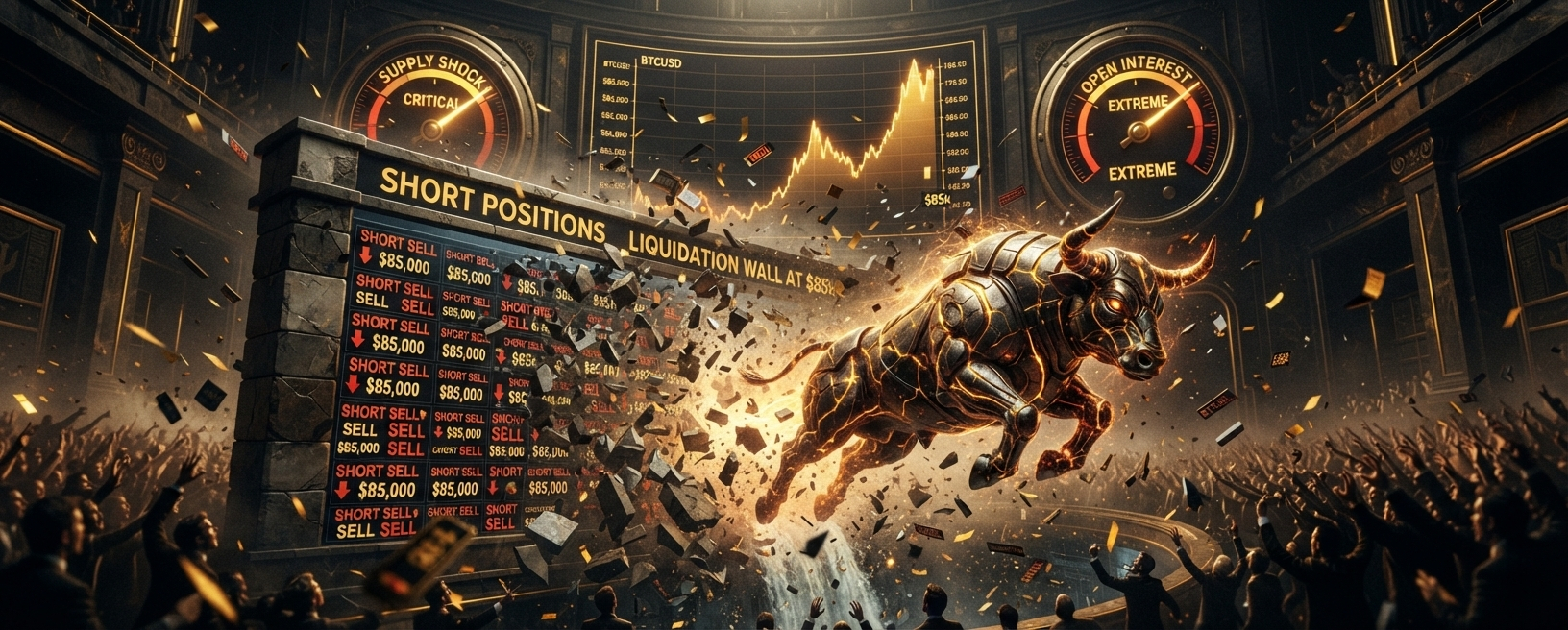
BTC’s $85K Break Turns a Squeeze Into a Positioning TestBitcoin did not drift through $85,000. It was pushed there. The market reclaimed the $85,000 to $86,000 area with a roughly 5% to 6% move over 24 hours, clearing multi-month resistance as short liquidations piled up. Estimates put the short wipeout in the $648 million to $666 million range, inside a broader liquidation total near $750 million. Open interest has been running near recent peaks, around $28.8 billion. Funding remains positive. Fear & Greed sits near 71.
That is a classic squeeze profile. The harder question is what comes after the forced buying. Crowded shorts can fuel a fast leg higher. Crowded longs and elevated open interest can just as easily set up the reversal once the liquidation fuel is gone. Pro traders are not debating whether the squeeze happened. They are debating whether the market still has demand after it.
Why This Level Matters Now
The break above prior resistance changed the immediate technical conversation. Liquidity above the old range was pulled in, and the move accelerated as short clusters between roughly $83,000 and $86,000 were forced to cover. Heatmaps had been flagging that concentration for days. When price enters a dense short band with high open interest, the cascade can become self-reinforcing. That appears to be exactly what traded.
Sentiment is supportive but not off the charts. A Fear & Greed reading around 71 fits a market willing to chase strength without full euphoria. That backdrop helps squeezes extend. It also means there is still room for positioning to become more one-sided from here. Positive funding, including prints around +0.0015% per hour on venues such as Hyperliquid, shows that longs are already paying to stay in. The longer that condition persists after a vertical advance, the more expensive and fragile the long side becomes if spot demand slows.
Derivatives Structure: OI, Funding, and the Post-Squeeze Window
Open interest near $28.83 billion is the central risk variable. High OI into a breakout can mean conviction. It can also mean the market is loaded with leverage that has not yet been resolved. The short side has taken the first major hit. That does not clear the board. It often transfers risk to the long side, especially when funding flips from a short-squeeze accelerant into a carrying cost for late longs.
This is where pure price charts understate the asymmetry. A market that has just cleared short liquidity can keep rising on relatively modest spot demand because forced buyers are still active and remaining shorts are defensive. Once that process completes, the same elevated OI can amplify downside if price fails to hold the breakout zone. The practical tell is acceptance. Holding above the reclaimed band keeps the squeeze-to-trend case alive. Losing it quickly while funding stays positive argues for a more tactical fade or at least a reduction in chase behavior.
On-Chain Supply and the ETF Overlay
The on-chain picture is more nuanced than the liquidation headline. Long-term holder supply outflows have slowed to about 21,700 BTC over 30 days, down from roughly 105,900 earlier. That deceleration matters. Heavy LTH distribution into strength is one of the cleaner warnings of a mature advance. A slower pace removes some of that pressure, though it does not by itself prove accumulation.
OTC desk reserves near record lows, around 123,000 BTC, tighten the picture further. When readily available off-exchange inventory is compressed, even moderate demand can move price more than models based on total free float would suggest. Against that, recent whale net exchange inflows of about 2,753 BTC introduce a caution flag. Coins moving onto exchanges into strength are never a signal to ignore. The size is not extreme on its own, but the direction is the wrong one if the bullish case depends on continued scarcity at the margin.
ETF flow has been supportive in a quieter way. A weekly net figure around +$6.2 million after Friday’s much larger $433 million inflow shows that product demand has not vanished, even if the latest weekly total is modest by recent standards. The market does not need record ETF prints every session to sustain a breakout. It does need the absence of persistent outflows while leverage is this elevated.
Practical Levels and Trader Implications
The operational map is straightforward. The $83,000 to $86,000 region has shifted from overhead liquidity to a zone the market must now defend if the breakout is real. RSI and momentum measures are extended after the cascade, which raises the odds of a pause or a sharp retest. That does not invalidate the move. It changes the preferred expression. Chasing stretched funding after a $648 million-plus short flush is a different trade from buying a controlled retest of the breakout area with cleaner positioning.
What I'm watching is the interaction of three things: open interest direction, funding persistence, and whether exchange-bound whale flow expands from here. Falling OI with stable price would suggest deleveraging without immediate trend failure. Rising OI and rising funding into another vertical leg would increase reversal risk. Expanding exchange inflows while price stalls would argue that supply is meeting the squeeze bid more actively.
Closing View
Bitcoin’s reclaim of $85,000 was driven by mechanics as much as by narrative. Short liquidations cleared a visible band of resistance, open interest remains near peak levels, funding is positive, and available OTC inventory is tight. ETF demand is still present in the background. Whale exchange inflows are the main near-term caution inside an otherwise constructive scarcity setup.
The data suggests asymmetric upside can remain in play as long as the market holds the reclaimed zone and leverage does not become one-sided on the long side. The same data also says this is no longer a clean short-squeeze entry. That trade has largely expressed. From here, the edge shifts to managing the post-cascade regime: respecting the breakout while refusing to ignore elevated OI, positive funding, and any acceleration in coins moving toward exchanges. The next decisive tell will be whether spot and product demand can lead once the forced buyers are done.
$BTC
#BitcoinSquareTurkiye #BTC #ShortSqueeze #BitcoinBreakout
BTC’s $85K Break Turns a Squeeze Into a Positioning Test
Bitcoin did not drift through $85,000. It was pushed there. The market reclaimed the $85,000 to $86,000 area with a roughly 5% to 6% move over 24 hours, clearing multi-month resistance as short liquidations piled up. Estimates put the short wipeout in the $648 million to $666 million range, inside a broader liquidation total near $750 million. Open interest has been running near recent peaks, around $28.8 billion. Funding remains positive. Fear & Greed sits near 71.
That is a classic squeeze profile. The harder question is what comes after the forced buying. Crowded shorts can fuel a fast leg higher. Crowded longs and elevated open interest can just as easily set up the reversal once the liquidation fuel is gone. Pro traders are not debating whether the squeeze happened. They are debating whether the market still has demand after it.
Why This Level Matters Now
The break above prior resistance changed the immediate technical conversation. Liquidity above the old range was pulled in, and the move accelerated as short clusters between roughly $83,000 and $86,000 were forced to cover. Heatmaps had been flagging that concentration for days. When price enters a dense short band with high open interest, the cascade can become self-reinforcing. That appears to be exactly what traded.
Sentiment is supportive but not off the charts. A Fear & Greed reading around 71 fits a market willing to chase strength without full euphoria. That backdrop helps squeezes extend. It also means there is still room for positioning to become more one-sided from here. Positive funding, including prints around +0.0015% per hour on venues such as Hyperliquid, shows that longs are already paying to stay in. The longer that condition persists after a vertical advance, the more expensive and fragile the long side becomes if spot demand slows.
Derivatives Structure: OI, Funding, and the Post-Squeeze Window
Open interest near $28.83 billion is the central risk variable. High OI into a breakout can mean conviction. It can also mean the market is loaded with leverage that has not yet been resolved. The short side has taken the first major hit. That does not clear the board. It often transfers risk to the long side, especially when funding flips from a short-squeeze accelerant into a carrying cost for late longs.
This is where pure price charts understate the asymmetry. A market that has just cleared short liquidity can keep rising on relatively modest spot demand because forced buyers are still active and remaining shorts are defensive. Once that process completes, the same elevated OI can amplify downside if price fails to hold the breakout zone. The practical tell is acceptance. Holding above the reclaimed band keeps the squeeze-to-trend case alive. Losing it quickly while funding stays positive argues for a more tactical fade or at least a reduction in chase behavior.
On-Chain Supply and the ETF Overlay
The on-chain picture is more nuanced than the liquidation headline. Long-term holder supply outflows have slowed to about 21,700 BTC over 30 days, down from roughly 105,900 earlier. That deceleration matters. Heavy LTH distribution into strength is one of the cleaner warnings of a mature advance. A slower pace removes some of that pressure, though it does not by itself prove accumulation.
OTC desk reserves near record lows, around 123,000 BTC, tighten the picture further. When readily available off-exchange inventory is compressed, even moderate demand can move price more than models based on total free float would suggest. Against that, recent whale net exchange inflows of about 2,753 BTC introduce a caution flag. Coins moving onto exchanges into strength are never a signal to ignore. The size is not extreme on its own, but the direction is the wrong one if the bullish case depends on continued scarcity at the margin.
ETF flow has been supportive in a quieter way. A weekly net figure around +$6.2 million after Friday’s much larger $433 million inflow shows that product demand has not vanished, even if the latest weekly total is modest by recent standards. The market does not need record ETF prints every session to sustain a breakout. It does need the absence of persistent outflows while leverage is this elevated.
Practical Levels and Trader Implications
The operational map is straightforward. The $83,000 to $86,000 region has shifted from overhead liquidity to a zone the market must now defend if the breakout is real. RSI and momentum measures are extended after the cascade, which raises the odds of a pause or a sharp retest. That does not invalidate the move. It changes the preferred expression. Chasing stretched funding after a $648 million-plus short flush is a different trade from buying a controlled retest of the breakout area with cleaner positioning.
What I'm watching is the interaction of three things: open interest direction, funding persistence, and whether exchange-bound whale flow expands from here. Falling OI with stable price would suggest deleveraging without immediate trend failure. Rising OI and rising funding into another vertical leg would increase reversal risk. Expanding exchange inflows while price stalls would argue that supply is meeting the squeeze bid more actively.
Closing View
Bitcoin’s reclaim of $85,000 was driven by mechanics as much as by narrative. Short liquidations cleared a visible band of resistance, open interest remains near peak levels, funding is positive, and available OTC inventory is tight. ETF demand is still present in the background. Whale exchange inflows are the main near-term caution inside an otherwise constructive scarcity setup.
The data suggests asymmetric upside can remain in play as long as the market holds the reclaimed zone and leverage does not become one-sided on the long side. The same data also says this is no longer a clean short-squeeze entry. That trade has largely expressed. From here, the edge shifts to managing the post-cascade regime: respecting the breakout while refusing to ignore elevated OI, positive funding, and any acceleration in coins moving toward exchanges. The next decisive tell will be whether spot and product demand can lead once the forced buyers are done.
$BTC
#BitcoinSquareTurkiye #BTC #ShortSqueeze #BitcoinBreakout
That is a classic squeeze profile. The harder question is what comes after the forced buying. Crowded shorts can fuel a fast leg higher. Crowded longs and elevated open interest can just as easily set up the reversal once the liquidation fuel is gone. Pro traders are not debating whether the squeeze happened. They are debating whether the market still has demand after it.
Why This Level Matters Now
The break above prior resistance changed the immediate technical conversation. Liquidity above the old range was pulled in, and the move accelerated as short clusters between roughly $83,000 and $86,000 were forced to cover. Heatmaps had been flagging that concentration for days. When price enters a dense short band with high open interest, the cascade can become self-reinforcing. That appears to be exactly what traded.
Sentiment is supportive but not off the charts. A Fear & Greed reading around 71 fits a market willing to chase strength without full euphoria. That backdrop helps squeezes extend. It also means there is still room for positioning to become more one-sided from here. Positive funding, including prints around +0.0015% per hour on venues such as Hyperliquid, shows that longs are already paying to stay in. The longer that condition persists after a vertical advance, the more expensive and fragile the long side becomes if spot demand slows.
Derivatives Structure: OI, Funding, and the Post-Squeeze Window
Open interest near $28.83 billion is the central risk variable. High OI into a breakout can mean conviction. It can also mean the market is loaded with leverage that has not yet been resolved. The short side has taken the first major hit. That does not clear the board. It often transfers risk to the long side, especially when funding flips from a short-squeeze accelerant into a carrying cost for late longs.
This is where pure price charts understate the asymmetry. A market that has just cleared short liquidity can keep rising on relatively modest spot demand because forced buyers are still active and remaining shorts are defensive. Once that process completes, the same elevated OI can amplify downside if price fails to hold the breakout zone. The practical tell is acceptance. Holding above the reclaimed band keeps the squeeze-to-trend case alive. Losing it quickly while funding stays positive argues for a more tactical fade or at least a reduction in chase behavior.
On-Chain Supply and the ETF Overlay
The on-chain picture is more nuanced than the liquidation headline. Long-term holder supply outflows have slowed to about 21,700 BTC over 30 days, down from roughly 105,900 earlier. That deceleration matters. Heavy LTH distribution into strength is one of the cleaner warnings of a mature advance. A slower pace removes some of that pressure, though it does not by itself prove accumulation.
OTC desk reserves near record lows, around 123,000 BTC, tighten the picture further. When readily available off-exchange inventory is compressed, even moderate demand can move price more than models based on total free float would suggest. Against that, recent whale net exchange inflows of about 2,753 BTC introduce a caution flag. Coins moving onto exchanges into strength are never a signal to ignore. The size is not extreme on its own, but the direction is the wrong one if the bullish case depends on continued scarcity at the margin.
ETF flow has been supportive in a quieter way. A weekly net figure around +$6.2 million after Friday’s much larger $433 million inflow shows that product demand has not vanished, even if the latest weekly total is modest by recent standards. The market does not need record ETF prints every session to sustain a breakout. It does need the absence of persistent outflows while leverage is this elevated.
Practical Levels and Trader Implications
The operational map is straightforward. The $83,000 to $86,000 region has shifted from overhead liquidity to a zone the market must now defend if the breakout is real. RSI and momentum measures are extended after the cascade, which raises the odds of a pause or a sharp retest. That does not invalidate the move. It changes the preferred expression. Chasing stretched funding after a $648 million-plus short flush is a different trade from buying a controlled retest of the breakout area with cleaner positioning.
What I'm watching is the interaction of three things: open interest direction, funding persistence, and whether exchange-bound whale flow expands from here. Falling OI with stable price would suggest deleveraging without immediate trend failure. Rising OI and rising funding into another vertical leg would increase reversal risk. Expanding exchange inflows while price stalls would argue that supply is meeting the squeeze bid more actively.
Closing View
Bitcoin’s reclaim of $85,000 was driven by mechanics as much as by narrative. Short liquidations cleared a visible band of resistance, open interest remains near peak levels, funding is positive, and available OTC inventory is tight. ETF demand is still present in the background. Whale exchange inflows are the main near-term caution inside an otherwise constructive scarcity setup.
The data suggests asymmetric upside can remain in play as long as the market holds the reclaimed zone and leverage does not become one-sided on the long side. The same data also says this is no longer a clean short-squeeze entry. That trade has largely expressed. From here, the edge shifts to managing the post-cascade regime: respecting the breakout while refusing to ignore elevated OI, positive funding, and any acceleration in coins moving toward exchanges. The next decisive tell will be whether spot and product demand can lead once the forced buyers are done.
$BTC
#BitcoinSquareTurkiye #BTC #ShortSqueeze #BitcoinBreakout
249
·
--
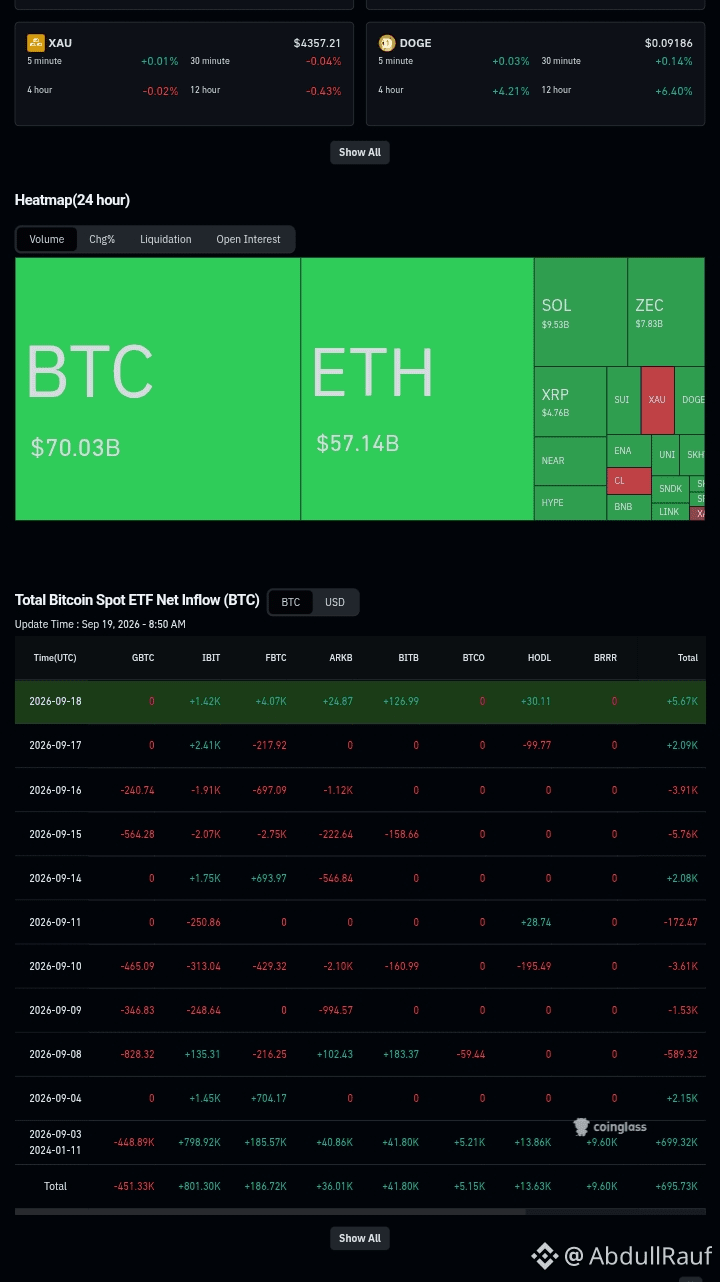
Bitcoin Spot ETF Inflows Turn Positive Again
After several days of outflows, Bitcoin Spot ETFs have flipped back to net inflows.
Sep 18: +5,670 BTC
Sep 17: +2,090 BTC
This comes after notable outflows on Sep 15 (-5,760 BTC) and Sep 16 (-3,910 BTC).
The shift suggests some institutional demand is returning, even as price action remains cautious.
Worth watching whether this inflow trend continues over the next few sessions.
$BTC
{spot}(BTCUSDT)
#BTC走势分析
Bitcoin Spot ETF Inflows Turn Positive Again
After several days of outflows, Bitcoin Spot ETFs have flipped back to net inflows.
Sep 18: +5,670 BTC
Sep 17: +2,090 BTC
This comes after notable outflows on Sep 15 (-5,760 BTC) and Sep 16 (-3,910 BTC).
The shift suggests some institutional demand is returning, even as price action remains cautious.
Worth watching whether this inflow trend continues over the next few sessions.
$BTC
#BTC走势分析
After several days of outflows, Bitcoin Spot ETFs have flipped back to net inflows.
Sep 18: +5,670 BTC
Sep 17: +2,090 BTC
This comes after notable outflows on Sep 15 (-5,760 BTC) and Sep 16 (-3,910 BTC).
The shift suggests some institutional demand is returning, even as price action remains cautious.
Worth watching whether this inflow trend continues over the next few sessions.
$BTC
#BTC走势分析
206
·
--
Проверено

Статья
Aethir’s 20 MW Push Turns the Compute Narrative PhysicalMost AI-token rallies still begin with a story. Aethir’s latest catalyst begins with sites and power. The ACCELERATE program is targeting up to 20 MW of high-density GPU capacity, with projected contract value in the hundreds of millions. That lands in a market already willing to fund infrastructure narratives. Fear & Greed has been holding in Greed territory, roughly 62 to 73, and altcoin momentum has been lifting mid-caps. Render and Akash have kept DePIN compute in the conversation through revenue and utilization metrics. Traders are looking for something sturdier than another abstract “AI demand” headline. Physical capacity is that something.
What stands out is the shift in emphasis. The market has spent a long stretch pricing decentralized compute as an option on future AI workloads. Programs that secure power, space, and enterprise-facing capacity force a more concrete question: can these networks move from token narrative to contract-backed infrastructure?
Why Capacity Matters More Than Another Price Spike
Institutional AI spending has not slowed in the broader technology complex. Training and inference still run into the same constraints: access to high-end GPUs, density, power, and reliable delivery. Centralized cloud providers remain the default. DePIN networks are trying to insert themselves as alternative or complementary supply, especially where workloads can be distributed or where cost and availability create openings.
Aethir’s ACCELERATE framing is useful because it is denominated in megawatts, not just roadmap language. Capacity targets can be overstated, and projected contract values can slip. Still, the market tends to reward projects that move the discussion from emissions and points to power, hardware, and customer pipeline. That is the core of the current bid across parts of GPU DePIN. Capital is less interested in pure thematic exposure and more interested in evidence that decentralized supply can be packaged into something enterprises will pay for.
Sector Context and Market Structure
Mid-cap infrastructure names often move hardest when two conditions overlap: broad risk appetite and a fresh catalyst that feels measurable. Both are present. Positive momentum across altcoins creates room for secondary leaders. A capacity announcement gives desks a number to debate.
Funding rates and open interest on related mid-cap perps become the tactical overlay. Modestly positive funding with rising interest can support continuation after digestion. Rapidly elevated funding after a vertical move raises the odds of a sharp squeeze in the opposite direction. Liquidity near recent highs also matters. If price probes those zones and finds acceptance, momentum traders stay engaged. If the highs are swept and rejected while open interest stays elevated, the move can unwind quickly.
For pro traders, the practical read is to separate the infrastructure thesis from the short-term positioning regime. The first can remain intact while the second turns. That distinction is where a lot of P&L is made or lost in these names.
On-Chain and Network Signals
Across GPU DePIN networks, the more useful metrics are still the unglamorous ones: node growth, utilization, active addresses, and whether supply dynamics favor participants who are actually providing work. Rising active addresses without utilization can mean marketing reach rather than demand. Utilization without durable pricing can mean activity that does not translate into sustainable revenue.
Supply behavior in compute tokens also deserves attention. Networks that dilute aggressively into a narrative peak often cap upside even when the product story is real. Networks that tie rewards more tightly to delivered compute have a cleaner long-term shape, though they can underperform in pure speculative phases. The data suggests investors are starting to make that distinction more carefully than they did in earlier AI-beta waves.
Aethir’s capacity plan should eventually show up in the same scorecard. Announced megawatts are an input. Deployed capacity, contracted usage, and realized revenue are the outputs that decide whether the re-rating holds.
Fundamentals, Risks, and Positioning
The fundamental case is straightforward. If decentralized GPU networks can assemble reliable capacity and sell it into enterprise or large-scale AI workflows, the sector graduates from speculative compute tokens toward infrastructure with backlog. Render and Akash have already helped the market understand that revenue traction is possible. Aethir’s ACCELERATE target is an attempt to scale that logic through physical buildout and high-density sites.
Risks are equally clear. Data-center timelines slip. Power is not abstract. Hardware procurement, deployment, and utilization can lag optimistic presentations. Competitive pressure from centralized providers remains intense on price and reliability. There is also market risk: if broader risk appetite fades, DePIN mid-caps will not be shielded by their megawatt targets.
For longer-term investors, the opportunity is in identifying which networks are building real supply and customer relationships rather than only harvesting narrative beta. For pro traders, the opportunity is in trading the gap between announcement momentum and operational delivery, with clear invalidation if price loses key post-catalyst structure while funding stays elevated.
Closing View
Aethir’s 20 MW ambition is not just another AI headline. It is a claim about physical capacity in a market that has been hungry for measurable infrastructure catalysts. The broader setup helps: greed-range sentiment, mid-cap participation, and existing DePIN revenue examples from peers. That does not make the projection destiny. It does explain why desks are treating capacity expansion as a more serious signal than pure token momentum.
What I'm watching from here is conversion. Sites and megawatt targets need to become deployed capacity, utilization, and contracts that survive outside a bullish tape. If that conversion happens, the decentralized GPU story becomes harder to dismiss as speculative packaging. If it does not, the market will likely treat ACCELERATE as another well-timed catalyst in a sector that still runs ahead of its balance sheet. The next phase belongs to the operators who can turn power into paid compute—and to the investors disciplined enough to wait for that evidence.
#Aethir
#ATH
#accelerate
#DePIN
$Acc
Aethir’s 20 MW Push Turns the Compute Narrative Physical
Most AI-token rallies still begin with a story. Aethir’s latest catalyst begins with sites and power. The ACCELERATE program is targeting up to 20 MW of high-density GPU capacity, with projected contract value in the hundreds of millions. That lands in a market already willing to fund infrastructure narratives. Fear & Greed has been holding in Greed territory, roughly 62 to 73, and altcoin momentum has been lifting mid-caps. Render and Akash have kept DePIN compute in the conversation through revenue and utilization metrics. Traders are looking for something sturdier than another abstract “AI demand” headline. Physical capacity is that something.
What stands out is the shift in emphasis. The market has spent a long stretch pricing decentralized compute as an option on future AI workloads. Programs that secure power, space, and enterprise-facing capacity force a more concrete question: can these networks move from token narrative to contract-backed infrastructure?
Why Capacity Matters More Than Another Price Spike
Institutional AI spending has not slowed in the broader technology complex. Training and inference still run into the same constraints: access to high-end GPUs, density, power, and reliable delivery. Centralized cloud providers remain the default. DePIN networks are trying to insert themselves as alternative or complementary supply, especially where workloads can be distributed or where cost and availability create openings.
Aethir’s ACCELERATE framing is useful because it is denominated in megawatts, not just roadmap language. Capacity targets can be overstated, and projected contract values can slip. Still, the market tends to reward projects that move the discussion from emissions and points to power, hardware, and customer pipeline. That is the core of the current bid across parts of GPU DePIN. Capital is less interested in pure thematic exposure and more interested in evidence that decentralized supply can be packaged into something enterprises will pay for.
Sector Context and Market Structure
Mid-cap infrastructure names often move hardest when two conditions overlap: broad risk appetite and a fresh catalyst that feels measurable. Both are present. Positive momentum across altcoins creates room for secondary leaders. A capacity announcement gives desks a number to debate.
Funding rates and open interest on related mid-cap perps become the tactical overlay. Modestly positive funding with rising interest can support continuation after digestion. Rapidly elevated funding after a vertical move raises the odds of a sharp squeeze in the opposite direction. Liquidity near recent highs also matters. If price probes those zones and finds acceptance, momentum traders stay engaged. If the highs are swept and rejected while open interest stays elevated, the move can unwind quickly.
For pro traders, the practical read is to separate the infrastructure thesis from the short-term positioning regime. The first can remain intact while the second turns. That distinction is where a lot of P&L is made or lost in these names.
On-Chain and Network Signals
Across GPU DePIN networks, the more useful metrics are still the unglamorous ones: node growth, utilization, active addresses, and whether supply dynamics favor participants who are actually providing work. Rising active addresses without utilization can mean marketing reach rather than demand. Utilization without durable pricing can mean activity that does not translate into sustainable revenue.
Supply behavior in compute tokens also deserves attention. Networks that dilute aggressively into a narrative peak often cap upside even when the product story is real. Networks that tie rewards more tightly to delivered compute have a cleaner long-term shape, though they can underperform in pure speculative phases. The data suggests investors are starting to make that distinction more carefully than they did in earlier AI-beta waves.
Aethir’s capacity plan should eventually show up in the same scorecard. Announced megawatts are an input. Deployed capacity, contracted usage, and realized revenue are the outputs that decide whether the re-rating holds.
Fundamentals, Risks, and Positioning
The fundamental case is straightforward. If decentralized GPU networks can assemble reliable capacity and sell it into enterprise or large-scale AI workflows, the sector graduates from speculative compute tokens toward infrastructure with backlog. Render and Akash have already helped the market understand that revenue traction is possible. Aethir’s ACCELERATE target is an attempt to scale that logic through physical buildout and high-density sites.
Risks are equally clear. Data-center timelines slip. Power is not abstract. Hardware procurement, deployment, and utilization can lag optimistic presentations. Competitive pressure from centralized providers remains intense on price and reliability. There is also market risk: if broader risk appetite fades, DePIN mid-caps will not be shielded by their megawatt targets.
For longer-term investors, the opportunity is in identifying which networks are building real supply and customer relationships rather than only harvesting narrative beta. For pro traders, the opportunity is in trading the gap between announcement momentum and operational delivery, with clear invalidation if price loses key post-catalyst structure while funding stays elevated.
Closing View
Aethir’s 20 MW ambition is not just another AI headline. It is a claim about physical capacity in a market that has been hungry for measurable infrastructure catalysts. The broader setup helps: greed-range sentiment, mid-cap participation, and existing DePIN revenue examples from peers. That does not make the projection destiny. It does explain why desks are treating capacity expansion as a more serious signal than pure token momentum.
What I'm watching from here is conversion. Sites and megawatt targets need to become deployed capacity, utilization, and contracts that survive outside a bullish tape. If that conversion happens, the decentralized GPU story becomes harder to dismiss as speculative packaging. If it does not, the market will likely treat ACCELERATE as another well-timed catalyst in a sector that still runs ahead of its balance sheet. The next phase belongs to the operators who can turn power into paid compute—and to the investors disciplined enough to wait for that evidence.
#Aethir
#ATH
#accelerate
#DePIN
$Acc
What stands out is the shift in emphasis. The market has spent a long stretch pricing decentralized compute as an option on future AI workloads. Programs that secure power, space, and enterprise-facing capacity force a more concrete question: can these networks move from token narrative to contract-backed infrastructure?
Why Capacity Matters More Than Another Price Spike
Institutional AI spending has not slowed in the broader technology complex. Training and inference still run into the same constraints: access to high-end GPUs, density, power, and reliable delivery. Centralized cloud providers remain the default. DePIN networks are trying to insert themselves as alternative or complementary supply, especially where workloads can be distributed or where cost and availability create openings.
Aethir’s ACCELERATE framing is useful because it is denominated in megawatts, not just roadmap language. Capacity targets can be overstated, and projected contract values can slip. Still, the market tends to reward projects that move the discussion from emissions and points to power, hardware, and customer pipeline. That is the core of the current bid across parts of GPU DePIN. Capital is less interested in pure thematic exposure and more interested in evidence that decentralized supply can be packaged into something enterprises will pay for.
Sector Context and Market Structure
Mid-cap infrastructure names often move hardest when two conditions overlap: broad risk appetite and a fresh catalyst that feels measurable. Both are present. Positive momentum across altcoins creates room for secondary leaders. A capacity announcement gives desks a number to debate.
Funding rates and open interest on related mid-cap perps become the tactical overlay. Modestly positive funding with rising interest can support continuation after digestion. Rapidly elevated funding after a vertical move raises the odds of a sharp squeeze in the opposite direction. Liquidity near recent highs also matters. If price probes those zones and finds acceptance, momentum traders stay engaged. If the highs are swept and rejected while open interest stays elevated, the move can unwind quickly.
For pro traders, the practical read is to separate the infrastructure thesis from the short-term positioning regime. The first can remain intact while the second turns. That distinction is where a lot of P&L is made or lost in these names.
On-Chain and Network Signals
Across GPU DePIN networks, the more useful metrics are still the unglamorous ones: node growth, utilization, active addresses, and whether supply dynamics favor participants who are actually providing work. Rising active addresses without utilization can mean marketing reach rather than demand. Utilization without durable pricing can mean activity that does not translate into sustainable revenue.
Supply behavior in compute tokens also deserves attention. Networks that dilute aggressively into a narrative peak often cap upside even when the product story is real. Networks that tie rewards more tightly to delivered compute have a cleaner long-term shape, though they can underperform in pure speculative phases. The data suggests investors are starting to make that distinction more carefully than they did in earlier AI-beta waves.
Aethir’s capacity plan should eventually show up in the same scorecard. Announced megawatts are an input. Deployed capacity, contracted usage, and realized revenue are the outputs that decide whether the re-rating holds.
Fundamentals, Risks, and Positioning
The fundamental case is straightforward. If decentralized GPU networks can assemble reliable capacity and sell it into enterprise or large-scale AI workflows, the sector graduates from speculative compute tokens toward infrastructure with backlog. Render and Akash have already helped the market understand that revenue traction is possible. Aethir’s ACCELERATE target is an attempt to scale that logic through physical buildout and high-density sites.
Risks are equally clear. Data-center timelines slip. Power is not abstract. Hardware procurement, deployment, and utilization can lag optimistic presentations. Competitive pressure from centralized providers remains intense on price and reliability. There is also market risk: if broader risk appetite fades, DePIN mid-caps will not be shielded by their megawatt targets.
For longer-term investors, the opportunity is in identifying which networks are building real supply and customer relationships rather than only harvesting narrative beta. For pro traders, the opportunity is in trading the gap between announcement momentum and operational delivery, with clear invalidation if price loses key post-catalyst structure while funding stays elevated.
Closing View
Aethir’s 20 MW ambition is not just another AI headline. It is a claim about physical capacity in a market that has been hungry for measurable infrastructure catalysts. The broader setup helps: greed-range sentiment, mid-cap participation, and existing DePIN revenue examples from peers. That does not make the projection destiny. It does explain why desks are treating capacity expansion as a more serious signal than pure token momentum.
What I'm watching from here is conversion. Sites and megawatt targets need to become deployed capacity, utilization, and contracts that survive outside a bullish tape. If that conversion happens, the decentralized GPU story becomes harder to dismiss as speculative packaging. If it does not, the market will likely treat ACCELERATE as another well-timed catalyst in a sector that still runs ahead of its balance sheet. The next phase belongs to the operators who can turn power into paid compute—and to the investors disciplined enough to wait for that evidence.
#Aethir
#ATH
#accelerate
#DePIN
$Acc
1
637
·
--
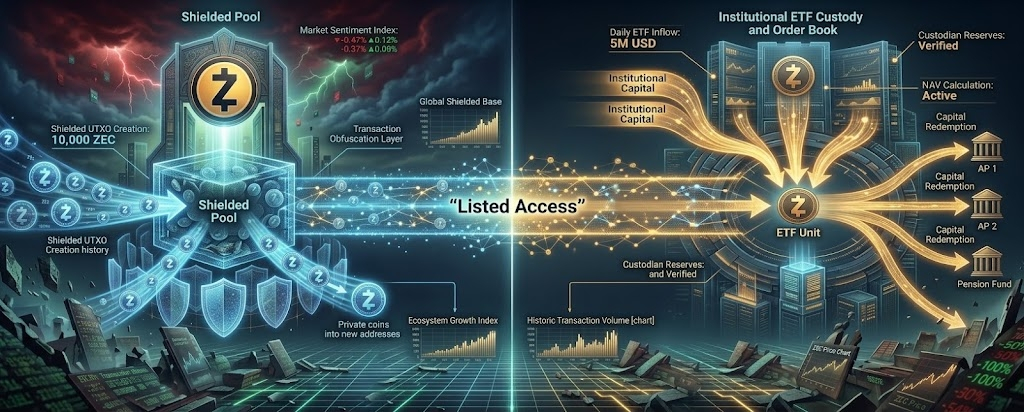
Статья
Zcash’s ETF Bid Puts the Privacy Trade Back on the DeskPrivacy coins do not usually lead during greed phases. They more often sit on the edge of the market until a regulatory scare or a sudden narrative rotation pulls them forward. This time the catalyst is more structured. ZEC has advanced roughly 37% on the week and traded near the $1,500 area, while spot Zcash ETF products have logged a multi-week inflow streak above $358 million. Social volume has spiked. Paradigm’s disclosed exposure added another institutional signal to the tape. Fear & Greed has been running roughly 62 to 73, and the Altcoin Season Index has been approaching 50.
That combination is unusual. A mid-cap privacy asset is receiving both retail attention and sustained product-level inflows while broader risk appetite is elevated but not yet extreme. The market is testing whether institutional wrappers can change the normal volatility pattern of a name like ZEC.
Why This Moment Is Different
ETF flow is the cleanest part of the story. A multi-week streak above $358 million is not a one-day curiosity print. It suggests repeated allocation rather than a single headline-driven burst. When price rises alongside that kind of inflow, the first question is whether the product is absorbing demand or simply lagging a speculative run already in motion. Both can happen. The useful work is comparing the pace of AUM growth with the pace of the rally.
What stands out is the backdrop. Greed readings and a rising altcoin-season pulse usually favor higher-beta beta trades and narrative rotation. Privacy has often been a defensive or ideological sleeve. Here it is behaving more like a catalyst-driven mid-cap with an institutional bid underneath it. That is why pro traders are paying attention. The setup is not only “ZEC is up.” It is “ZEC is up while listed product keeps taking money.”
Technical Structure After the Squeeze
The weekly advance has left shorter-term indicators stretched. RSI near the high-60s, around 69, fits a market that has already traveled far in a short window. Recent short liquidations help explain part of the speed. Forced covering can flatten resistance and pull opportunistic longs in behind it. The same process can also leave the tape vulnerable once the liquidation fuel is gone.
Order-block support from the squeeze zone becomes the practical reference. If price can hold above the area where the forced buying accelerated, the structure remains constructive even if momentum cools. If the market slips back through that zone while ETF inflows slow, the advance starts to look more like a completed catalyst spike than the start of a durable re-rating.
Volume and social activity are elevated. That is consistent with a real impulse. It is also consistent with late participation. For active traders, the distinction matters more than the headline percentage gain.
On-Chain and Fundamental Layers
On-chain, the shielded pool remains the core of Zcash’s identity. Changes in shielded activity and exchange reserves help show whether coins are moving into privacy sets, onto venues for sale, or into longer-term holding patterns. Rising price with declining exchange reserves is usually healthier than rising price with expanding reserves. The ETF channel complicates that read slightly, because product creation and redemption flows can interact with underlying liquidity in ways that pure spot markets do not.
Fundamentally, the market is also looking ahead to the NU7 upgrade window targeting November. Upgrade timelines often support attention in privacy networks when the broader tape is already receptive. Mining economics relative to Bitcoin remain part of the longer-term picture as well. ZEC does not need to win a pure store-of-value contest with BTC to matter; it needs to remain credible as a privacy-preserving monetary network with enough liquidity and institutional access to stay relevant. The ETF layer is an attempt to solve the access part of that problem.
Risks, Opportunities, and Positioning
The central risk is classic mid-cap behavior dressed up in institutional clothing. Sustained inflows can support price. They do not eliminate drawdowns when sentiment turns or when a privacy-specific headline hits. Regulatory sensitivity remains higher for privacy assets than for mainstream large caps. A sharp shift in enforcement tone, exchange treatment, or product eligibility can move ZEC faster than flow data can offset.
There is also valuation and expectation risk. A 37% weekly move near stretched momentum readings prices in a lot of good news quickly. If inflows merely stabilize rather than accelerate, the market may need time to digest.
The opportunity is the other side of the same structure. If ETF demand remains persistent and on-chain behavior does not show heavy distribution into strength, ZEC can continue to trade as a distinct liquidity venue for the privacy narrative rather than as a pure speculative satellite. For pro traders, that means tracking three things together: inflow persistence, exchange-reserve direction, and whether price holds the post-squeeze support band. For longer-term investors, the question is whether listed access permanently widens the buyer base or only amplifies the current cycle.
Closing View
Zcash is not rallying in isolation. It is rallying with a multi-week ETF inflow streak, a clear privacy narrative, visible institutional mention, and a market already willing to fund altcoin risk. That is a stronger package than a social-volume spike alone. It is also a package that can unwind if flows fade and momentum buyers are left holding the move.
What the data suggests right now is a live test of whether product demand can impose a more durable bid on a historically volatile mid-cap privacy asset. The next useful signal is not another up day. It is whether inflows remain positive after the first serious pause in price, and whether on-chain behavior supports accumulation rather than distribution into strength. Until that becomes clearer, treating the rally as an important institutional experiment rather than a settled re-rating is the more disciplined stance.
#zcash
#zec
#PrivacyCoins
#ZcashETF
#CryptoETF
$ZEC
{spot}(ZECUSDT)
Zcash’s ETF Bid Puts the Privacy Trade Back on the Desk
Privacy coins do not usually lead during greed phases. They more often sit on the edge of the market until a regulatory scare or a sudden narrative rotation pulls them forward. This time the catalyst is more structured. ZEC has advanced roughly 37% on the week and traded near the $1,500 area, while spot Zcash ETF products have logged a multi-week inflow streak above $358 million. Social volume has spiked. Paradigm’s disclosed exposure added another institutional signal to the tape. Fear & Greed has been running roughly 62 to 73, and the Altcoin Season Index has been approaching 50.
That combination is unusual. A mid-cap privacy asset is receiving both retail attention and sustained product-level inflows while broader risk appetite is elevated but not yet extreme. The market is testing whether institutional wrappers can change the normal volatility pattern of a name like ZEC.
Why This Moment Is Different
ETF flow is the cleanest part of the story. A multi-week streak above $358 million is not a one-day curiosity print. It suggests repeated allocation rather than a single headline-driven burst. When price rises alongside that kind of inflow, the first question is whether the product is absorbing demand or simply lagging a speculative run already in motion. Both can happen. The useful work is comparing the pace of AUM growth with the pace of the rally.
What stands out is the backdrop. Greed readings and a rising altcoin-season pulse usually favor higher-beta beta trades and narrative rotation. Privacy has often been a defensive or ideological sleeve. Here it is behaving more like a catalyst-driven mid-cap with an institutional bid underneath it. That is why pro traders are paying attention. The setup is not only “ZEC is up.” It is “ZEC is up while listed product keeps taking money.”
Technical Structure After the Squeeze
The weekly advance has left shorter-term indicators stretched. RSI near the high-60s, around 69, fits a market that has already traveled far in a short window. Recent short liquidations help explain part of the speed. Forced covering can flatten resistance and pull opportunistic longs in behind it. The same process can also leave the tape vulnerable once the liquidation fuel is gone.
Order-block support from the squeeze zone becomes the practical reference. If price can hold above the area where the forced buying accelerated, the structure remains constructive even if momentum cools. If the market slips back through that zone while ETF inflows slow, the advance starts to look more like a completed catalyst spike than the start of a durable re-rating.
Volume and social activity are elevated. That is consistent with a real impulse. It is also consistent with late participation. For active traders, the distinction matters more than the headline percentage gain.
On-Chain and Fundamental Layers
On-chain, the shielded pool remains the core of Zcash’s identity. Changes in shielded activity and exchange reserves help show whether coins are moving into privacy sets, onto venues for sale, or into longer-term holding patterns. Rising price with declining exchange reserves is usually healthier than rising price with expanding reserves. The ETF channel complicates that read slightly, because product creation and redemption flows can interact with underlying liquidity in ways that pure spot markets do not.
Fundamentally, the market is also looking ahead to the NU7 upgrade window targeting November. Upgrade timelines often support attention in privacy networks when the broader tape is already receptive. Mining economics relative to Bitcoin remain part of the longer-term picture as well. ZEC does not need to win a pure store-of-value contest with BTC to matter; it needs to remain credible as a privacy-preserving monetary network with enough liquidity and institutional access to stay relevant. The ETF layer is an attempt to solve the access part of that problem.
Risks, Opportunities, and Positioning
The central risk is classic mid-cap behavior dressed up in institutional clothing. Sustained inflows can support price. They do not eliminate drawdowns when sentiment turns or when a privacy-specific headline hits. Regulatory sensitivity remains higher for privacy assets than for mainstream large caps. A sharp shift in enforcement tone, exchange treatment, or product eligibility can move ZEC faster than flow data can offset.
There is also valuation and expectation risk. A 37% weekly move near stretched momentum readings prices in a lot of good news quickly. If inflows merely stabilize rather than accelerate, the market may need time to digest.
The opportunity is the other side of the same structure. If ETF demand remains persistent and on-chain behavior does not show heavy distribution into strength, ZEC can continue to trade as a distinct liquidity venue for the privacy narrative rather than as a pure speculative satellite. For pro traders, that means tracking three things together: inflow persistence, exchange-reserve direction, and whether price holds the post-squeeze support band. For longer-term investors, the question is whether listed access permanently widens the buyer base or only amplifies the current cycle.
Closing View
Zcash is not rallying in isolation. It is rallying with a multi-week ETF inflow streak, a clear privacy narrative, visible institutional mention, and a market already willing to fund altcoin risk. That is a stronger package than a social-volume spike alone. It is also a package that can unwind if flows fade and momentum buyers are left holding the move.
What the data suggests right now is a live test of whether product demand can impose a more durable bid on a historically volatile mid-cap privacy asset. The next useful signal is not another up day. It is whether inflows remain positive after the first serious pause in price, and whether on-chain behavior supports accumulation rather than distribution into strength. Until that becomes clearer, treating the rally as an important institutional experiment rather than a settled re-rating is the more disciplined stance.
#zcash
#zec
#PrivacyCoins
#ZcashETF
#CryptoETF
$ZEC
That combination is unusual. A mid-cap privacy asset is receiving both retail attention and sustained product-level inflows while broader risk appetite is elevated but not yet extreme. The market is testing whether institutional wrappers can change the normal volatility pattern of a name like ZEC.
Why This Moment Is Different
ETF flow is the cleanest part of the story. A multi-week streak above $358 million is not a one-day curiosity print. It suggests repeated allocation rather than a single headline-driven burst. When price rises alongside that kind of inflow, the first question is whether the product is absorbing demand or simply lagging a speculative run already in motion. Both can happen. The useful work is comparing the pace of AUM growth with the pace of the rally.
What stands out is the backdrop. Greed readings and a rising altcoin-season pulse usually favor higher-beta beta trades and narrative rotation. Privacy has often been a defensive or ideological sleeve. Here it is behaving more like a catalyst-driven mid-cap with an institutional bid underneath it. That is why pro traders are paying attention. The setup is not only “ZEC is up.” It is “ZEC is up while listed product keeps taking money.”
Technical Structure After the Squeeze
The weekly advance has left shorter-term indicators stretched. RSI near the high-60s, around 69, fits a market that has already traveled far in a short window. Recent short liquidations help explain part of the speed. Forced covering can flatten resistance and pull opportunistic longs in behind it. The same process can also leave the tape vulnerable once the liquidation fuel is gone.
Order-block support from the squeeze zone becomes the practical reference. If price can hold above the area where the forced buying accelerated, the structure remains constructive even if momentum cools. If the market slips back through that zone while ETF inflows slow, the advance starts to look more like a completed catalyst spike than the start of a durable re-rating.
Volume and social activity are elevated. That is consistent with a real impulse. It is also consistent with late participation. For active traders, the distinction matters more than the headline percentage gain.
On-Chain and Fundamental Layers
On-chain, the shielded pool remains the core of Zcash’s identity. Changes in shielded activity and exchange reserves help show whether coins are moving into privacy sets, onto venues for sale, or into longer-term holding patterns. Rising price with declining exchange reserves is usually healthier than rising price with expanding reserves. The ETF channel complicates that read slightly, because product creation and redemption flows can interact with underlying liquidity in ways that pure spot markets do not.
Fundamentally, the market is also looking ahead to the NU7 upgrade window targeting November. Upgrade timelines often support attention in privacy networks when the broader tape is already receptive. Mining economics relative to Bitcoin remain part of the longer-term picture as well. ZEC does not need to win a pure store-of-value contest with BTC to matter; it needs to remain credible as a privacy-preserving monetary network with enough liquidity and institutional access to stay relevant. The ETF layer is an attempt to solve the access part of that problem.
Risks, Opportunities, and Positioning
The central risk is classic mid-cap behavior dressed up in institutional clothing. Sustained inflows can support price. They do not eliminate drawdowns when sentiment turns or when a privacy-specific headline hits. Regulatory sensitivity remains higher for privacy assets than for mainstream large caps. A sharp shift in enforcement tone, exchange treatment, or product eligibility can move ZEC faster than flow data can offset.
There is also valuation and expectation risk. A 37% weekly move near stretched momentum readings prices in a lot of good news quickly. If inflows merely stabilize rather than accelerate, the market may need time to digest.
The opportunity is the other side of the same structure. If ETF demand remains persistent and on-chain behavior does not show heavy distribution into strength, ZEC can continue to trade as a distinct liquidity venue for the privacy narrative rather than as a pure speculative satellite. For pro traders, that means tracking three things together: inflow persistence, exchange-reserve direction, and whether price holds the post-squeeze support band. For longer-term investors, the question is whether listed access permanently widens the buyer base or only amplifies the current cycle.
Closing View
Zcash is not rallying in isolation. It is rallying with a multi-week ETF inflow streak, a clear privacy narrative, visible institutional mention, and a market already willing to fund altcoin risk. That is a stronger package than a social-volume spike alone. It is also a package that can unwind if flows fade and momentum buyers are left holding the move.
What the data suggests right now is a live test of whether product demand can impose a more durable bid on a historically volatile mid-cap privacy asset. The next useful signal is not another up day. It is whether inflows remain positive after the first serious pause in price, and whether on-chain behavior supports accumulation rather than distribution into strength. Until that becomes clearer, treating the rally as an important institutional experiment rather than a settled re-rating is the more disciplined stance.
#zcash
#zec
#PrivacyCoins
#ZcashETF
#CryptoETF
$ZEC
332
·
--
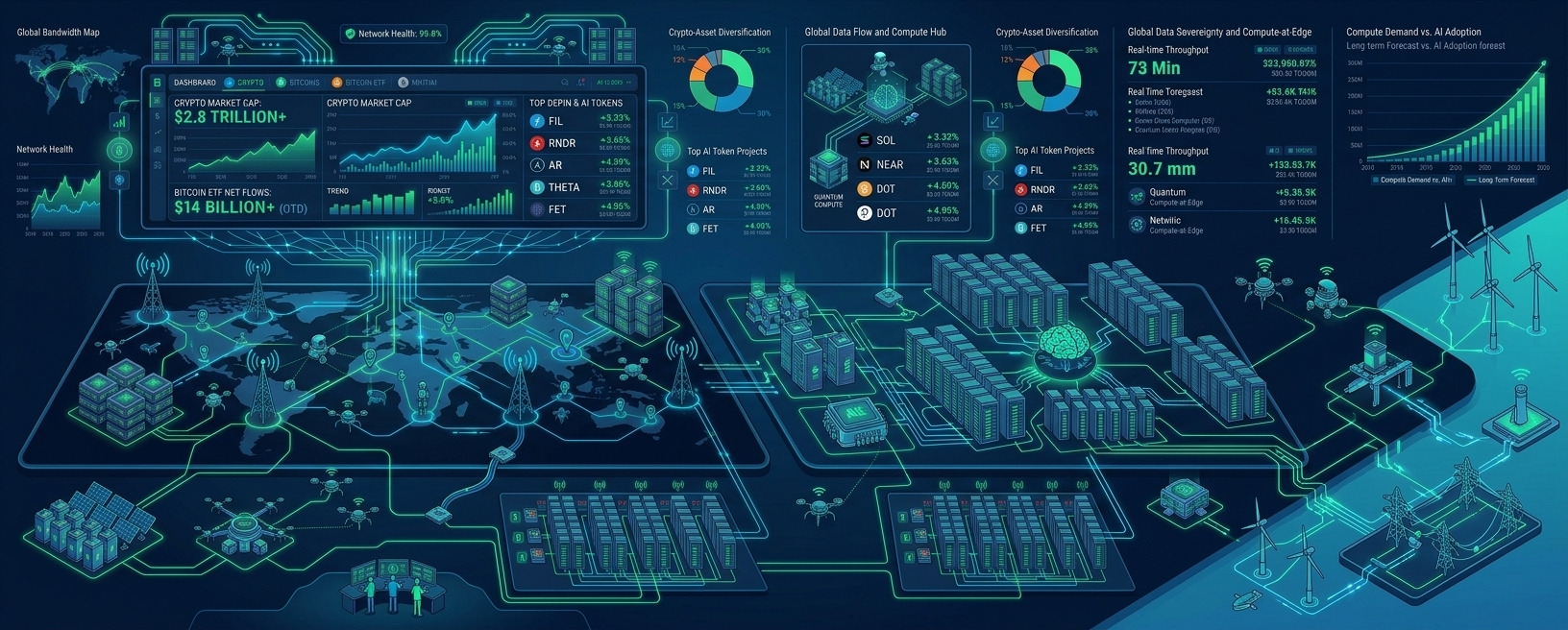
Статья
DePIN and AI Infrastructure Quietly Take the BidWhile ETF flows and Bitcoin’s headline levels dominate the conversation, another part of the market has been doing the work. DePIN names have advanced roughly 5.5% at the sector level, with Geodnet jumping about 44.9%. AI-linked tokens continue to show elevated volume. Bittensor’s TAO is holding in a more neutral-to-greed sentiment band rather than an extreme reading. Broader crypto market cap has pushed above $2.8 trillion, and Layer-1 plus infrastructure names are participating.
What stands out is not just that these sectors are up. It is where the capital is going. Risk appetite is present—Fear & Greed has been running roughly 57 to 71—but the bid is landing more cleanly in real-utility infrastructure than in pure meme rotation. That creates a two-tier tape worth paying attention to.
Why the Rotation Matters Now
Bitcoin dominance near the high-50s, around 58%, still frames the market. Large-cap and ETF-related flows remain the main story for many desks. Underneath that, mid-cap DePIN and AI infrastructure are absorbing a meaningful share of speculative and thematic capital.
This is familiar in structure and different in content. In previous cycles, the second tier was often pure narrative beta. Here, the better-performing names are tied to physical networks, decentralized compute, sensor data, and AI-agent demand. Geodnet’s outsized move is a reminder that single-name catalysts inside DePIN can still reprice a token sharply when the sector is already in favor. TAO’s more measured sentiment reading suggests the AI complex is active without being fully one-sided.
For pro traders, the practical point is relative value. When BTC and the largest ETFs hold attention, liquidity in mid-cap infrastructure can move further on less size. That cuts both ways: upside can be faster, and drawdowns can be just as sharp.
Sector Structure and Technical Read
Relative strength in mid-cap DePIN versus Bitcoin has been visible in the recent stretch. That does not mean the group is immune to a BTC-led risk-off day. It does mean that, inside the current risk-on window, capital has been willing to pay for exposure lower down the curve.
Funding rates across related perpetual markets have stayed modestly positive. That is important. Aggressive positive funding after vertical moves often signals a crowded long. Modestly positive funding alongside sector gains is a healthier mix. It suggests leverage is participating without the market already being stretched to the same degree seen in the most crowded AI beta trades earlier in the year.
Volume in AI-linked tokens remains elevated relative to longer historical baselines. Elevated volume during strength is constructive. Elevated volume during the first serious pullback will be the test. If the group corrects on light activity and buyers reappear near prior breakout zones, the rotation thesis stays intact. If volume expands hard on the downside, the move starts to look like another short-cycle thematic spike.
On-Chain and Fundamental Context
DePIN market-cap indices had already shown strong monthly performance earlier in 2026. The latest advance sits on top of that context rather than appearing from nowhere. The fundamental hook remains consistent: AI systems need compute, data, and physical infrastructure. Centralized providers still dominate, but cost, availability, and control concerns leave room for decentralized alternatives. Networks that coordinate GPS, wireless, GPU, or other real-world resources are trying to turn that gap into a market.
Restaking TVL has cooled from peak levels, yet it remains a related security and yield layer for parts of the infrastructure stack. The cooling matters. It shows that not every adjacent narrative is still in pure expansion mode. Capital is becoming more selective. Projects that can point to usage, node growth, or service demand are better placed than those offering only thematic exposure.
What I'm seeing is a market that still likes the AI and DePIN story, but is starting to differentiate inside it. That differentiation is usually where the next phase of returns—and the next phase of underperformance—gets decided.
Risks, Opportunities, and Positioning
The main risk is correlation. If Bitcoin loses momentum and broader risk sentiment fades, mid-cap DePIN and AI names will not be protected by their utility narrative. They may even underperform on the way down because they are the higher-beta sleeve of the market. Single-name risk is also elevated. A 45% jump in a name like Geodnet can attract momentum buyers late and punish them quickly if the catalyst is fully priced.
The opportunity sits in the relative-value structure itself. While large-cap ETF flows dominate headlines, selective strength in infrastructure mid-caps can offer cleaner expression of the decentralized compute and physical-network thesis. For pro traders, that means watching sector relative strength against BTC, funding conditions, and whether leadership persists or rotates rapidly between names. For longer-term investors, it means separating networks with measurable real-world activity from those still priced mainly on narrative adjacency to AI.
A disciplined approach is to treat the sector bid as real but conditional. The condition is continued risk appetite and continued evidence that these networks are doing work, not just trading as AI proxies.
Closing View
DePIN and AI infrastructure are leading a meaningful slice of the market while Bitcoin and ETF flows still take most of the attention. Geodnet’s sharp advance shows how far single names can run inside that backdrop. TAO’s less extreme sentiment reading shows that not every AI-linked asset is being chased the same way. Market cap above $2.8 trillion and modestly positive funding complete the picture of a risk-on environment that is still selective rather than indiscriminate.
The data suggests a two-tier market: large-cap and ETF liquidity on one side, mid-cap infrastructure beta on the other. That structure can persist as long as risk appetite holds and the utility narrative keeps finding confirmation in usage metrics. It can also unwind quickly if BTC dominance rises hard or if the sector’s leaders fail to hold relative strength after the first serious down day. From here, the useful work is less about celebrating the sector label and more about tracking which names still look like infrastructure—and which ones only looked like it on the way up.
$TAO
#DePIN
#crypto
#bitcoin
#bittensor
#TAO
DePIN and AI Infrastructure Quietly Take the Bid
While ETF flows and Bitcoin’s headline levels dominate the conversation, another part of the market has been doing the work. DePIN names have advanced roughly 5.5% at the sector level, with Geodnet jumping about 44.9%. AI-linked tokens continue to show elevated volume. Bittensor’s TAO is holding in a more neutral-to-greed sentiment band rather than an extreme reading. Broader crypto market cap has pushed above $2.8 trillion, and Layer-1 plus infrastructure names are participating.
What stands out is not just that these sectors are up. It is where the capital is going. Risk appetite is present—Fear & Greed has been running roughly 57 to 71—but the bid is landing more cleanly in real-utility infrastructure than in pure meme rotation. That creates a two-tier tape worth paying attention to.
Why the Rotation Matters Now
Bitcoin dominance near the high-50s, around 58%, still frames the market. Large-cap and ETF-related flows remain the main story for many desks. Underneath that, mid-cap DePIN and AI infrastructure are absorbing a meaningful share of speculative and thematic capital.
This is familiar in structure and different in content. In previous cycles, the second tier was often pure narrative beta. Here, the better-performing names are tied to physical networks, decentralized compute, sensor data, and AI-agent demand. Geodnet’s outsized move is a reminder that single-name catalysts inside DePIN can still reprice a token sharply when the sector is already in favor. TAO’s more measured sentiment reading suggests the AI complex is active without being fully one-sided.
For pro traders, the practical point is relative value. When BTC and the largest ETFs hold attention, liquidity in mid-cap infrastructure can move further on less size. That cuts both ways: upside can be faster, and drawdowns can be just as sharp.
Sector Structure and Technical Read
Relative strength in mid-cap DePIN versus Bitcoin has been visible in the recent stretch. That does not mean the group is immune to a BTC-led risk-off day. It does mean that, inside the current risk-on window, capital has been willing to pay for exposure lower down the curve.
Funding rates across related perpetual markets have stayed modestly positive. That is important. Aggressive positive funding after vertical moves often signals a crowded long. Modestly positive funding alongside sector gains is a healthier mix. It suggests leverage is participating without the market already being stretched to the same degree seen in the most crowded AI beta trades earlier in the year.
Volume in AI-linked tokens remains elevated relative to longer historical baselines. Elevated volume during strength is constructive. Elevated volume during the first serious pullback will be the test. If the group corrects on light activity and buyers reappear near prior breakout zones, the rotation thesis stays intact. If volume expands hard on the downside, the move starts to look like another short-cycle thematic spike.
On-Chain and Fundamental Context
DePIN market-cap indices had already shown strong monthly performance earlier in 2026. The latest advance sits on top of that context rather than appearing from nowhere. The fundamental hook remains consistent: AI systems need compute, data, and physical infrastructure. Centralized providers still dominate, but cost, availability, and control concerns leave room for decentralized alternatives. Networks that coordinate GPS, wireless, GPU, or other real-world resources are trying to turn that gap into a market.
Restaking TVL has cooled from peak levels, yet it remains a related security and yield layer for parts of the infrastructure stack. The cooling matters. It shows that not every adjacent narrative is still in pure expansion mode. Capital is becoming more selective. Projects that can point to usage, node growth, or service demand are better placed than those offering only thematic exposure.
What I'm seeing is a market that still likes the AI and DePIN story, but is starting to differentiate inside it. That differentiation is usually where the next phase of returns—and the next phase of underperformance—gets decided.
Risks, Opportunities, and Positioning
The main risk is correlation. If Bitcoin loses momentum and broader risk sentiment fades, mid-cap DePIN and AI names will not be protected by their utility narrative. They may even underperform on the way down because they are the higher-beta sleeve of the market. Single-name risk is also elevated. A 45% jump in a name like Geodnet can attract momentum buyers late and punish them quickly if the catalyst is fully priced.
The opportunity sits in the relative-value structure itself. While large-cap ETF flows dominate headlines, selective strength in infrastructure mid-caps can offer cleaner expression of the decentralized compute and physical-network thesis. For pro traders, that means watching sector relative strength against BTC, funding conditions, and whether leadership persists or rotates rapidly between names. For longer-term investors, it means separating networks with measurable real-world activity from those still priced mainly on narrative adjacency to AI.
A disciplined approach is to treat the sector bid as real but conditional. The condition is continued risk appetite and continued evidence that these networks are doing work, not just trading as AI proxies.
Closing View
DePIN and AI infrastructure are leading a meaningful slice of the market while Bitcoin and ETF flows still take most of the attention. Geodnet’s sharp advance shows how far single names can run inside that backdrop. TAO’s less extreme sentiment reading shows that not every AI-linked asset is being chased the same way. Market cap above $2.8 trillion and modestly positive funding complete the picture of a risk-on environment that is still selective rather than indiscriminate.
The data suggests a two-tier market: large-cap and ETF liquidity on one side, mid-cap infrastructure beta on the other. That structure can persist as long as risk appetite holds and the utility narrative keeps finding confirmation in usage metrics. It can also unwind quickly if BTC dominance rises hard or if the sector’s leaders fail to hold relative strength after the first serious down day. From here, the useful work is less about celebrating the sector label and more about tracking which names still look like infrastructure—and which ones only looked like it on the way up.
$TAO
#DePIN
#crypto
#bitcoin
#bittensor
#TAO
What stands out is not just that these sectors are up. It is where the capital is going. Risk appetite is present—Fear & Greed has been running roughly 57 to 71—but the bid is landing more cleanly in real-utility infrastructure than in pure meme rotation. That creates a two-tier tape worth paying attention to.
Why the Rotation Matters Now
Bitcoin dominance near the high-50s, around 58%, still frames the market. Large-cap and ETF-related flows remain the main story for many desks. Underneath that, mid-cap DePIN and AI infrastructure are absorbing a meaningful share of speculative and thematic capital.
This is familiar in structure and different in content. In previous cycles, the second tier was often pure narrative beta. Here, the better-performing names are tied to physical networks, decentralized compute, sensor data, and AI-agent demand. Geodnet’s outsized move is a reminder that single-name catalysts inside DePIN can still reprice a token sharply when the sector is already in favor. TAO’s more measured sentiment reading suggests the AI complex is active without being fully one-sided.
For pro traders, the practical point is relative value. When BTC and the largest ETFs hold attention, liquidity in mid-cap infrastructure can move further on less size. That cuts both ways: upside can be faster, and drawdowns can be just as sharp.
Sector Structure and Technical Read
Relative strength in mid-cap DePIN versus Bitcoin has been visible in the recent stretch. That does not mean the group is immune to a BTC-led risk-off day. It does mean that, inside the current risk-on window, capital has been willing to pay for exposure lower down the curve.
Funding rates across related perpetual markets have stayed modestly positive. That is important. Aggressive positive funding after vertical moves often signals a crowded long. Modestly positive funding alongside sector gains is a healthier mix. It suggests leverage is participating without the market already being stretched to the same degree seen in the most crowded AI beta trades earlier in the year.
Volume in AI-linked tokens remains elevated relative to longer historical baselines. Elevated volume during strength is constructive. Elevated volume during the first serious pullback will be the test. If the group corrects on light activity and buyers reappear near prior breakout zones, the rotation thesis stays intact. If volume expands hard on the downside, the move starts to look like another short-cycle thematic spike.
On-Chain and Fundamental Context
DePIN market-cap indices had already shown strong monthly performance earlier in 2026. The latest advance sits on top of that context rather than appearing from nowhere. The fundamental hook remains consistent: AI systems need compute, data, and physical infrastructure. Centralized providers still dominate, but cost, availability, and control concerns leave room for decentralized alternatives. Networks that coordinate GPS, wireless, GPU, or other real-world resources are trying to turn that gap into a market.
Restaking TVL has cooled from peak levels, yet it remains a related security and yield layer for parts of the infrastructure stack. The cooling matters. It shows that not every adjacent narrative is still in pure expansion mode. Capital is becoming more selective. Projects that can point to usage, node growth, or service demand are better placed than those offering only thematic exposure.
What I'm seeing is a market that still likes the AI and DePIN story, but is starting to differentiate inside it. That differentiation is usually where the next phase of returns—and the next phase of underperformance—gets decided.
Risks, Opportunities, and Positioning
The main risk is correlation. If Bitcoin loses momentum and broader risk sentiment fades, mid-cap DePIN and AI names will not be protected by their utility narrative. They may even underperform on the way down because they are the higher-beta sleeve of the market. Single-name risk is also elevated. A 45% jump in a name like Geodnet can attract momentum buyers late and punish them quickly if the catalyst is fully priced.
The opportunity sits in the relative-value structure itself. While large-cap ETF flows dominate headlines, selective strength in infrastructure mid-caps can offer cleaner expression of the decentralized compute and physical-network thesis. For pro traders, that means watching sector relative strength against BTC, funding conditions, and whether leadership persists or rotates rapidly between names. For longer-term investors, it means separating networks with measurable real-world activity from those still priced mainly on narrative adjacency to AI.
A disciplined approach is to treat the sector bid as real but conditional. The condition is continued risk appetite and continued evidence that these networks are doing work, not just trading as AI proxies.
Closing View
DePIN and AI infrastructure are leading a meaningful slice of the market while Bitcoin and ETF flows still take most of the attention. Geodnet’s sharp advance shows how far single names can run inside that backdrop. TAO’s less extreme sentiment reading shows that not every AI-linked asset is being chased the same way. Market cap above $2.8 trillion and modestly positive funding complete the picture of a risk-on environment that is still selective rather than indiscriminate.
The data suggests a two-tier market: large-cap and ETF liquidity on one side, mid-cap infrastructure beta on the other. That structure can persist as long as risk appetite holds and the utility narrative keeps finding confirmation in usage metrics. It can also unwind quickly if BTC dominance rises hard or if the sector’s leaders fail to hold relative strength after the first serious down day. From here, the useful work is less about celebrating the sector label and more about tracking which names still look like infrastructure—and which ones only looked like it on the way up.
$TAO
#DePIN
#crypto
#bitcoin
#bittensor
#TAO
2
1.2k
Войдите, чтобы посмотреть больше материала
Присоединяйтесь к пользователям криптовалют по всему миру на Binance Square
⚡️ Получайте новейшую и полезную информацию о криптоактивах.
💬 Нам доверяет крупнейшая в мире криптобиржа.
👍 Получите достоверные аналитические данные от верифицированных создателей контента.
Эл. почта/номер телефона