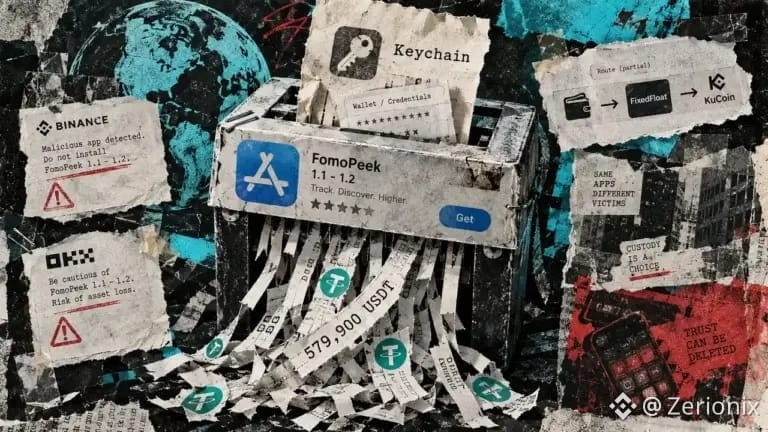
Amalicious iOS app just turned “read only” into a $580K crypto theft.
SlowMist says malicious versions of FomoPeek, an app distributed through Apple’s App Store, have been linked to roughly $580,000 in stolen USDT.
The scary part isn't that the app was pretending to be a wallet.
It was reportedly marketed as a read only crypto tracking tool.
Researchers found kernel exploits that could escape iOS's app sandbox and access sensitive data belonging to other apps, including Keychain data, private keys and seed phrases.
Versions 1.1 and 1.2, released September 9 and 12, contained the malicious components. Version 1.3, released September 17, removed them.
Personally, this is a good reminder that crypto security isn't just about what you sign.
Sometimes the biggest risk is what you install.
And the App Store label doesn't automatically mean an app is safe.
If someone installed an affected version, simply deleting the app shouldn't be treated as enough. If private keys or seed phrases were exposed, those credentials should be considered compromised and assets moved to a newly generated wallet from a clean device.
Crypto users spend so much time worrying about fake links and malicious transactions.
Meanwhile, the attack surface can literally be sitting inside your phone.
The wallet might be secure. The device running it is another story.
$BTC #BTC Price Analysis# #Altcoin Season# $SOL
SlowMist says malicious versions of FomoPeek, an app distributed through Apple’s App Store, have been linked to roughly $580,000 in stolen USDT.
The scary part isn't that the app was pretending to be a wallet.
It was reportedly marketed as a read only crypto tracking tool.
Researchers found kernel exploits that could escape iOS's app sandbox and access sensitive data belonging to other apps, including Keychain data, private keys and seed phrases.
Versions 1.1 and 1.2, released September 9 and 12, contained the malicious components. Version 1.3, released September 17, removed them.
Personally, this is a good reminder that crypto security isn't just about what you sign.
Sometimes the biggest risk is what you install.
And the App Store label doesn't automatically mean an app is safe.
If someone installed an affected version, simply deleting the app shouldn't be treated as enough. If private keys or seed phrases were exposed, those credentials should be considered compromised and assets moved to a newly generated wallet from a clean device.
Crypto users spend so much time worrying about fake links and malicious transactions.
Meanwhile, the attack surface can literally be sitting inside your phone.
The wallet might be secure. The device running it is another story.
$BTC #BTC Price Analysis# #Altcoin Season# $SOL