
Oil fell for a fifth straight session Tuesday as Saudi Arabia moved to restart a critical pipeline and traders weighed the latest signals out of the U.S.-Iran standoff, including a three-hour sideline meeting at the United Nations that both sides called productive without saying what it actually produced.
A Pipeline Comes Back Online
Saudi Arabia spent the day building pressure through its East-West pipeline, aiming for a meaningful restart of flows by Saturday, according to people familiar with the matter, with exports resuming at the end of the week. The line had let Riyadh route crude around the Strait of Hormuz entirely, until a drone attack knocked it offline earlier this month.
Multiple traders reported tankers already gathering at Yanbu, the Red Sea port that receives the pipeline's output. A restart would bring relief to a market that has been short of supply since the shutdown forced Saudi Arabia to pivot its exports back through the Gulf. Ras Tanura, the kingdom's main Gulf terminal, logged its busiest loading day since before the war began in late February.
Three Hours on the Sidelines
Oil was also weighed down by President Donald Trump's account of a three-hour meeting between U.S. officials and Iranian envoys on the sidelines of the U.N. General Assembly in New York. Trump called it a very good, very productive meeting and said another round was already being arranged.
He added that he sees real momentum for Tehran to make a deal, and that he expects his envoys, Steve Witkoff and Jared Kushner, to get an agreement over the line. He also urged Iran to move quickly, warning that a point will come when it is too late to negotiate.
Witkoff and Kushner sat down with Iran's foreign minister and Qatari mediators to work through the terms of ending the war. Witkoff later wrote that the two sides had completed "a round of discussions we hope will prove constructive and promising," and that the mediators would keep working the channel.
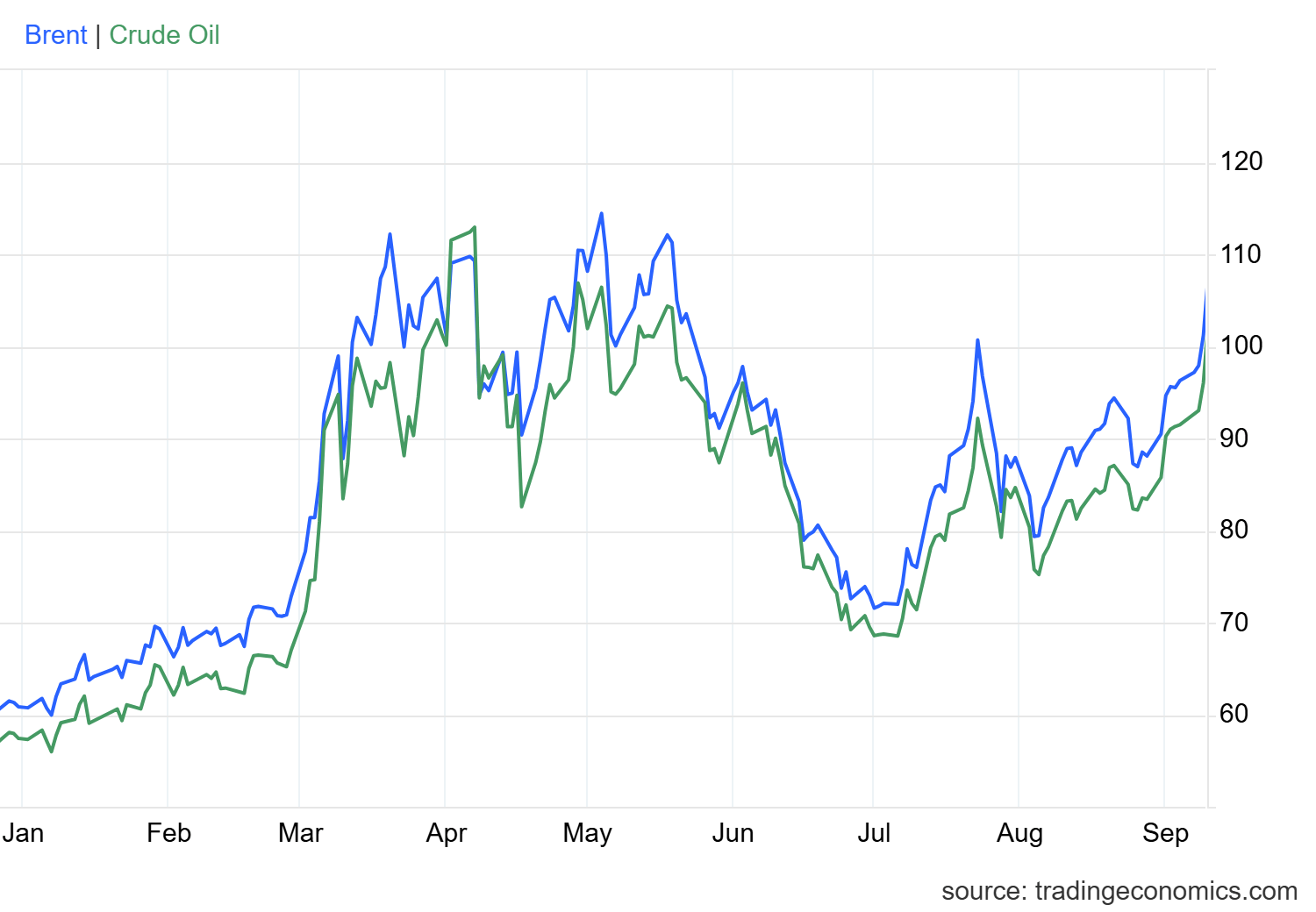
Both benchmarks fell below $100 a barrel. Brent crude settled 1.09% lower at $99.25. West Texas Intermediate shed about 1.2% to close at $94.59. It was a fifth consecutive losing session for both, and the slide carried into early Wednesday trading in Asia, though the moves were smaller than the sharp drops seen earlier in the week.
Even so, crude remains up sharply for the month and still trades well above where it sat before the war started.
The diplomacy came hours after Trump, addressing the General Assembly, threatened to eliminate the Iranian government outright. He spent much of a roughly 35-minute speech defending the nearly seven-month-old war, portraying Iran's government as the source of years of regional violence and casting himself as a leader who acts while others merely talk.
"Or do I annihilate the Islamic Republic and do it quickly?" Trump asked, framing what he called a stark choice: a negotiated deal that would let Iran rebuild into one of the greatest countries in the region, or its total destruction. He said he has already urged Iran to negotiate on several occasions.
Trump predicted Tehran will hold out for a deal until after the midterm elections, arguing Iran is waiting to see how Republicans perform at the polls. He insisted the election calendar would not change his own approach to Iran and said oil prices will fall sharply once the war is over.
On the military side, he said there had been little activity at Pickaxe Mountain, the fortified underground site near Iran's Natanz enrichment complex, but warned that any pickup would draw an immediate strike. He repeated that Iran will never be allowed to have a nuclear weapon and suggested the war could wind down after the midterms, possibly sooner.
Trump called on other nations to tighten Iran's economic isolation and said the U.S. and Iran will reach an agreement one way or another. British Prime Minister Andy Burnham, in his first meeting with Trump since taking office in July, told him the U.K. wants the conflict over as quickly as possible and that "we stand ready to play our part."
The Real Bottleneck
None of that resolves the actual mechanics of reopening the Strait of Hormuz, which still requires an agreement with Tehran. A senior Iranian government official told Reuters and Japan's Kyodo News that Iran could reopen the strait within seven days if Washington eased its military pressure and lifted the blockade on Iranian ports.
Through Qatari mediators, Iran laid out three conditions for reopening the Strait: an immediate halt to fighting on every front, the return of frozen Iranian assets, and an end to the U.S. naval blockade. It is a short list. Whether it survives contact with Washington is a separate matter.
Trump's sideline meeting with Gulf Cooperation Council leaders on Tuesday grew well past its original guest list, eventually pulling in officials from Turkey, Syria and Jordan as the session shifted from a narrow Gulf briefing into a broader regional summit. Gulf officials pressed for de-escalation while Trump kept up both the financial and military pressure on Iran.
Jordan's King Abdullah, speaking shortly after Trump, warned that the war's reach extends far beyond the region. He pointed to "the energy and grocery bills of ordinary families from Mumbai to Madrid to Minnesota" as proof that a Middle East crisis rarely stays contained to the Middle East.
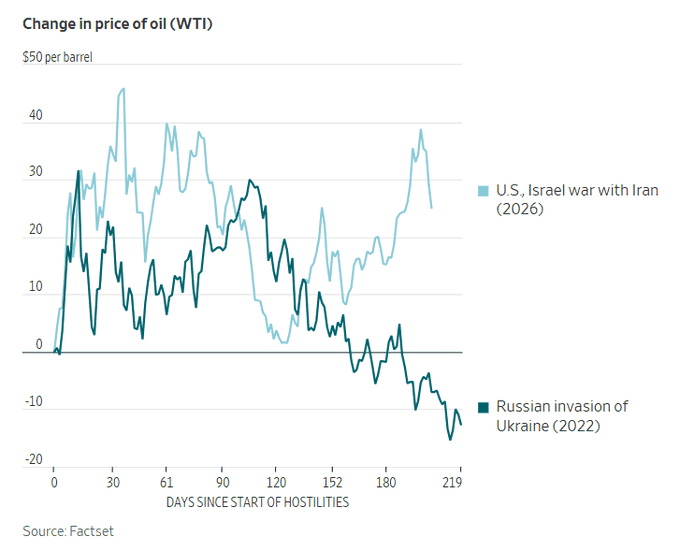
Here is the comparison worth sitting with. Roughly 200 days after the U.S. and Israel first struck Iran, crude is still trading about $25 above its pre-invasion price. Run the same 200-day clock on Russia's invasion of Ukraine, and oil had already reversed course to trade $7 below where it started. Same kind of shock. Very different recovery.