Job anxiety is spiking across income levels.
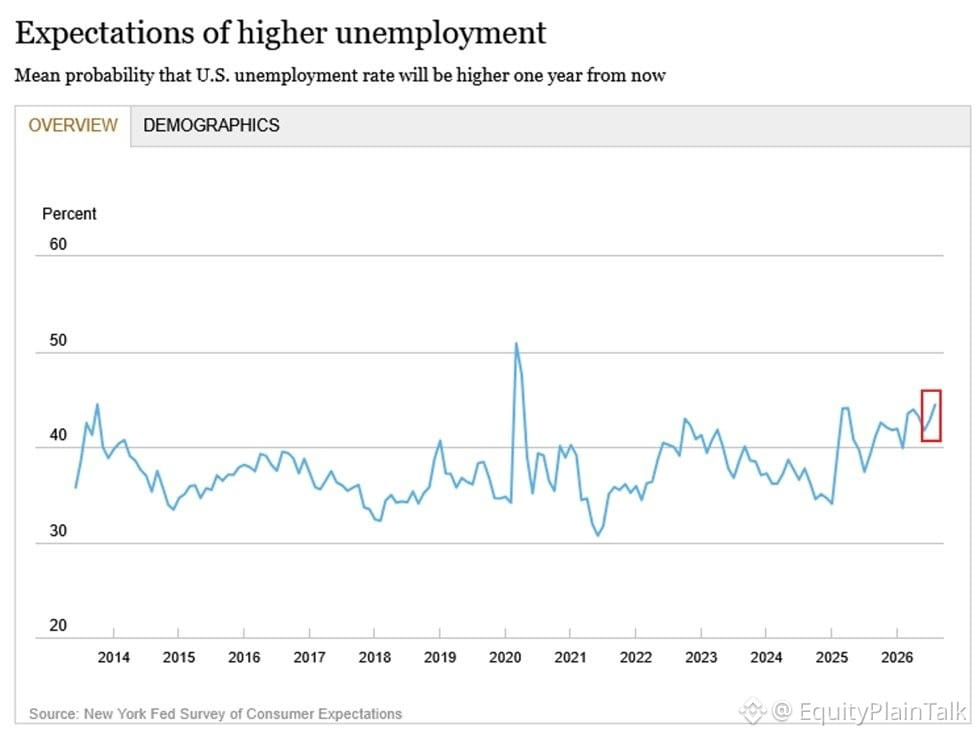
Consumers now see a 44.4% chance unemployment will be higher in a year—highest since April 2020. Outside the pandemic, that's the worst read since this survey started in 2013.
What's striking: high earners ($100k+) are the most worried at 50.3%, near record levels. Middle earners ($50k-$100k) at 43.5%, low earners at 38.0%—all elevated.
This isn't just noise. When people fear losing their jobs, they pull back spending. That feeds through consumer discretionary stocks, housing, credit, everything.
We saw this indicator peak at 44.1% in April 2025 during tariff uncertainty. Now we're back there without a single obvious catalyst.
Fear of unemployment doesn't always predict recession, but it does predict behavior. And behavior drives markets.
Consumers now see a 44.4% chance unemployment will be higher in a year—highest since April 2020. Outside the pandemic, that's the worst read since this survey started in 2013.
What's striking: high earners ($100k+) are the most worried at 50.3%, near record levels. Middle earners ($50k-$100k) at 43.5%, low earners at 38.0%—all elevated.
This isn't just noise. When people fear losing their jobs, they pull back spending. That feeds through consumer discretionary stocks, housing, credit, everything.
We saw this indicator peak at 44.1% in April 2025 during tariff uncertainty. Now we're back there without a single obvious catalyst.
Fear of unemployment doesn't always predict recession, but it does predict behavior. And behavior drives markets.