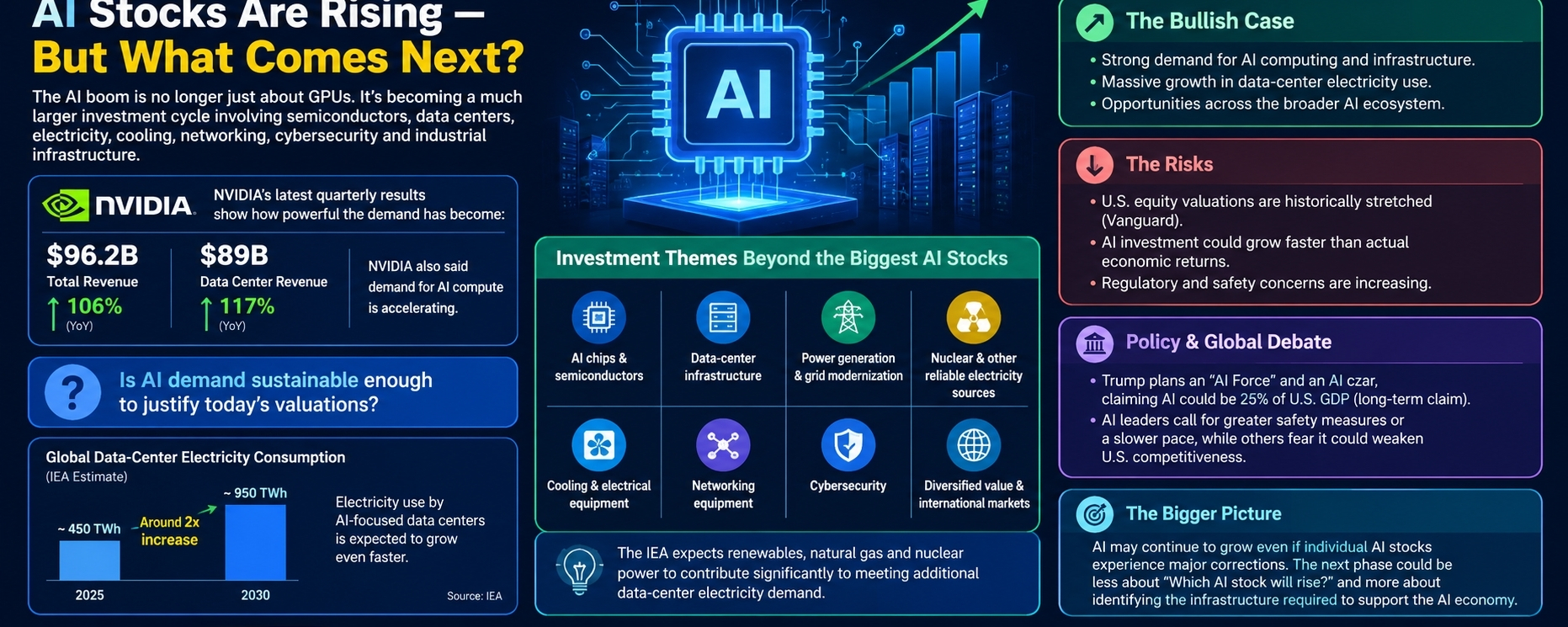

The AI boom is no longer just a story about GPUs. It is becoming a much larger investment cycle involving semiconductors, data centers, electricity, cooling, networking, cybersecurity and industrial infrastructure.
NVIDIA’s latest quarterly results show how powerful the demand has become: revenue reached $96.2 billion, up 106% year over year, while Data Center revenue jumped 117% to $89 billion. NVIDIA also said demand for AI compute is accelerating.
But there is an important question investors should ask:
Is AI demand sustainable enough to justify today’s valuations?
The bullish case is clear. The International Energy Agency estimates that global data-center electricity consumption could roughly double from 2025 to around 950 TWh by 2030, while electricity use by AI-focused data centers is expected to grow even faster.
That creates opportunities beyond the biggest AI stocks.
Power generation, electricity grids, transformers, cooling systems, data-center construction, networking equipment, cybersecurity and nuclear-energy infrastructure could all benefit if AI computing continues expanding. The IEA expects renewables, natural gas and nuclear power to contribute significantly to meeting additional data-center electricity demand.
There is also a diversification argument.
Vanguard recently noted that U.S. equity valuations have become historically stretched, with enthusiasm around AI contributing to valuation expansion. It also highlighted value stocks, non-U.S. equities and bonds as areas investors may consider when thinking about portfolio diversification.
Meanwhile, the political and regulatory debate is becoming impossible to ignore. President Donald Trump recently announced plans for an “AI Force” and an AI czar, while saying AI could eventually represent as much as 25% of U.S. GDP. That 25% figure is a long-term claim, not a current measure of AI’s share of the economy.
At the same time, several AI leaders have called for greater safety measures or a slower development pace, while others argue that slowing down could weaken U.S. competitiveness.
So my key takeaway is simple:
AI may continue to grow even if individual AI stocks experience major corrections.
The next phase could be less about simply asking “Which AI stock will rise?” and more about identifying the infrastructure required to support the AI economy.
Watch these themes:
• AI chips and semiconductors
• Data-center infrastructure
• Power generation and grid modernization
• Nuclear and other reliable electricity sources
• Cooling and electrical equipment
• Networking
• Cybersecurity
• Diversified value and international markets
The biggest risk is that AI investment grows faster than actual economic returns. The biggest opportunity is that AI becomes a broad productivity cycle rather than a short-lived technology boom.
This is not financial advice. Always research valuations, earnings, debt, competition and risk before investing.