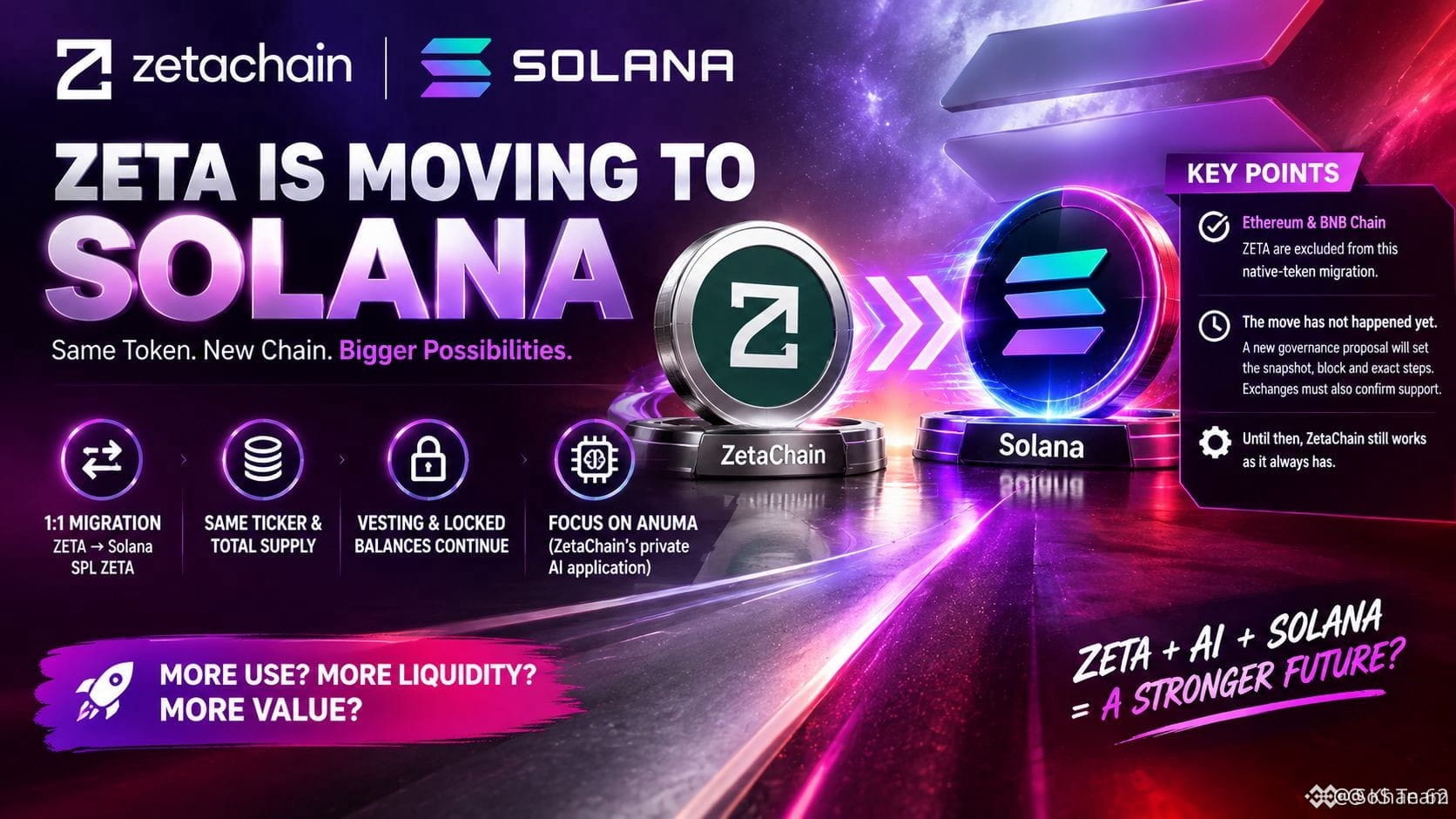
Picture this: a multi-chain protocol built entirely on the promise of interoperability suddenly decides its native token is better off living on another layer 1.
For anyone holding cross-chain governance assets, migration proposals bring back the dreaded headache of bridged liquidity risks and sudden tokenomics shifts. Most traders get caught flat-footed trying to figure out whether a network jump is an upgrade or an admission of defeat.
The recent governance move around $ZETA exploring a migration path to the high-throughput ecosystem of $SOL echoes what we saw when major protocols like MakerDAO debated NewChain or Render made the leap. Maintaining an isolated chain comes with massive validator overhead, liquidity fragmentation, and constant security maintenance. By anchoring core assets to a network with established execution speed and deep liquidity, projects often trade sovereign independence for immediate scale.
What makes this shift interesting is how it changes the value capture thesis. When infrastructure layers pivot to becoming applications or asset classes on top of $BTC or leading monolithic chains, the entire ecosystem calculus resets. Instead of fighting for validator adoption, the focus moves straight to user activity and composability where volume already exists.
Where do you think this trend of infrastructure projects consolidating onto established ecosystems goes from here?
#ZetaChainVotesToMigrateZETAToSolana #SolanaCutsTargetSlotTimeTo250ms
For anyone holding cross-chain governance assets, migration proposals bring back the dreaded headache of bridged liquidity risks and sudden tokenomics shifts. Most traders get caught flat-footed trying to figure out whether a network jump is an upgrade or an admission of defeat.
The recent governance move around $ZETA exploring a migration path to the high-throughput ecosystem of $SOL echoes what we saw when major protocols like MakerDAO debated NewChain or Render made the leap. Maintaining an isolated chain comes with massive validator overhead, liquidity fragmentation, and constant security maintenance. By anchoring core assets to a network with established execution speed and deep liquidity, projects often trade sovereign independence for immediate scale.
What makes this shift interesting is how it changes the value capture thesis. When infrastructure layers pivot to becoming applications or asset classes on top of $BTC or leading monolithic chains, the entire ecosystem calculus resets. Instead of fighting for validator adoption, the focus moves straight to user activity and composability where volume already exists.
Where do you think this trend of infrastructure projects consolidating onto established ecosystems goes from here?
#ZetaChainVotesToMigrateZETAToSolana #SolanaCutsTargetSlotTimeTo250ms