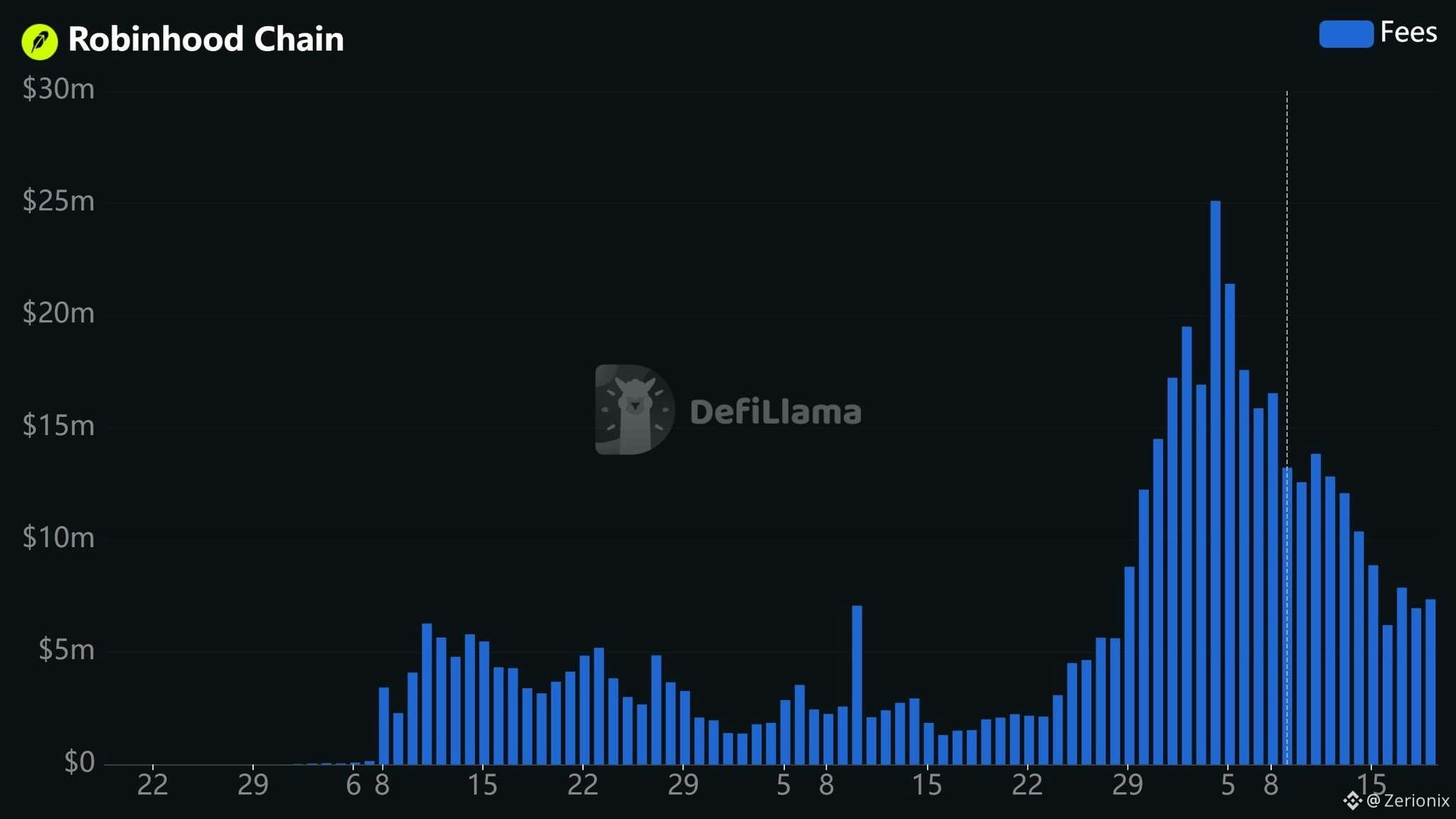
Robinhood Chain's fees just fell 97% while transaction counts barely moved, and the gap between those two numbers is the actual story, not the collapse itself.
At the early-September peak, the chain pulled in roughly $8 million in daily fees from 13.1 million transactions, averaging 64 cents each. By September 16, daily fees had dropped to about $230,000 across 8.9 million transactions, just 2.6 cents per transaction. Transaction count fell 32% on a daily basis, but only 6% on a seven-day average, a much narrower decline than the fee chart alone suggests.
What stands out to me is that the volume data actively argues against the "traders fled" read.
Robinhood's DEXs processed about $13 billion over the seven days through September 16, up 5% from the prior week, and stablecoin supply slipped only 1%. Roughly $1.5 billion is still moving through the network daily. Capital didn't leave, the price of moving it did.
The real driver here is a mix shift, not an exodus. Pons, the memecoin launchpad that drove the early fee spike, saw its own volume drop 37% week over week, down to about $616 million.
Memecoin issuance and trading, the highest-fee activity on the chain, cooled specifically, while lower-fee transaction types kept the overall throughput near its highs.
Worth adding the mechanical piece too, Robinhood reportedly raised the chain's gas limit to expand block capacity, a deliberate tradeoff, cheaper block space in exchange for scaling volume rather than maximizing fee revenue per transaction. That's a real strategic choice, not just organic cooling.
The open question is whether this fee model is sustainable long-term. A chain processing near-record volume on near-zero fees is great for users and adoption, but eventually something has to fund the infrastructure, and whether that's subsidization, a future fee redesign, or Robinhood absorbing the cost as a customer acquisition play isn't answered by this data alone.
$BTC #Altcoin Season# #Altcoin Season#
At the early-September peak, the chain pulled in roughly $8 million in daily fees from 13.1 million transactions, averaging 64 cents each. By September 16, daily fees had dropped to about $230,000 across 8.9 million transactions, just 2.6 cents per transaction. Transaction count fell 32% on a daily basis, but only 6% on a seven-day average, a much narrower decline than the fee chart alone suggests.
What stands out to me is that the volume data actively argues against the "traders fled" read.
Robinhood's DEXs processed about $13 billion over the seven days through September 16, up 5% from the prior week, and stablecoin supply slipped only 1%. Roughly $1.5 billion is still moving through the network daily. Capital didn't leave, the price of moving it did.
The real driver here is a mix shift, not an exodus. Pons, the memecoin launchpad that drove the early fee spike, saw its own volume drop 37% week over week, down to about $616 million.
Memecoin issuance and trading, the highest-fee activity on the chain, cooled specifically, while lower-fee transaction types kept the overall throughput near its highs.
Worth adding the mechanical piece too, Robinhood reportedly raised the chain's gas limit to expand block capacity, a deliberate tradeoff, cheaper block space in exchange for scaling volume rather than maximizing fee revenue per transaction. That's a real strategic choice, not just organic cooling.
The open question is whether this fee model is sustainable long-term. A chain processing near-record volume on near-zero fees is great for users and adoption, but eventually something has to fund the infrastructure, and whether that's subsidization, a future fee redesign, or Robinhood absorbing the cost as a customer acquisition play isn't answered by this data alone.
$BTC #Altcoin Season# #Altcoin Season#