

What happens when investors stop looking at earnings and start looking almost entirely at the Federal Reserve?
That is the question hanging over Wall Street today.
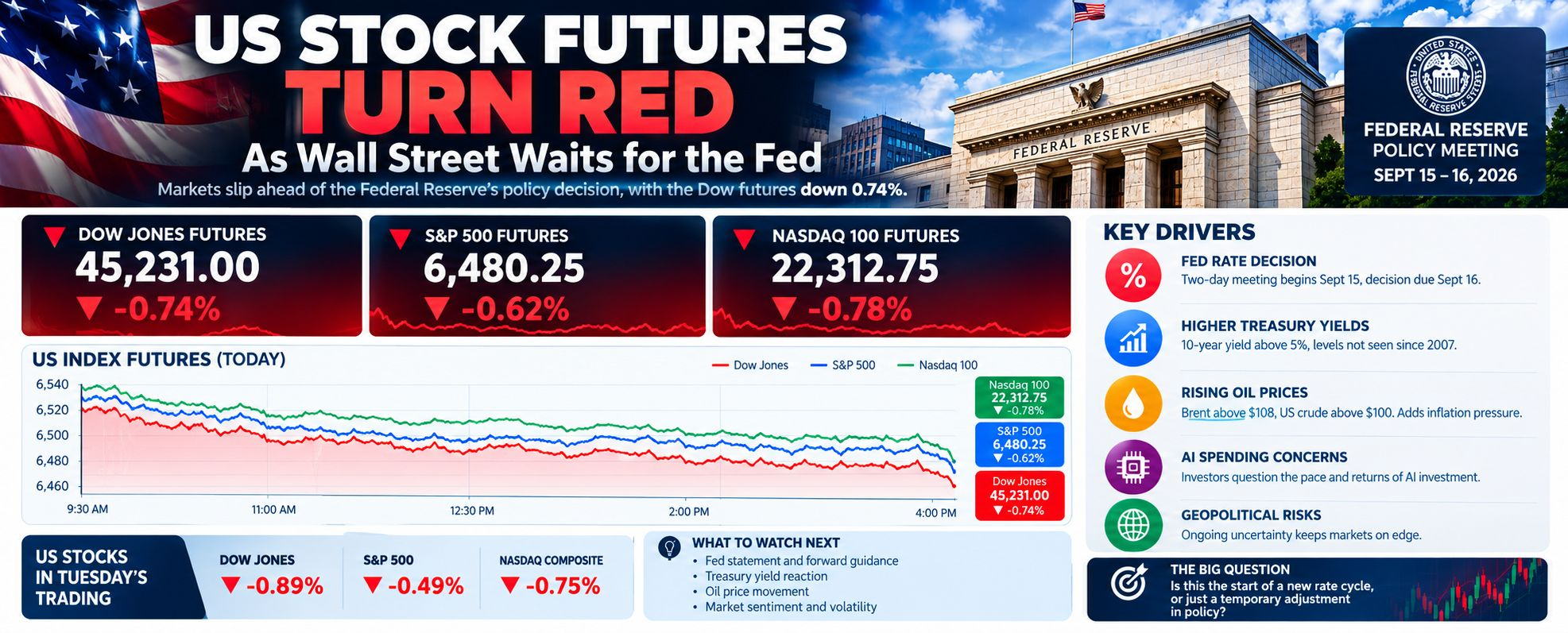
US index futures reversed lower on September 15 as traders positioned themselves ahead of the Federal Reserve’s upcoming policy decision. Dow Jones futures were recently down around 0.74%, while S&P 500 and Nasdaq 100 futures were also under pressure.
The move is important because markets had already been showing signs of caution. Investors are now dealing with several pressures at the same time: higher Treasury yields, expensive crude oil, inflation concerns, uncertainty around artificial intelligence spending and a major Fed decision that could influence the direction of risk assets.
The Fed Is the Main Catalyst
The Federal Reserve’s two-day policy meeting began on September 15, with the decision expected on September 16.
Markets have increasingly been pricing in a rate increase. Reuters reported that expectations for a hike strengthened after recent inflation data remained hotter than investors wanted to see.
That creates a difficult environment for stocks.
When interest rates rise, the cost of money increases. Higher borrowing costs can pressure consumers and businesses, while higher bond yields can make fixed-income assets more attractive relative to equities.
But the bigger issue is not simply whether the Fed raises rates.
The real question is what the Fed says about the months ahead.
A rate hike that investors already expect may produce a limited reaction. A more hawkish message about future policy could create much greater volatility.
Treasury Yields Are Sending a Warning
One of the biggest developments behind today’s market weakness is the surge in Treasury yields.
The US 10-year Treasury yield moved above 5%, reaching levels not seen since 2007. Reuters reported that the yield climbed toward 5% as investors assessed inflation risks and the possibility of tighter monetary policy.
This matters because Treasury yields influence borrowing costs across the economy and are also used as a reference point when investors value stocks.
If yields continue moving higher, companies whose valuations depend heavily on future growth can face additional pressure.
That does not automatically mean stocks must fall.
But it changes the calculation investors make when deciding how much they are willing to pay for future earnings.
Oil Adds Another Layer of Risk
Oil prices are also complicating the Fed’s decision.
Brent crude moved above $108 per barrel, while US crude traded above $100 as geopolitical developments and supply concerns pushed energy prices higher.
Higher oil prices can feed directly into inflation.
That creates an uncomfortable situation for policymakers. If inflation remains elevated while energy prices rise, the Fed has less room to respond aggressively to economic weakness.
In other words, markets are watching two forces moving in opposite directions:
Higher yields can slow the economy, while higher energy prices can keep inflation elevated.
That combination is one reason investors are becoming more cautious.
Wall Street Is Already Feeling the Pressure
The weakness is not limited to futures.
US stocks declined during Tuesday trading, with the Dow falling about 0.89%, the S&P 500 dropping roughly 0.49%, and the Nasdaq Composite losing around 0.75%, according to Reuters.
Technology stocks have been particularly sensitive because higher interest rates can reduce the present value investors assign to future growth.
At the same time, concerns about the pace and safety of AI development have added another source of uncertainty for technology companies. Several major technology companies have faced renewed debate over the enormous investment required to build AI infrastructure and whether spending can continue at the current pace.
This creates an unusual market environment where investors are questioning both interest-rate conditions and future technology spending.
Why Today’s Futures Reversal Matters
The most interesting part of today’s move is not simply that futures are red.
It is the reversal.
US futures had shown periods of stabilization earlier in the session as oil prices and Treasury yields temporarily eased. MarketWatch reported that S&P 500 futures recovered from an earlier decline before pressure returned.
That kind of price action shows how sensitive the market currently is to changes in yields and commodities.
Investors are not trading in a normal environment where one earnings report determines sentiment.
They are reacting to every change in:
- Treasury yields
- Oil prices
- Inflation expectations
- Fed rate probabilities
- AI investment concerns
- Geopolitical developments
That makes the market much more headline-sensitive.
What Investors Should Watch Next
The Fed decision will obviously be the biggest event.
But the statement and forward guidance may matter even more than the actual rate decision.
If policymakers deliver the rate move investors already expect and communicate a relatively balanced outlook, stocks could stabilize.
If the Fed signals that rates may need to remain higher for longer, markets could face another wave of selling pressure.
The reaction in Treasury yields may provide an important clue.
If yields rise sharply after the Fed announcement, growth stocks could remain under pressure. If yields fall, risk appetite could return quickly.
Oil will also remain important.
A sustained move higher in crude could reinforce inflation concerns and complicate the Fed’s policy outlook.
The Bigger Picture
Today’s market weakness is not necessarily a signal that a major crash is beginning.
It is better understood as a market struggling with conflicting information.
Investors want economic growth, but they also want lower inflation.
They want lower interest rates, but they do not want inflation to accelerate again.
They want massive AI investment, but they also want companies to prove that the spending will eventually generate sustainable returns.
And they want geopolitical risks to fade, while energy markets are showing that those risks can quickly return to the inflation conversation.
That is why the Fed meeting has become such a major market event.
The Dow being down around 0.74% in futures is only one piece of the story. The bigger signal is that investors are reducing risk while waiting for clarity on the cost of money.
For now, Wall Street is effectively waiting for one message from the Fed: is this the beginning of a new rate cycle, or simply a temporary adjustment in policy?
And if the Fed delivers the rate move markets are already expecting, will its next guidance calm investors—or trigger an even bigger reaction across stocks, bonds and crypto?