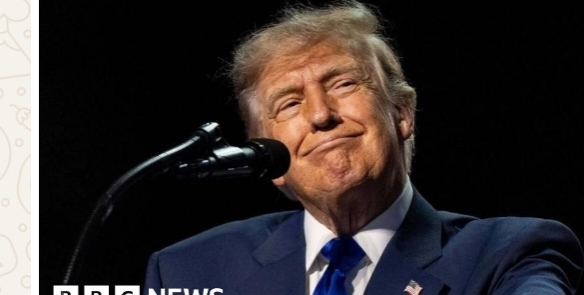
US President Donald Trump has promised a $5,000 “Trump Dividend” to every adult American if Republicans retain control of both the House of Representatives and Senate in the November 2026 midterm elections.
The big question is simple: Can the government actually afford it?
Trump announced the proposal at the Republican Party’s midterm convention in Dallas, saying the payment would be possible because of the strength of the US economy and the money generated through tariffs. The White House has since formally promoted the idea as a $5,000 cash payment for every adult US citizen.
The cost could be enormous
There are roughly 245 million US citizens over the age of 18. A $5,000 payment for every adult would therefore cost more than $1.2 trillion. Other estimates put the total cost closer to $1.3 trillion, depending on eligibility and exclusions.
That is far more money than the federal government currently collects from tariffs in a single year.
Vice-President JD Vance has suggested that tariff revenue could help fund the payments, but analysts say tariff income would not be enough to cover the entire program. That means the government could potentially need to borrow more money or find another source of funding.
Would Trump be able to do it himself?
No.
The president cannot simply order $5,000 checks to be sent to every American without legal and congressional authority. The proposal would need to go through the legislative process, creating another major hurdle before any payments could actually be made.
There is also uncertainty over who would qualify. Vance has suggested that wealthy Americans might be excluded, but Trump has not provided a complete eligibility framework.
Is it legal?
The legal question is complicated.
Federal law prohibits payments intended to influence how someone votes. Critics have argued that promising money shortly before an election could raise concerns about whether the proposal is effectively a political inducement.
However, legal experts cited by the BBC and Reuters have pointed out that a benefit available broadly to eligible citizens could be treated differently from directly paying people in exchange for their votes. The proposal would still need to be implemented through lawful legislation.
Could it cause inflation?
This is another major concern.
Putting more than $1 trillion in cash into the economy could increase consumer spending. Economists warn that, if demand rises while inflation is already elevated, the payments could put additional pressure on prices.
More government borrowing could also push bond yields and interest rates higher, increasing borrowing costs for households and businesses.
So, will Americans actually get $5,000?
Not yet.
Trump has made the promise, but the program still faces major questions over funding, eligibility, congressional approval and its economic impact. There is currently no finalized payment program that guarantees Americans will receive the money.
For now, the $5,000 “Trump Dividend” is a political proposal rather than an approved government payment.
The biggest question is whether Republicans can retain control of Congress in November and, if they do, whether lawmakers will actually approve the massive spending plan.
Would a $5,000 payment help Americans, or would it create even more inflation and debt?