


At first, I thought the interesting part would simply be the word “Tokenized.”
But the more I looked at the numbers and the way settlement is described, the less that seemed like the real point.
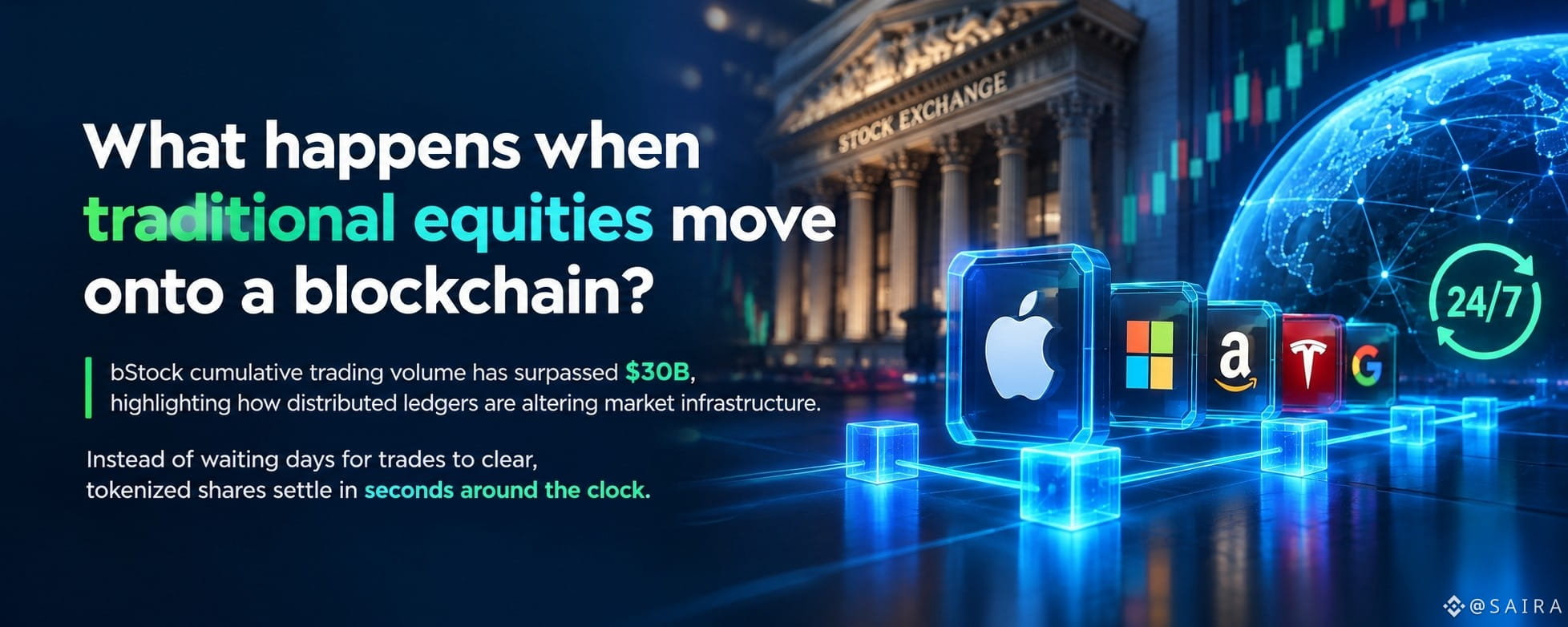
bStock’s cumulative trading volume has surpassed $30B.
That number caught my attention, not because it gives me a reason to celebrate the market, but because it makes the underlying infrastructure harder to ignore. A distributed ledger handling that level of trading activity raises a more practical question for me:
What actually changes when the ledger itself becomes part of the market process?
I usually think about equities through the lens of the familiar system around them.
A trade happens.
Then there is a process behind that trade.
Clearing has to happen. Settlement has to happen. Different parts of the financial system have to coordinate with each other before the transaction is completely finished.
I had almost treated that waiting period as an unavoidable characteristic of trading.
Maybe that was the wrong assumption.
The detail that keeps standing out is the difference between waiting days and settling in seconds.
That sounds like a simple improvement when written in one sentence.
But it isn't really about speed alone.
If tokenized shares can settle in seconds around the clock, then the timing of the transaction starts to look fundamentally different. The market is no longer being described only by when people can trade. The infrastructure underneath the trade is also changing how quickly ownership can be finalized.
And that distinction matters.
I kept thinking about the word “settle.”
Trading and settlement are easy to mentally combine because, from the outside, they can look like one event.
But they aren't the same thing.
You can agree on a trade without everything being finished.
The interesting part here is that moving equities onto a blockchain appears to bring the settlement process much closer to the transaction itself.
That made me reconsider what “24/7” really means in this context.
It isn't just a statement about being able to transact outside traditional market hours.
If settlement can happen around the clock, then the infrastructure is no longer operating according to the same timing assumptions I normally associate with traditional markets.
There is something subtle about that.
The change isn't necessarily visible in the equity itself.
A share is still a share.
The difference is underneath it.
The ledger changes.
The way transactions are recorded changes.
The timing of final settlement changes.
And suddenly, something that looked like a normal financial asset starts behaving differently because the infrastructure carrying it is different.
That is probably why the $30B figure kept pulling my attention back.
Without that number, it would be easy to look at tokenized equities as an interesting technical idea.
With cumulative trading volume surpassing $30B, the discussion becomes less abstract.
It makes me wonder whether the important question is actually about the asset at all.
Maybe the more interesting question is what happens when financial market infrastructure stops assuming that settlement has to happen on the timetable we have become accustomed to.
I also don't think faster settlement automatically answers everything.
Speed can remove waiting, but waiting itself isn't necessarily the only issue.
There is still the question of what this changes for the people and systems interacting with these assets.
Does faster settlement change how participants behave?
Does 24/7 availability change how markets are used?
Does moving the equity onto a distributed ledger meaningfully alter the relationship between trading and settlement?
I don't think the information here answers those questions.
And maybe that's what makes the idea more interesting to me.
The architecture can make something possible without telling us how people will actually respond to it.
That distinction is easy to miss.
It is tempting to look at “seconds instead of days” and stop there.
But the deeper implication seems to be that blockchain isn't merely being used as another place to represent an equity. It is changing part of the machinery through which that equity moves from one participant to another.
That feels more significant than the word “Tokenized” itself.
At the same time, I'm still hesitant to reduce the whole thing to settlement speed.
The $30B figure tells me there is real trading volume behind this particular example, but it doesn't tell me everything about what participants value most.
Maybe they care about the asset.
Maybe they care about the access.
Maybe the settlement process matters more than I initially assumed.
Or maybe the infrastructure only becomes truly interesting when these pieces start affecting behavior rather than simply making transactions technically faster.
That's the part I keep coming back to.
Traditional equities moving onto a blockchain sounds, at first, like a change in where an asset lives.
The more I think about it, the more it looks like a question about what happens when the underlying rules of movement, recording, and settlement change.
And I'm not sure the most important part is that a trade can settle in seconds.
Maybe the more useful question is what markets eventually become when “waiting for settlement” stops being a normal part of the experience.