


AI agents are moving beyond answering questions.
They are increasingly being asked to execute tasks, interact with software, manage workflows, and eventually operate across financial and digital infrastructure.
That creates a new problem.
How do you give an AI agent the ability to act without giving it unlimited permission to act?
This is where IronClaw 1.0 from @NEAR Protocol becomes interesting.
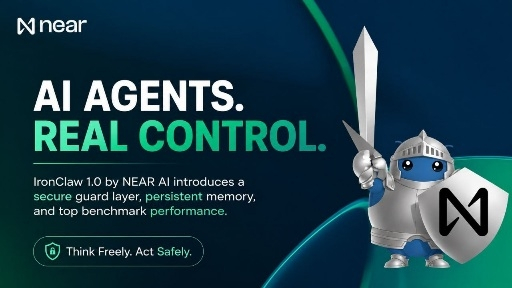
From Thinking to Acting
Traditional AI systems largely operate around generating an answer.
An agentic system is different. It needs to reason, make decisions, interact with external systems, and execute actions.
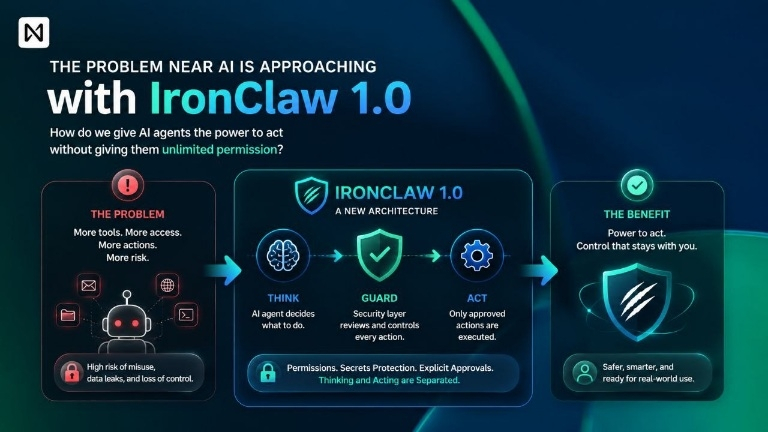
IronClaw 1.0 addresses the risk created by that transition through a separation between decision making and execution.
Its architecture can be simplified as:
THINK → GUARD → ACT
The agent can determine what it wants to do, but the action passes through a dedicated Guard layer before execution.
This creates a control point between an AI's reasoning and its ability to affect the outside world.
Sensitive actions can require explicit approval, while secrets are designed to be single use and protected from appearing in logs, errors, or reports.
For enterprise environments, this distinction matters.
The question is no longer simply whether an AI agent is intelligent.
It is whether its intelligence can be deployed with appropriate controls.
The Benchmark Results
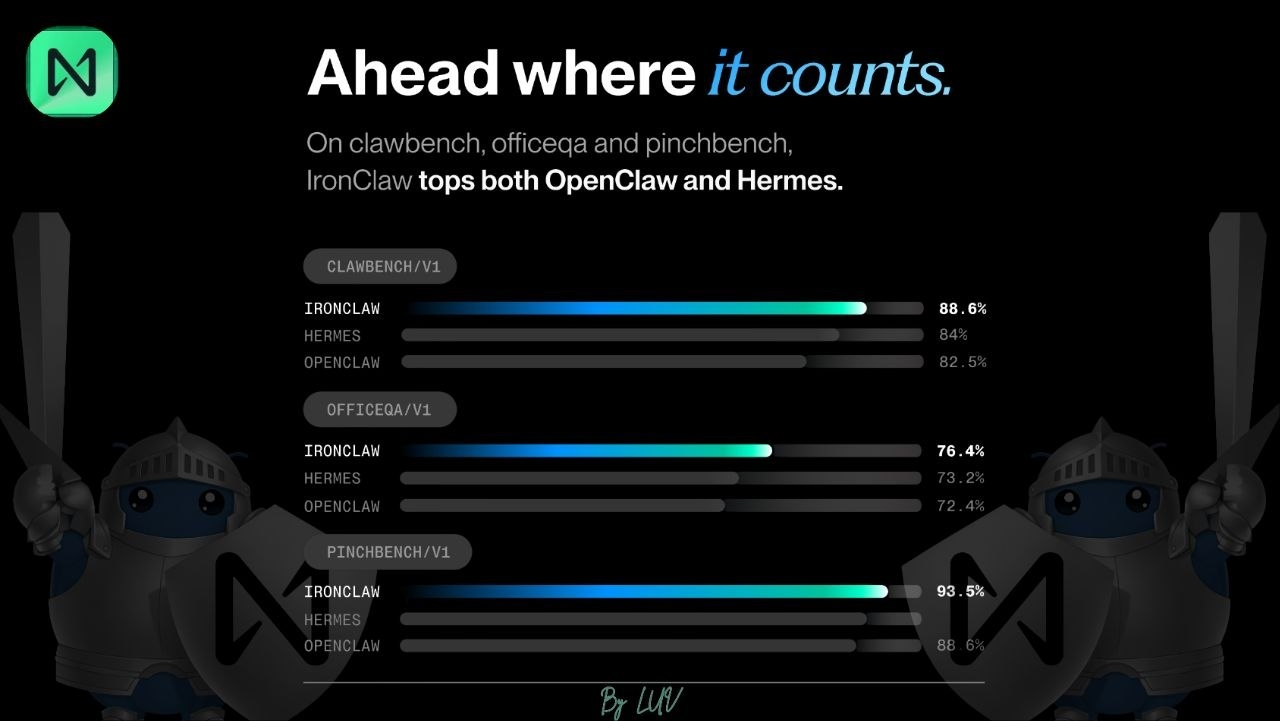
NEAR AI reported strong results for IronClaw 1.0 across three agent benchmarks using deepseek-v4-flash as the underlying model:
93.5% | PinchBench
88.6% | ClawBench
76.4% | OfficeQA
According to NEAR AI, IronClaw was roughly four percentage points ahead of the next best system on PinchBench and approximately five points ahead of the field average on ClawBench.
On OfficeQA, NEAR AI reported around 12% fewer errors than Hermes and 15% fewer than OpenClaw.
These figures should be viewed in their proper context: they were the results reported by NEAR AI for the IronClaw 1.0 release in July 2026, rather than a claim about today's broader benchmark leaderboards.
The more interesting point is that IronClaw is combining model intelligence with an execution architecture designed around control.
Persistence Changes the Agent Experience
Another important component is continuous checkpointing.
AI agents can fail for mundane reasons.
A process can stop. A connection can break. A session can restart.
Without persistent state, the agent may lose the context of what it was doing.
IronClaw's checkpointing approach allows interrupted work to resume instead of simply starting over.
That moves agents closer to functioning like persistent digital workers rather than temporary chat sessions.
IronClaw also maintains a shared memory and safety model across CLI, Web, Slack, and Telegram.
That means the interface can change without necessarily fragmenting the agent's context.
Where NEAR AI Fits
This is also where the connection to NEAR AI becomes important.
NEAR's broader AI direction focuses on user owned and verifiable AI infrastructure, including confidential inference and secure execution.
IronClaw represents the agent layer.
NEAR AI represents part of the infrastructure supporting that broader ecosystem.
And underneath the network sits another important component: staking.
Staking is often discussed primarily in terms of rewards, but its deeper function is economic security.
NEAR uses Proof of Stake, where validators secure the network and delegated stake provides economic backing for the infrastructure processing transactions.
If AI agents increasingly depend on decentralized infrastructure to hold state, execute transactions, access assets, or coordinate across networks, the security of that underlying infrastructure becomes increasingly important.
That makes staking more than a yield mechanism.
It becomes part of the security foundation for the infrastructure that future AI agents can rely on.
The Bigger Picture
IronClaw 1.0 points toward an important shift in how we should evaluate AI agents.
Raw intelligence is only one part of the equation.
A useful autonomous agent also needs:
Intelligence to reason.
Guardrails to control execution.
Persistence to maintain state.
Memory to operate across environments.
Secure infrastructure to support real world actions.
That is what makes the NEAR AI direction particularly interesting.
The next generation of AI agents will not simply need to know what to do.
They will need a reliable way to decide when they are allowed to do it, how they should do it, and what happens if something goes wrong.
IronClaw 1.0 is an interesting step toward that model.
What do you think matters more for the next generation of AI agents: better reasoning or better control over execution?
References
www.near.ai/blog/introducing-ironclaw-1-0
www.near.org/ai
docs.near.org/protocol/network/validators
github.com/nearai/ironclaw