Banks Cannot Paste Their Book Anywhere 🔒
A bank cannot put its positions into a chatbot, a hospital cannot put patient records in, and a law firm cannot put discovery in.
So the work that would be worth the most simply never runs.
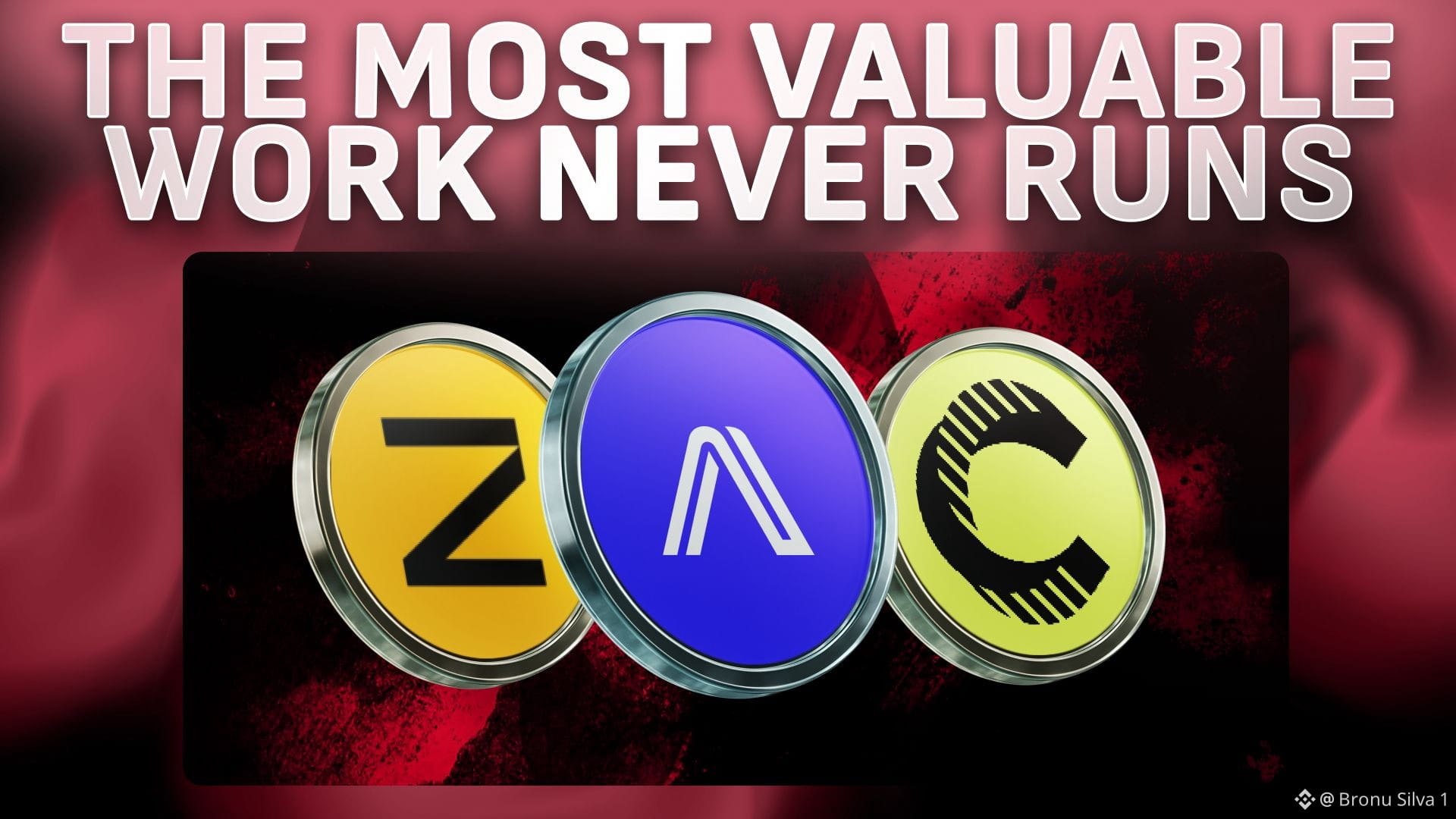
More than $130M has gone into $ZAMA to build confidential computation for exactly those institutions, which is a lot of capital chasing a problem nobody outside the category talks about.
$CC is the other half of that picture, settling more than $4 trillion of tokenized RWA volume a year with Goldman Sachs, BNP Paribas, Visa and Nasdaq running the network themselves.
Those are the same institutions that cannot let a model near their books.
Sealed chips looked like the answer for a while, and the problem is that almost nobody has them.
Most of the world's compute sits on ordinary GPUs, which is where this work is going to run whether the guarantee is ready or not.
That gap is the thing I find most interesting in the whole AI trade right now.
Everybody is pricing compute capacity and almost nobody is pricing whether the operator can read the job.
Arcium replaces the sealed chip with cryptography, splitting a computation across a cluster of nodes so each one holds a fragment and none can read the input.
So it runs on ordinary hardware, which is the entire point of doing it this way.
The network underneath has been live on Solana since February 2, with more than 4,000 nodes and over 30 apps, and teams building there have raised more than $7.5M.
But Blackthorn is the AI protocol meant to bring this to models, and it is still to come.
Banks and hospitals have had the data the whole time, and the first network that computes on it without ever receiving it will take the enterprise side of this market.
#AI #RWA
A bank cannot put its positions into a chatbot, a hospital cannot put patient records in, and a law firm cannot put discovery in.
So the work that would be worth the most simply never runs.
More than $130M has gone into $ZAMA to build confidential computation for exactly those institutions, which is a lot of capital chasing a problem nobody outside the category talks about.
$CC is the other half of that picture, settling more than $4 trillion of tokenized RWA volume a year with Goldman Sachs, BNP Paribas, Visa and Nasdaq running the network themselves.
Those are the same institutions that cannot let a model near their books.
Sealed chips looked like the answer for a while, and the problem is that almost nobody has them.
Most of the world's compute sits on ordinary GPUs, which is where this work is going to run whether the guarantee is ready or not.
That gap is the thing I find most interesting in the whole AI trade right now.
Everybody is pricing compute capacity and almost nobody is pricing whether the operator can read the job.
Arcium replaces the sealed chip with cryptography, splitting a computation across a cluster of nodes so each one holds a fragment and none can read the input.
So it runs on ordinary hardware, which is the entire point of doing it this way.
The network underneath has been live on Solana since February 2, with more than 4,000 nodes and over 30 apps, and teams building there have raised more than $7.5M.
But Blackthorn is the AI protocol meant to bring this to models, and it is still to come.
Banks and hospitals have had the data the whole time, and the first network that computes on it without ever receiving it will take the enterprise side of this market.
#AI #RWA