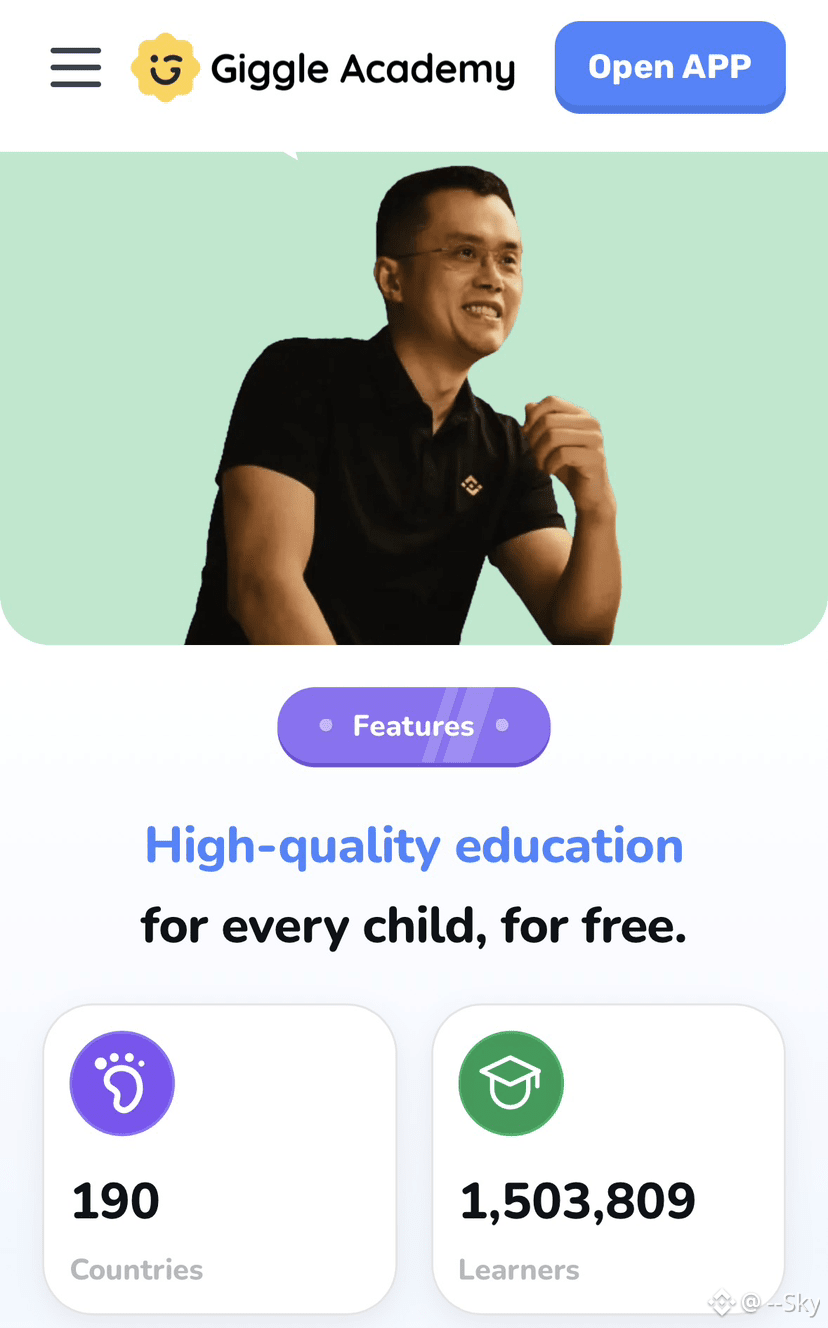

After Building Binance, CZ Wants to Teach One Billion Children for Free
In February 2024, Giggle Academy existed as a concept paper. On March 19, CZ announced his mission to provide free, gamified and adaptive education worldwide.
The idea came from a global problem: hundreds of millions still cannot read or write, while many children in developing countries have no access to school. Instead of building physical schools everywhere, CZ believed smartphones, AI and the internet could deliver education globally.
The vision covered Grades 1 through 12, from reading and mathematics to science, finance, programming and AI. Giggle Academy was not designed to replace schools, but to reach children existing systems could not.
At launch, the project had no logo, no finished product and zero learners. CZ was hiring a team. About one month later, around 10 people had produced one experimental Android lesson.
Then growth accelerated.
Giggle Academy reached 5,000 learners in February 2025, 90,000 by the end of 2025, 472,000 in May 2026 and more than one million in July. By the end of August, it had reached 1,478,577 learners across 189 countries.
The app has surpassed one million Google Play downloads. Its games, stories, speaking exercises and lessons remain free, with no ads or subscriptions.
But reaching millions is only the first challenge.
AI can scale content production, yet children preferred human generated stories over AI generated ones. Quality education still requires teachers, curriculum experts and human review.
Giggle Academy must localize lessons, protect children’s privacy, maintain a stable app and fund a platform designed to generate no revenue. Advanced subjects are harder to gamify, while online learning cannot fully recreate teachers, classmates and group learning.
The real test is no longer how many children register. It is whether they truly learn and whether that education changes their future.
If Giggle Academy can turn global access into measurable results, it may become one of the most meaningful legacies CZ leaves behind.
In February 2024, Giggle Academy existed as a concept paper. On March 19, CZ announced his mission to provide free, gamified and adaptive education worldwide.
The idea came from a global problem: hundreds of millions still cannot read or write, while many children in developing countries have no access to school. Instead of building physical schools everywhere, CZ believed smartphones, AI and the internet could deliver education globally.
The vision covered Grades 1 through 12, from reading and mathematics to science, finance, programming and AI. Giggle Academy was not designed to replace schools, but to reach children existing systems could not.
At launch, the project had no logo, no finished product and zero learners. CZ was hiring a team. About one month later, around 10 people had produced one experimental Android lesson.
Then growth accelerated.
Giggle Academy reached 5,000 learners in February 2025, 90,000 by the end of 2025, 472,000 in May 2026 and more than one million in July. By the end of August, it had reached 1,478,577 learners across 189 countries.
The app has surpassed one million Google Play downloads. Its games, stories, speaking exercises and lessons remain free, with no ads or subscriptions.
But reaching millions is only the first challenge.
AI can scale content production, yet children preferred human generated stories over AI generated ones. Quality education still requires teachers, curriculum experts and human review.
Giggle Academy must localize lessons, protect children’s privacy, maintain a stable app and fund a platform designed to generate no revenue. Advanced subjects are harder to gamify, while online learning cannot fully recreate teachers, classmates and group learning.
The real test is no longer how many children register. It is whether they truly learn and whether that education changes their future.
If Giggle Academy can turn global access into measurable results, it may become one of the most meaningful legacies CZ leaves behind.