
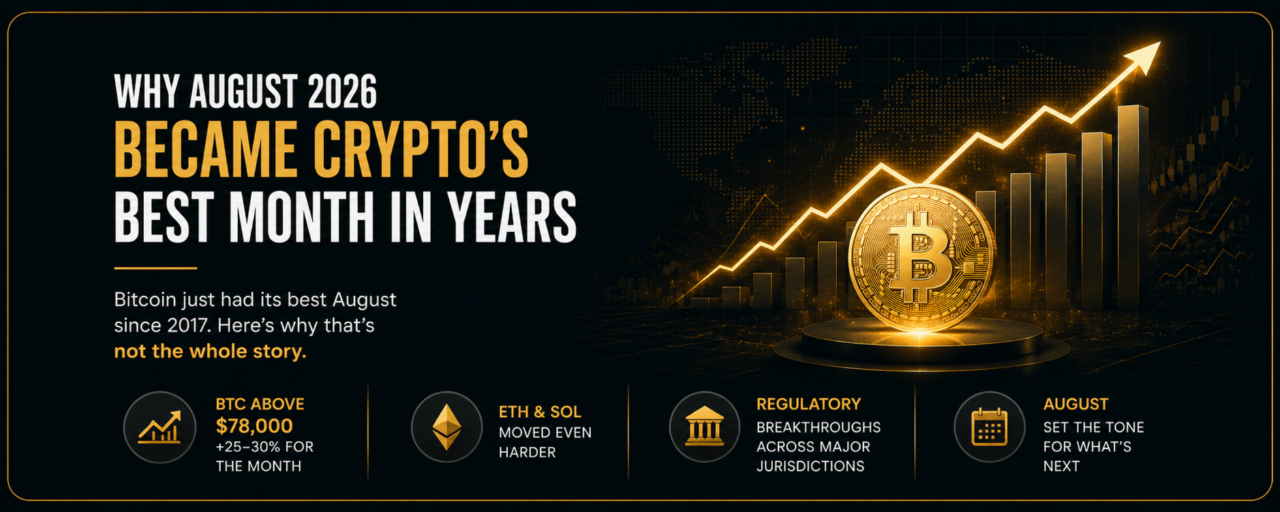


Bitcoin just had its best August since 2017. Here's why that's not the whole story.
For most of 2026, Bitcoin was stuck. It entered August near $64,000, still down roughly 45-50% from the previous year's levels, grinding sideways while traders debated whether the bottom was in. Then, in the space of about ten days, the entire year's narrative flipped.
By August 31, Bitcoin was trading above $78,000, up roughly 25-30% for the month. Ethereum and Solana moved even harder. Regulators in Washington, Moscow, Frankfurt and Tokyo all made moves that would have seemed unlikely a year ago. None of this happened in isolation. It's worth pulling apart what actually drove the month, what's confirmed versus still speculative, and what it sets up for September.
What triggered the rally?
The turning point was August 19. At a White House event with technology and crypto executives, President Trump was asked whether the administration planned to buy more Bitcoin. His answer wasn't a firm commitment, but it moved markets anyway: he said the idea "has been talked about," that Bitcoin accumulation had "taken a lot of pressure off the dollar," and that he would listen to purchase recommendations from SEC Chair Paul Atkins.
That's an important distinction. Trump did not announce a purchase program, a funding mechanism, or a timeline. The existing Strategic Bitcoin Reserve, created by executive order in March 2025, is currently funded only through forfeited assets, and any large-scale open-market buying would likely need new legal authority from Congress. Still, traders read the comments as the clearest signal yet that direct government buying was on the table, and Bitcoin broke out of a six-week trading range within hours.
That move triggered a chain reaction. Heavily leveraged short positions, built up during months of sideways price action, got caught offside. On August 19 and 20, more than $2.7 billion in short positions were liquidated within roughly 24 hours, according to data from CoinGlass and other trackers, the largest concentrated short-liquidation event on record dating back to 2021. Bitcoin alone accounted for over $1.3 billion of that figure. Forced buybacks from liquidated shorts pushed prices higher still, a classic short-squeeze feedback loop.
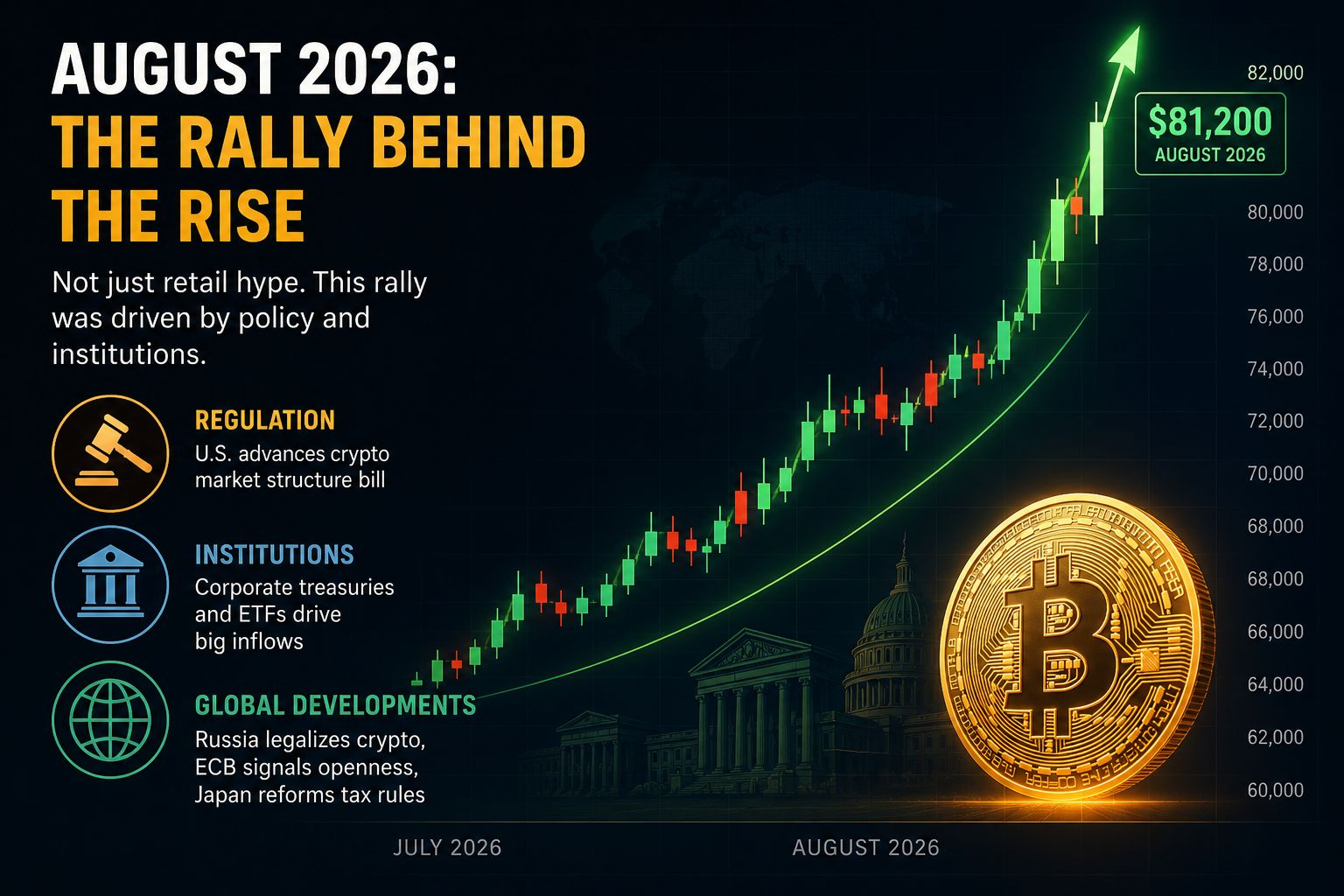
The numbers, without the exaggeration
Monthly performance:
Bitcoin gained roughly 25-30% in August, its strongest August since 2017 and a rare green month for a period that's historically been one of Bitcoin's weakest. It's still down 28-33% year-to-date and remains well below its October 2025 peak near $126,000.
Ethereum posted a strong August as well, extending gains that made it one of the better-performing majors of the month.
Solana was the standout, closing the month up roughly 40-46%, its first positive month after ten straight monthly declines stretching back to October 2025
ETF flows told a similar story. Spot Bitcoin ETFs pulled in more than $3 billion over the month, their strongest showing in close to a year. Spot Ethereum ETFs recorded their best month since the products launched in 2024, powered largely by BlackRock's ETHA fund, which alone accounted for roughly 70% of a nine-day, $1.4 billion inflow streak in late August. Solana's smaller ETF category also had its strongest month since launch, with cumulative inflows crossing $1.3 billion and Bitwise's BSOL fund becoming the first Solana ETF to cross $1 billion in assets.
Worth noting: some of these figures vary slightly depending on the data provider and exact cutoff date. SoSoValue, Farside Investors and CoinGlass don't always agree to the dollar, but the direction and scale across all of them point to the same conclusion — institutional demand returned in size after a rough first half of the year.
Regulation moved almost as fast as price
The CLARITY Act is back on the calendar. The Senate left for its August recess without voting on the Digital Asset Market Clarity Act (H.R. 3633), which passed the House 294-134 back in July 2025. Majority Leader John Thune has filed cloture for a procedural vote on September 15, which needs 60 votes to succeed. President Trump has publicly pushed for a "fair version" of the bill to pass, but Democrats remain split over an ethics provision that critics say carves out protection for Trump's own crypto holdings, and banks are lobbying against language that would restrict stablecoin yield. Passage is not guaranteed.
Russia opened the door to regulated crypto trading. President Putin signed Federal Law No. 282-FZ on August 4, creating Russia's first comprehensive legal framework for crypto exchanges, brokers, and custodians under Bank of Russia supervision. Core provisions take effect September 1. Retail investors face an annual purchase cap of roughly $3,700-3,800 through approved intermediaries; qualified investors face no cap. Crucially, the law keeps domestic crypto payments banned while explicitly legalizing crypto for cross-border trade settlement — a carve-out widely read as easing sanctions pressure on Russian exporters and importers.
The ECB called for central bank money to go on-chain. Speaking at the Jackson Hole symposium on August 28, ECB Executive Board member Isabel Schnabel argued that central banks need to issue tokenized reserves directly on programmable ledgers to keep pace with tokenized markets and prevent private stablecoins from displacing public money as the core settlement asset. This builds on the ECB's existing Pontes and Appia initiatives, which aim to connect blockchain platforms to the euro area's TARGET payment infrastructure.
Japan is preparing to put its bond and equity markets on blockchain rails. The Financial Services Agency, Ministry of Finance and Bank of Japan plan to launch a joint study group this year targeting a development roadmap by early 2027, with live systems potentially arriving in the early 2030s. The goal is round-the-clock, near-instant settlement for Japanese government bonds — a market worth roughly $7-8 trillion — and eventually equities, cutting settlement times from the current one-to-two days down to near zero. Four of Japan's largest banks have already been running blockchain collateral trials on the Canton Network since April.
Big banks are circling stablecoins. According to Wall Street Journal reporting, JPMorgan has held internal discussions about issuing a public stablecoin separate from its existing JPM Coin deposit token, though the bank says no product is currently planned. Separately, a group of more than a dozen institutions including Bank of America, Wells Fargo and Santander is reportedly working on a jointly sponsored, multicurrency stablecoin for commercial use, starting with a dollar-denominated token. Neither project has a confirmed launch date.
Coinbase pushed crypto further into everyday finance
Coinbase and Better Mortgage expanded their Bitcoin-collateralized home loan product to general customers nationwide in late August. The structure pairs a standard Fannie Mae-eligible first mortgage with a separate second loan secured by pledged Bitcoin or USDC, letting buyers cover a down payment without selling their crypto. Collateral requirements sit at 250% of the loan amount, and Better says price declines alone won't trigger margin calls — though pledged assets can be liquidated if payments run more than 60 days late. The product's waitlist had already surpassed $260 million in potential loan volume before the nationwide expansion.
So what does this actually mean going forward?
The honest answer is that August solved less than the price charts suggest. Bitcoin's rally was real, but a large share of it came from a mechanical short squeeze rather than fresh, sustained buying — the kind of move that can partially unwind once leveraged positioning resets. Fed Chair Kevin Warsh's hawkish comments at Jackson Hole on August 28 were enough to snap Bitcoin ETFs' nine-day inflow streak, a reminder of how sensitive this rally still is to macro headlines.
On the regulatory side, momentum is genuine but incomplete. The CLARITY Act has a real vote scheduled, not just a vague promise, but a 60-vote threshold with active Democratic opposition means passage is a coin flip, not a formality. Russia's law and Japan's blockchain roadmap are both real and signed or scheduled, but their practical effects — sanctions workarounds, settlement efficiency — will play out over years, not weeks.
What's clear is that the range of institutions treating crypto as core financial infrastructure widened materially in a single month: a G7 central bank, one of the world's largest bond markets, a nuclear-armed sanctioned economy, and America's largest bank all moved in the same direction at roughly the same time. That kind of convergence is unusual, and it's a better explanation for why August mattered than any single price chart.
What to watch in September
The September 15 CLARITY Act cloture vote and whether Thune can find 60 votes.
Whether Bitcoin ETF inflows resume after the late-August pause tied to Fed commentary.
Any follow-up from the Trump administration on a funding mechanism or executive order for expanded Bitcoin or altcoin purchases — so far, none has been announced.
Progress on JPMorgan's stablecoin decision and the multi-bank commercial stablecoin venture.
FAQ
Did the U.S. government actually buy Bitcoin in August 2026? No. President Trump said on August 19 that large-scale Bitcoin and altcoin purchases had "been talked about," but no purchase, funding mechanism, or timeline has been announced. The existing Strategic Bitcoin Reserve is currently funded only through forfeited assets.
Is the CLARITY Act guaranteed to pass in September? No. A procedural cloture vote is scheduled for September 15, but it requires 60 votes in the Senate, and Democrats remain divided over an ethics provision and stablecoin yield restrictions. Passage is possible but not confirmed.
Why did crypto rally so hard in such a short window? Two forces combined: Trump's comments about potential government Bitcoin purchases triggered a wave of short covering, and that squeeze coincided with a cluster of institutional and regulatory developments — from Russia's new crypto law to record ETF inflows — that reinforced the move.
HASHTAGS
#Bitcoin #CryptoRegulation #CLARITYAct #Ethereum #Solana #CryptoNews