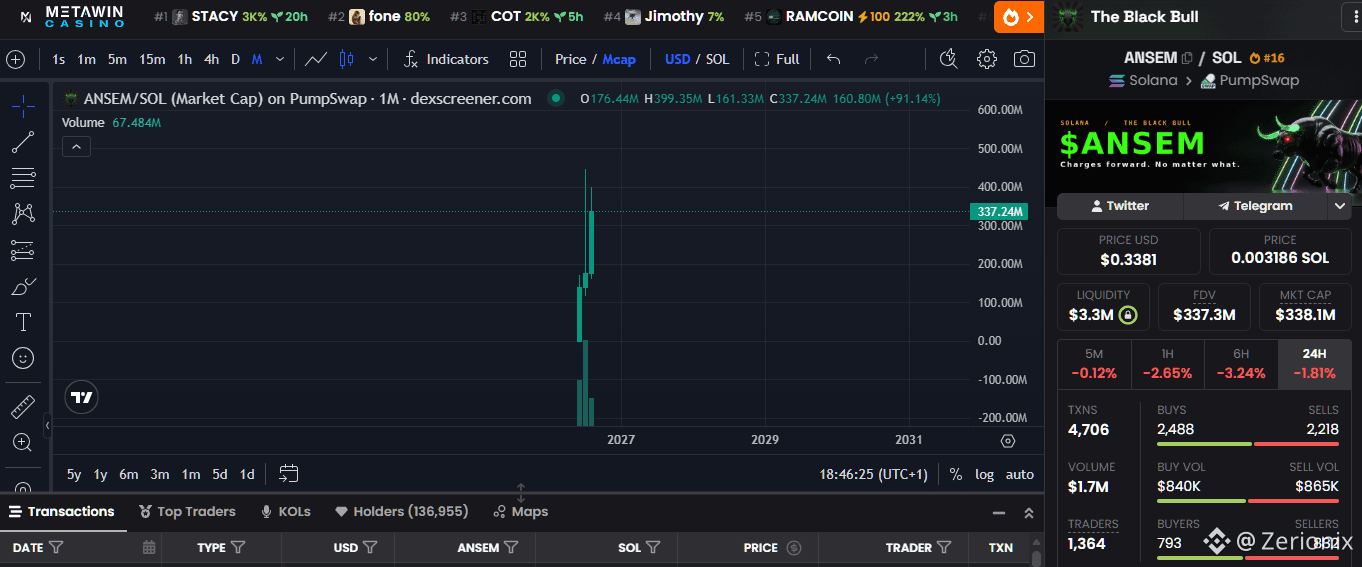
When 65% of a Token Sits in One Wallet $ANSEM on Solana currently shows a striking ownership structure. Roughly 65% of the supply sits in a single public wallet associated with the influencer the token is named after. The rest is distributed across a large holder base, with the token trading at a market cap in the hundreds of millions. This is not unusual in the current memecoin cycle. Supply is often concentrated by design — either through intentional transfers to prominent wallets or through early accumulation that never fully disperses. The result is a token whose price action is heavily influenced by the behavior of a very small number of addresses. The interesting part is not the concentration itself. It is what that concentration reveals about the difference between attention and economic activity. Tokens like this can generate enormous short-term volume and mindshare. They rarely develop the kind of recurring, fee-generating usage that sustains a protocol over longer periods. Liquidity is reactive. Holders are largely speculative. The narrative does the heavy lifting. This is where the contrast with infrastructure becomes clear. Platforms that process consistent swap volume, maintain deep active liquidity, and serve as execution layers for other applications are playing a different game. Their value accrues from repeated use rather than from a single concentrated holder or a wave of social attention. STON.fi ’s position on TON, processing the majority of DEX volume and functioning as a core routing layer through Omniston, sits on the opposite end of that spectrum. Attention can move prices quickly. Usage compounds more slowly, but it tends to leave something more durable behind. The $ANSEM structure is a clean illustration of one model. The quieter question is which model actually retains relevance once the attention cycle moves on. 👉 Explore sustained volume and liquidity on STON.fi → https://ston.fi $BTC #BTC Price Analysis# #Altcoin Season#

Посты

--
Отказ от ответственности. Содержит мнения третьих сторон. Не является рекомендацией. Binance AI не предоставляет гарантий. См. Правила и условия.