
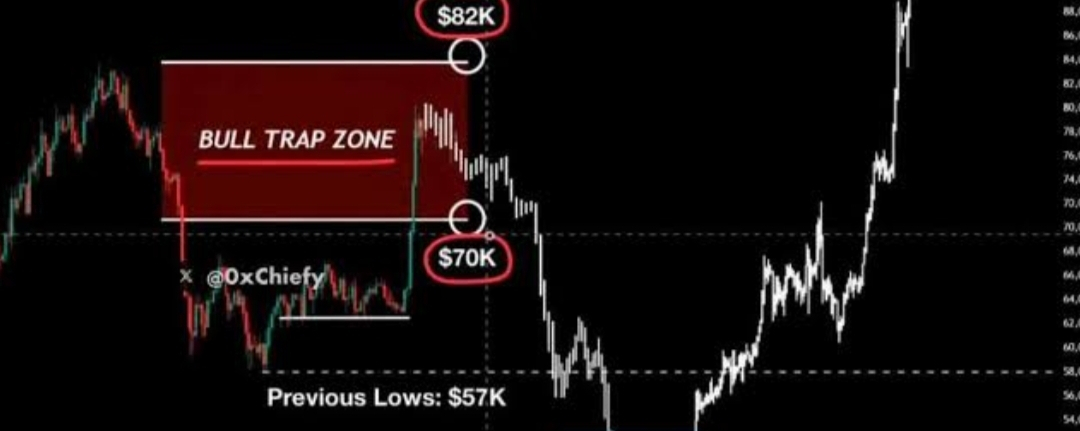


Bitcoin’s rejection around the $80,000 area has quickly become one of the most important developments for the crypto market. After a strong recovery, $BTC reached a level where sellers stepped back in, raising a simple question: is this just a normal pullback, or is the market preparing for something deeper?
A rejection after a strong rally is not automatically bearish. Markets rarely move higher in a straight line. Traders take profits, leveraged positions get flushed out, and price often returns to previous support before deciding its next direction.
Why $80K Matters
The $80,000 region is more than just a psychological number. When Bitcoin approaches a major round-number level, attention increases, liquidity builds around it, and both buyers and sellers become more aggressive.
The failure to hold above $80K shows that buyers haven't fully taken control yet. However, a rejection alone doesn't confirm a bearish reversal. What happens after the rejection matters much more.
The Healthy Pullback Scenario
The bullish scenario is relatively simple. Bitcoin pulls back, finds strong demand at a lower support zone, and starts forming higher lows again.
That would suggest traders are using weakness to accumulate rather than rushing for the exit. A period of consolidation could also help cool excessive leverage and create a healthier foundation for another attempt at $80K.
If Bitcoin eventually reclaims $80K and can hold above it, the rejection could end up looking like nothing more than a temporary shakeout before the next expansion.
The Bearish Scenario
The situation becomes more concerning if Bitcoin continues losing important support levels while every recovery attempt becomes weaker.
A pattern of lower highs and lower lows would indicate that sellers are gaining control. In that environment, traders who bought the move toward $80K could begin exiting, adding even more selling pressure.
Leverage is another factor to watch. When too many traders are positioned in the same direction, a relatively small decline can trigger liquidations and accelerate the move.
Watch the Reaction, Not Just the Price
This is where patience becomes important.
Instead of assuming that every dip is a buying opportunity or every rejection means a crash, watch how Bitcoin reacts around support. Strong buying volume and quick recoveries would favor the bulls. Weak bounces followed by fresh lows would strengthen the bearish case.
The broader crypto market can provide clues as well. If Bitcoin stabilizes while Ethereum and major altcoins remain strong, risk appetite may still be healthy. If weakness spreads across the entire market, the correction deserves more attention.
What Could Bring the Bulls Back?
A convincing recovery toward $80K would immediately change market sentiment.
The strongest signal would be Bitcoin breaking above the rejected area and then successfully holding it as support. That would show that sellers around the psychological barrier are being absorbed.
Until then, $80K remains an important level for traders to respect rather than assume will automatically break.
Final Thoughts
Bitcoin’s $80K rejection does not necessarily mean the bull move is finished. Pullbacks are a normal part of every market cycle, especially after aggressive rallies.
But this is also not a level to ignore.
If buyers defend support and Bitcoin rebuilds momentum, the pullback could become another consolidation before a fresh breakout attempt. If support continues breaking and rallies become weaker, the probability of a deeper correction increases.
For now, I’m watching the market structure rather than trying to predict every candle.
The real question isn't whether Bitcoin was rejected at $80K. It’s whether buyers are strong enough to bring it back there.