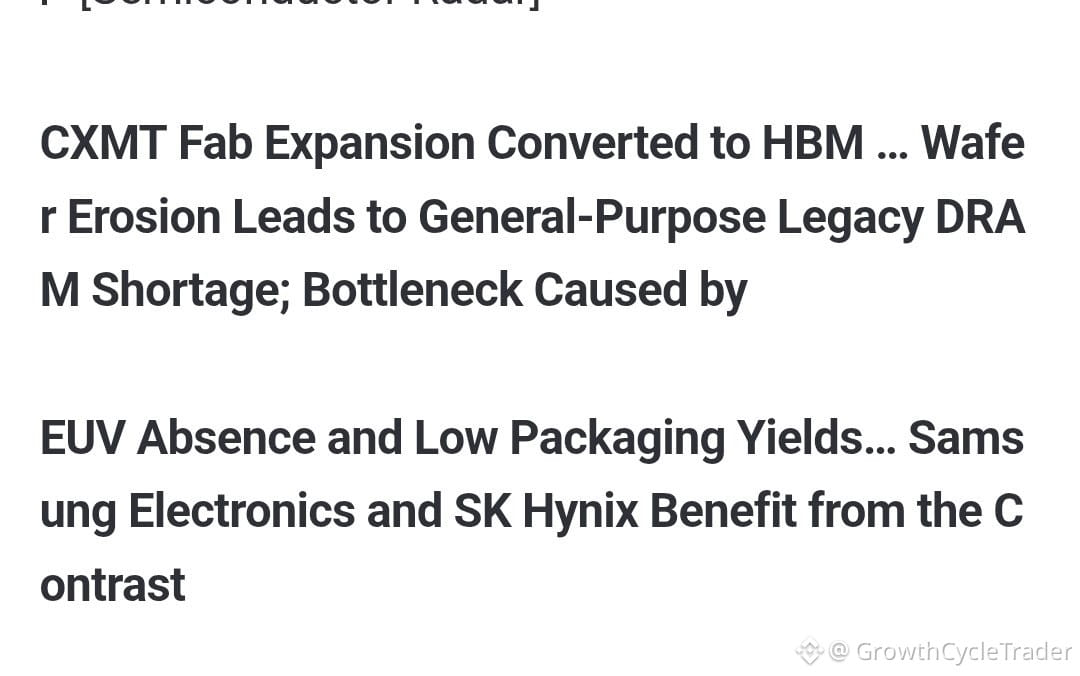
China's HBM push is tightening commodity DRAM supply, not loosening it.
CXMT is redirecting more 12-inch capacity toward Huawei-linked HBM development. TrendForce estimates year-end output near 300,000–350,000 wafers/month. The old worry was Chinese wafer floods dumping cheap DDR4 and DDR5. The opposite is happening.
HBM consumes far more silicon. Larger die, 8-high or 12-high stacks, TSV packaging complexity—one finished HBM can eat three to four times the wafer area of standard DRAM.
Without EUV, CXMT relies on DUV multi-patterning. Front-end yields run 40%+ below Korean peers. Packaging yields sit around 50%. That combo burns wafers fast for every good stack.
If those wafers shift away from legacy DRAM, China ships less cheap DDR4/DDR5 into phones and PCs.
TrendForce sees H2 commodity DRAM contracts rising another 13–18% QoQ. Set makers who wanted a low-cost China option are rotating back to Samsung and SK Hynix.
The paradox is clean: trying to self-supply HBM without EUV and mature packaging shrinks the very commodity supply that was supposed to undercut Korea.
Korean memory collects on both ends—premium HBM where it still leads, and firmer pricing in the parts CXMT is no longer flooding.
CXMT is redirecting more 12-inch capacity toward Huawei-linked HBM development. TrendForce estimates year-end output near 300,000–350,000 wafers/month. The old worry was Chinese wafer floods dumping cheap DDR4 and DDR5. The opposite is happening.
HBM consumes far more silicon. Larger die, 8-high or 12-high stacks, TSV packaging complexity—one finished HBM can eat three to four times the wafer area of standard DRAM.
Without EUV, CXMT relies on DUV multi-patterning. Front-end yields run 40%+ below Korean peers. Packaging yields sit around 50%. That combo burns wafers fast for every good stack.
If those wafers shift away from legacy DRAM, China ships less cheap DDR4/DDR5 into phones and PCs.
TrendForce sees H2 commodity DRAM contracts rising another 13–18% QoQ. Set makers who wanted a low-cost China option are rotating back to Samsung and SK Hynix.
The paradox is clean: trying to self-supply HBM without EUV and mature packaging shrinks the very commodity supply that was supposed to undercut Korea.
Korean memory collects on both ends—premium HBM where it still leads, and firmer pricing in the parts CXMT is no longer flooding.