


If you hold Bitcoin, there is one document worth reading at least once: Satoshi Nakamoto’s whitepaper.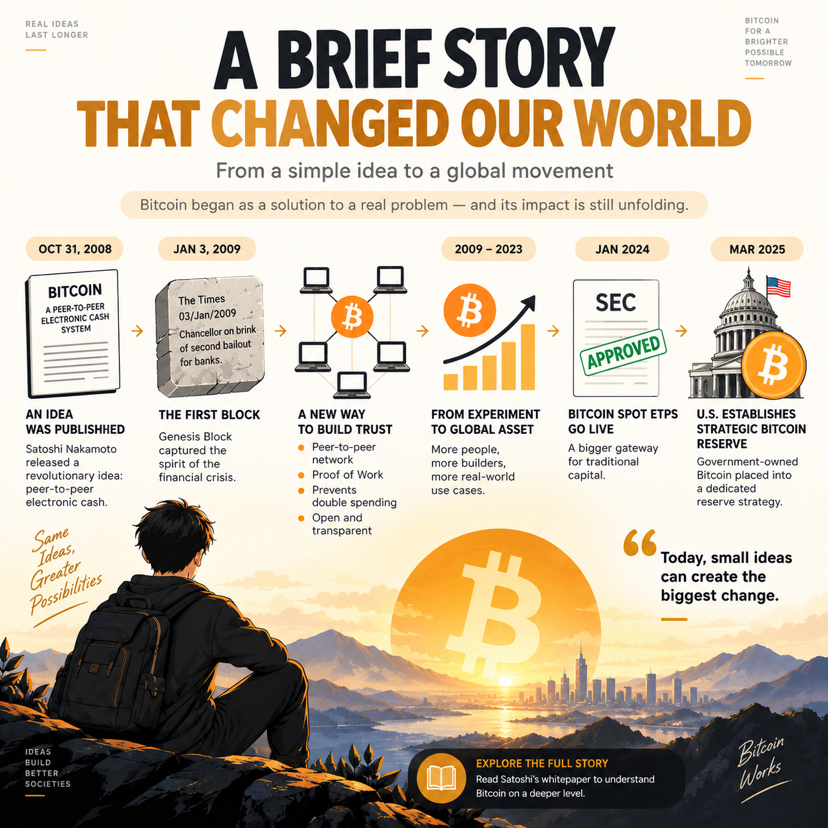
It is only nine pages long. Yet those nine pages laid the foundation for an entirely new financial system.
On October 31, 2008, in the middle of one of the most severe financial crises in modern history, a person or group using the name Satoshi Nakamoto published a paper titled “Bitcoin: A Peer-to-Peer Electronic Cash System.”
Bitcoin was not introduced as a speculative asset. It was not presented as digital gold, an institutional investment, or a shortcut to wealth.
It began with a much simpler problem.
Most online payments relied on banks and financial institutions to act as trusted intermediaries. They maintained the records, verified transactions, resolved disputes, and ultimately decided which payments were valid.
Satoshi asked a different question:
Could two people transfer value directly across the internet without depending on a central institution to control the entire system?
That question became the starting point of Bitcoin.
Satoshi combined digital signatures, a peer-to-peer network, Proof of Work, and a chain of cryptographically linked blocks to address one of the hardest problems in digital money: preventing the same unit of value from being spent twice without relying on a central server to determine which transaction was legitimate.
On January 3, 2009, Bitcoin’s first block was created.
Embedded inside the Genesis Block was a message that has since become part of Bitcoin’s history:
“The Times 03/Jan/2009 Chancellor on brink of second bailout for banks.”
It was a headline published by The Times that day, while the banking system was still struggling with the consequences of the financial crisis.
No one can say with certainty what political message Satoshi intended to send.
But the line tells us something important about the world into which Bitcoin was born. Trust in some of the largest financial institutions was being tested, governments were rescuing banks, and the weaknesses of a system built around centralized intermediaries had become impossible to ignore.
Bitcoin proposed a different model.
Instead of allowing one institution to maintain the ledger and approve every transaction, Bitcoin enabled independent participants around the world to verify the same rules and share the same transaction history.
It would be inaccurate to say that Bitcoin eliminated trust completely.
What it did was change where trust had to be placed.
Instead of relying entirely on one bank, government, company, or central operator, users could rely on transparent rules, cryptography, economic incentives, and a public record that anyone could independently verify.
That distinction is one of the most important ideas behind Bitcoin.
What happened next is even more remarkable.
In 2009, Bitcoin was little more than an experimental piece of software known to a small group of cryptographers and early developers.
In January 2024, the U.S. Securities and Exchange Commission approved the listing and trading of spot Bitcoin exchange-traded products, opening a much wider regulated path for traditional capital to gain exposure to Bitcoin.
Then, in March 2025, the United States established a Strategic Bitcoin Reserve, placing government-held Bitcoin within a dedicated reserve framework.
A nine-page document once shared on a cryptography mailing list had gradually become the foundation of an asset studied and held by individuals, financial institutions, public companies, and governments.
For me, that is the most fascinating part of Bitcoin.
Not how much BTC moved today.
Not whether the price will rise or fall tomorrow.
Not how many times its value could multiply from here.
The more important question is why Bitcoin needed to exist in the first place.
If you have held BTC for years but have never read Satoshi’s whitepaper, spending 30 minutes with those nine pages may teach you more about Bitcoin than months of watching price charts.
Before trying to predict where Bitcoin is going, understand where it came from.