I used to think the hard part of putting a security on Dusk was creating the token itself. Everything after that felt like details.
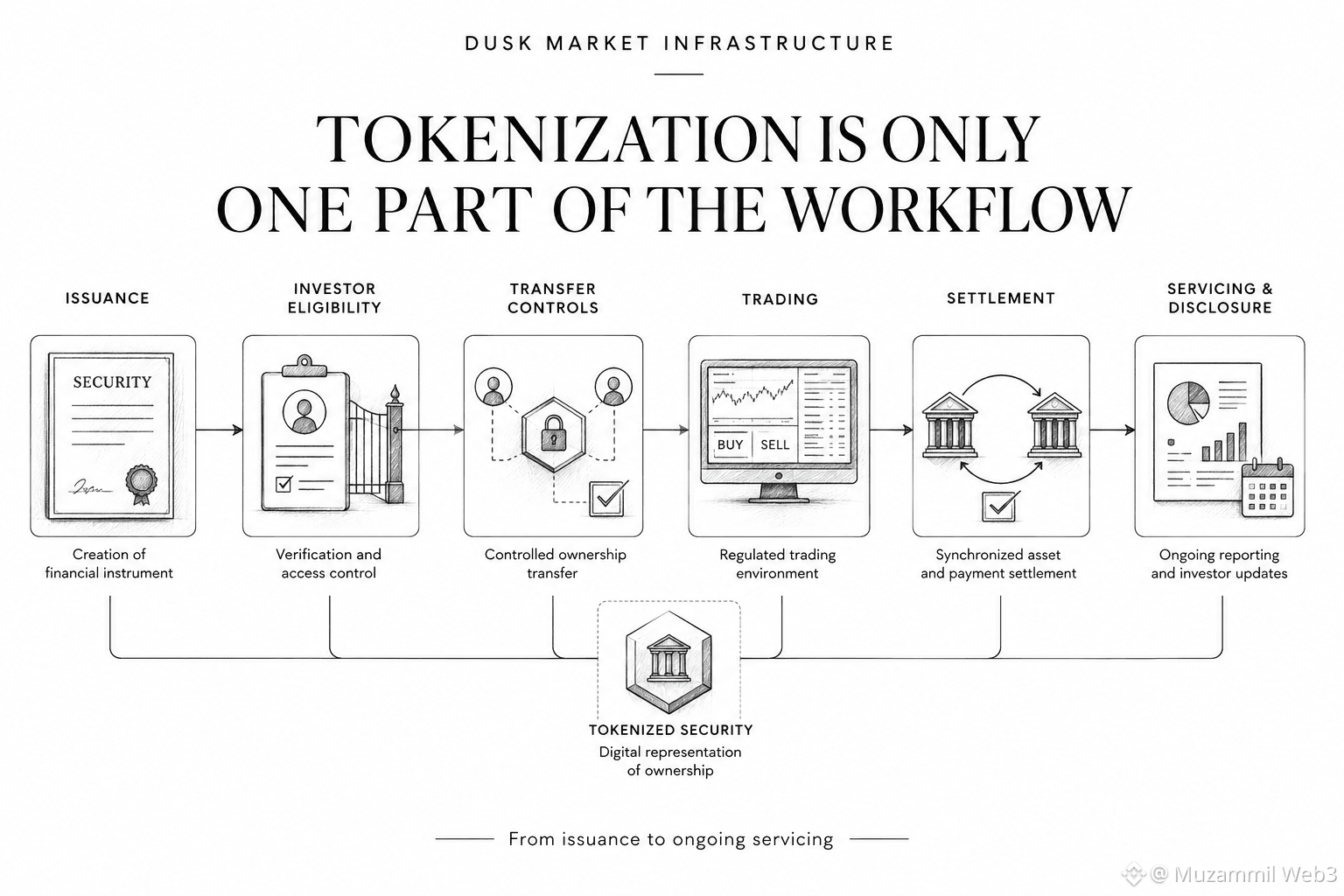
Dusk's own market infrastructure documentation made me look at it differently. It describes issuer setup, investor eligibility, transfer controls, trading and distribution, settlement, and servicing and disclosure as connected parts of the same market workflow.
That caught my attention because it changes how I think about tokenization. The token is only one part of the process. The asset still needs rules around who can hold it, how it can move, how it can be traded, how settlement happens, and what happens after issuance.
I don't think that makes the workflow simple. Connecting these different requirements is a much broader problem than simply creating an on-chain representation of an asset.
For me, the interesting part is not just putting a security on-chain, but how the surrounding market workflow continues to operate once that security is there.
How would this workflow need to adapt if the same asset eventually had to move between multiple regulated venues with different eligibility rules?
#dusk $DUSK @Dusk
Dusk's own market infrastructure documentation made me look at it differently. It describes issuer setup, investor eligibility, transfer controls, trading and distribution, settlement, and servicing and disclosure as connected parts of the same market workflow.
That caught my attention because it changes how I think about tokenization. The token is only one part of the process. The asset still needs rules around who can hold it, how it can move, how it can be traded, how settlement happens, and what happens after issuance.
I don't think that makes the workflow simple. Connecting these different requirements is a much broader problem than simply creating an on-chain representation of an asset.
For me, the interesting part is not just putting a security on-chain, but how the surrounding market workflow continues to operate once that security is there.
How would this workflow need to adapt if the same asset eventually had to move between multiple regulated venues with different eligibility rules?
#dusk $DUSK @Dusk