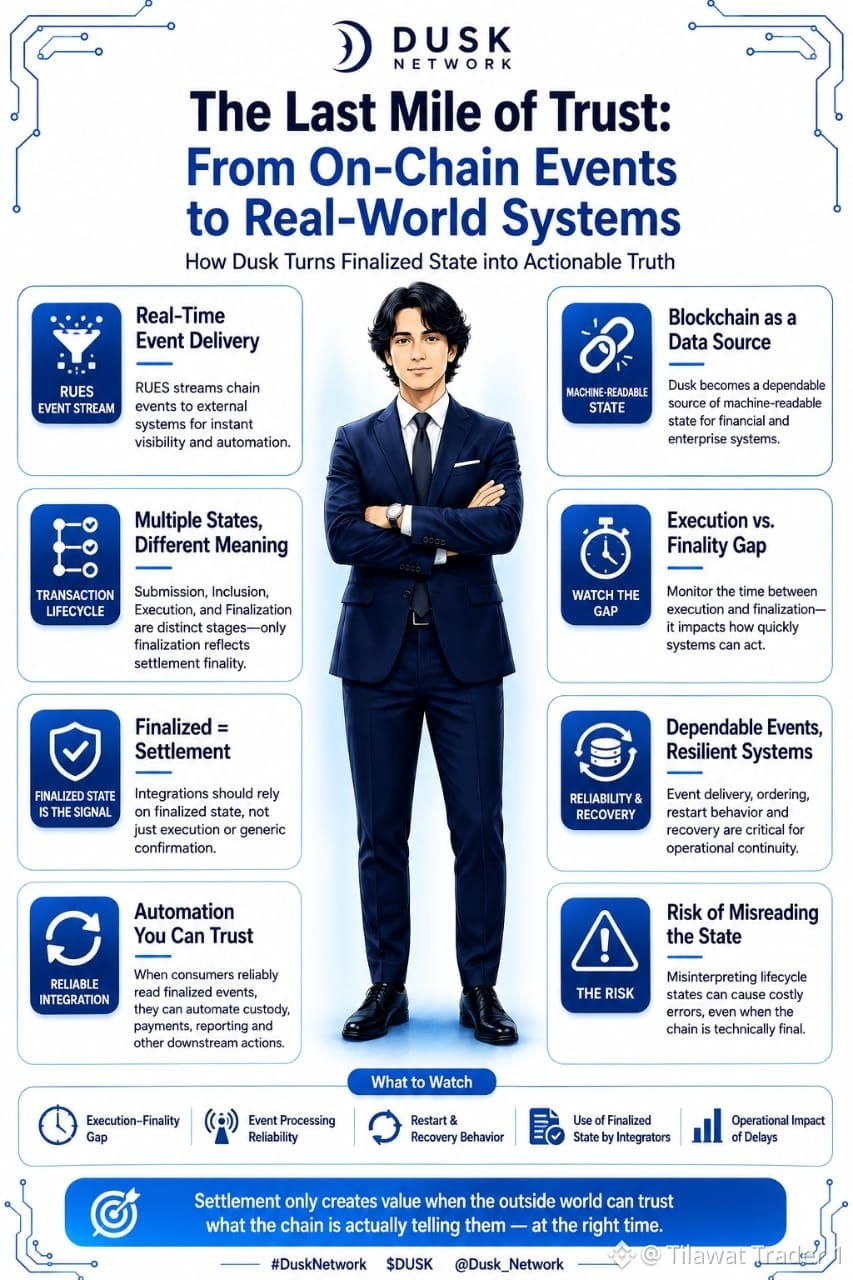
@Dusk I’ve been looking at Dusk from a layer that sits after the transaction itself: how external systems know what actually happened on-chain.
Dusk’s architecture includes RUES, an event system designed to stream chain events to external consumers. But the interesting part is that Dusk distinguishes several stages of a transaction: submission, inclusion, execution and finalization.
Those states are not interchangeable.
A transaction can be accepted for routing without being in a block. It can execute in an accepted block without that block being final. Dusk’s own integration guidance therefore treats finalized state as the meaningful settlement signal rather than relying on a generic “confirmed” status.
That creates an operational question I think is worth watching.
Can exchanges, custodians, wallets and financial applications consume Dusk’s finalized state reliably enough to automate their own downstream actions?
If they can, the blockchain becomes more than a place where transactions settle. It becomes a dependable source of machine-readable state for the systems built around it.
I’d watch the gap between execution and finality, event-processing reliability, restart/recovery behavior and whether integrators consistently use finalized state rather than weaker transaction signals.
There is a risk here.
More event infrastructure does not automatically mean better integration. If applications interpret lifecycle states incorrectly, a technically final blockchain can still produce operational mistakes outside the chain.
“Settlement is only useful when the systems around it know when it is final.”
For Dusk, I think that last-mile reliability could become a surprisingly important measure of whether its settlement layer can support real financial infrastructure.
#dusk $DUSK $BTR $TAC