I’ve been spending more time looking into Dusk lately, and I think calling it a “privacy chain” misses a big part of what’s actually being built.
Over the past few months, Dusk has quietly kept upgrading the network. Aegis introduced PLONK V3 verification, Boreas went live on mainnet, more than 210M $DUSK is staked, and community trackers show around 200 active nodes. None of these things are extraordinary on their own, but together they show a network that is still being improved instead of standing still.
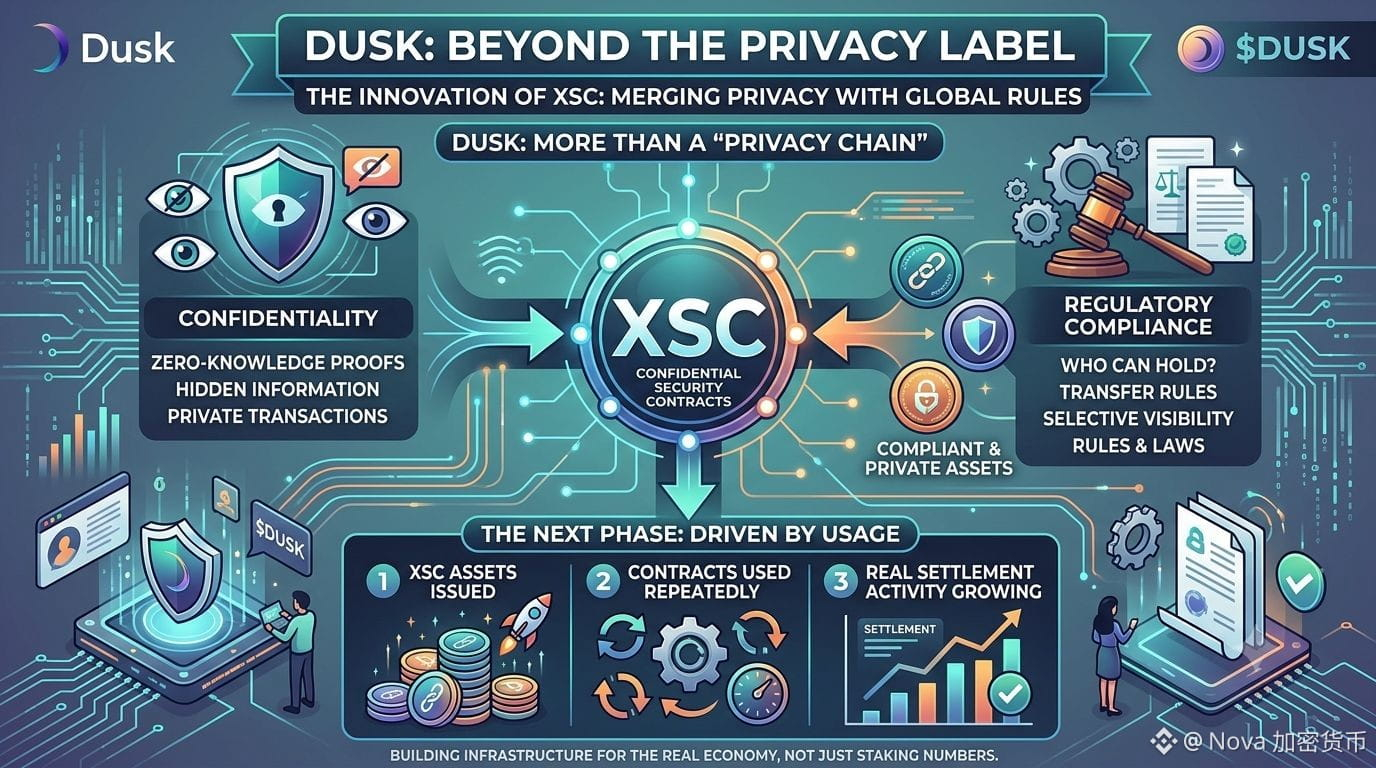
What caught my attention most is XSC.
Most discussions around privacy focus on hiding information, but assets in the real world often need more than that. Sometimes there are rules around who can hold an asset, how it can be transferred, or what information should remain visible to specific parties while staying private from everyone else.
That feels like the problem Dusk is trying to solve.
And it’s a more difficult challenge than simply creating private transactions, because the goal is not just confidentiality. The goal is building assets that can work within rules without putting every detail out in public.
I think the next phase for Dusk will be decided by usage, not by staking numbers or upgrades.
How many XSC assets are being issued?
Are contracts being used repeatedly?
Is real settlement activity growing?
Those are the questions I’m watching now, because technology is interesting, but real adoption is what turns an idea into infrastructure.
If Dusk can prove that assets need both privacy and rules at the same time, it could end up solving a problem that most blockchains still haven’t really addressed.
@Dusk #dusk $DUSK
Over the past few months, Dusk has quietly kept upgrading the network. Aegis introduced PLONK V3 verification, Boreas went live on mainnet, more than 210M $DUSK is staked, and community trackers show around 200 active nodes. None of these things are extraordinary on their own, but together they show a network that is still being improved instead of standing still.
What caught my attention most is XSC.
Most discussions around privacy focus on hiding information, but assets in the real world often need more than that. Sometimes there are rules around who can hold an asset, how it can be transferred, or what information should remain visible to specific parties while staying private from everyone else.
That feels like the problem Dusk is trying to solve.
And it’s a more difficult challenge than simply creating private transactions, because the goal is not just confidentiality. The goal is building assets that can work within rules without putting every detail out in public.
I think the next phase for Dusk will be decided by usage, not by staking numbers or upgrades.
How many XSC assets are being issued?
Are contracts being used repeatedly?
Is real settlement activity growing?
Those are the questions I’m watching now, because technology is interesting, but real adoption is what turns an idea into infrastructure.
If Dusk can prove that assets need both privacy and rules at the same time, it could end up solving a problem that most blockchains still haven’t really addressed.
@Dusk #dusk $DUSK