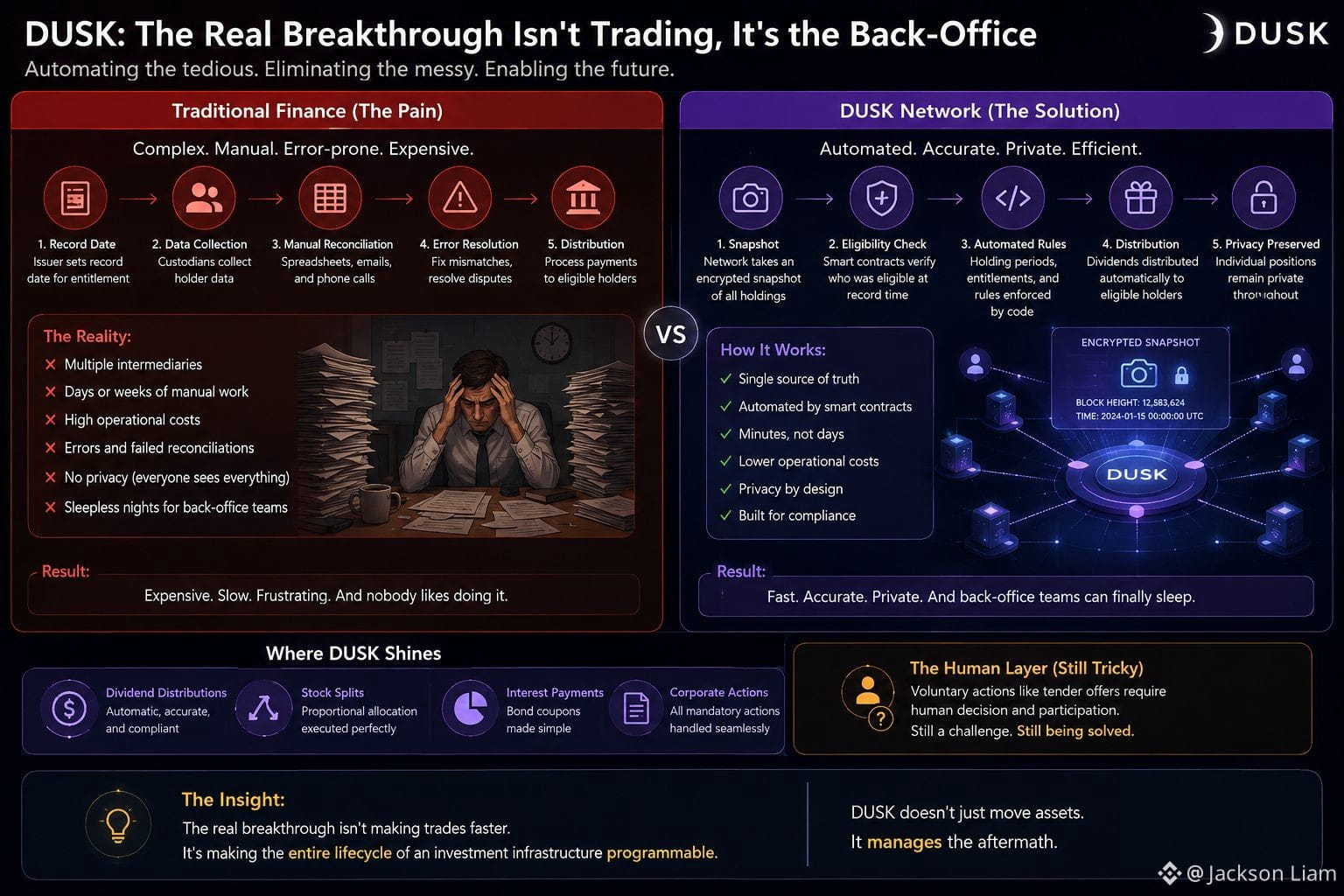

The more I look at DUSK, the more I think the real breakthrough isn't about trading at all. It's about the tedious back-office stuff nobody likes talking about—things like dividend distributions and stock splits.
I used to think tokenizing a security was straightforward. You put it on a blockchain, and suddenly everything's faster and cheaper. But the more I dug in, the more I realized I was ignoring the messy middle. The corporate actions. The record-keeping. The reconciliation nightmares that keep traditional finance teams up at night.
Here's what DUSK actually does that caught me off guard. Instead of just tracking balances, the network can take a snapshot of all holdings at a specific moment in time. When a dividend needs to be paid, the system checks who was eligible based on that snapshot, verifies the holding period, and processes the distribution automatically—all while keeping individual positions private. No spreadsheets. No phone calls between custodians. Just code enforcing the rules.
That moment made me rethink everything. We've been so focused on making trades faster that we forgot about what happens after the trade. DUSK seems designed to handle the boring stuff programmatically, which honestly might be more valuable than speed.
I'm still skeptical about voluntary actions like tender offers, where users need to actively decide. That human layer is tricky. But watching DUSK tackle these operational headaches makes me wonder—is automating the back-office the actual killer use case? I'm not sure yet, but it's the first time a blockchain project made me care about dividends.
#dusk @Dusk $DUSK
I used to think tokenizing a security was straightforward. You put it on a blockchain, and suddenly everything's faster and cheaper. But the more I dug in, the more I realized I was ignoring the messy middle. The corporate actions. The record-keeping. The reconciliation nightmares that keep traditional finance teams up at night.
Here's what DUSK actually does that caught me off guard. Instead of just tracking balances, the network can take a snapshot of all holdings at a specific moment in time. When a dividend needs to be paid, the system checks who was eligible based on that snapshot, verifies the holding period, and processes the distribution automatically—all while keeping individual positions private. No spreadsheets. No phone calls between custodians. Just code enforcing the rules.
That moment made me rethink everything. We've been so focused on making trades faster that we forgot about what happens after the trade. DUSK seems designed to handle the boring stuff programmatically, which honestly might be more valuable than speed.
I'm still skeptical about voluntary actions like tender offers, where users need to actively decide. That human layer is tricky. But watching DUSK tackle these operational headaches makes me wonder—is automating the back-office the actual killer use case? I'm not sure yet, but it's the first time a blockchain project made me care about dividends.
#dusk @Dusk $DUSK