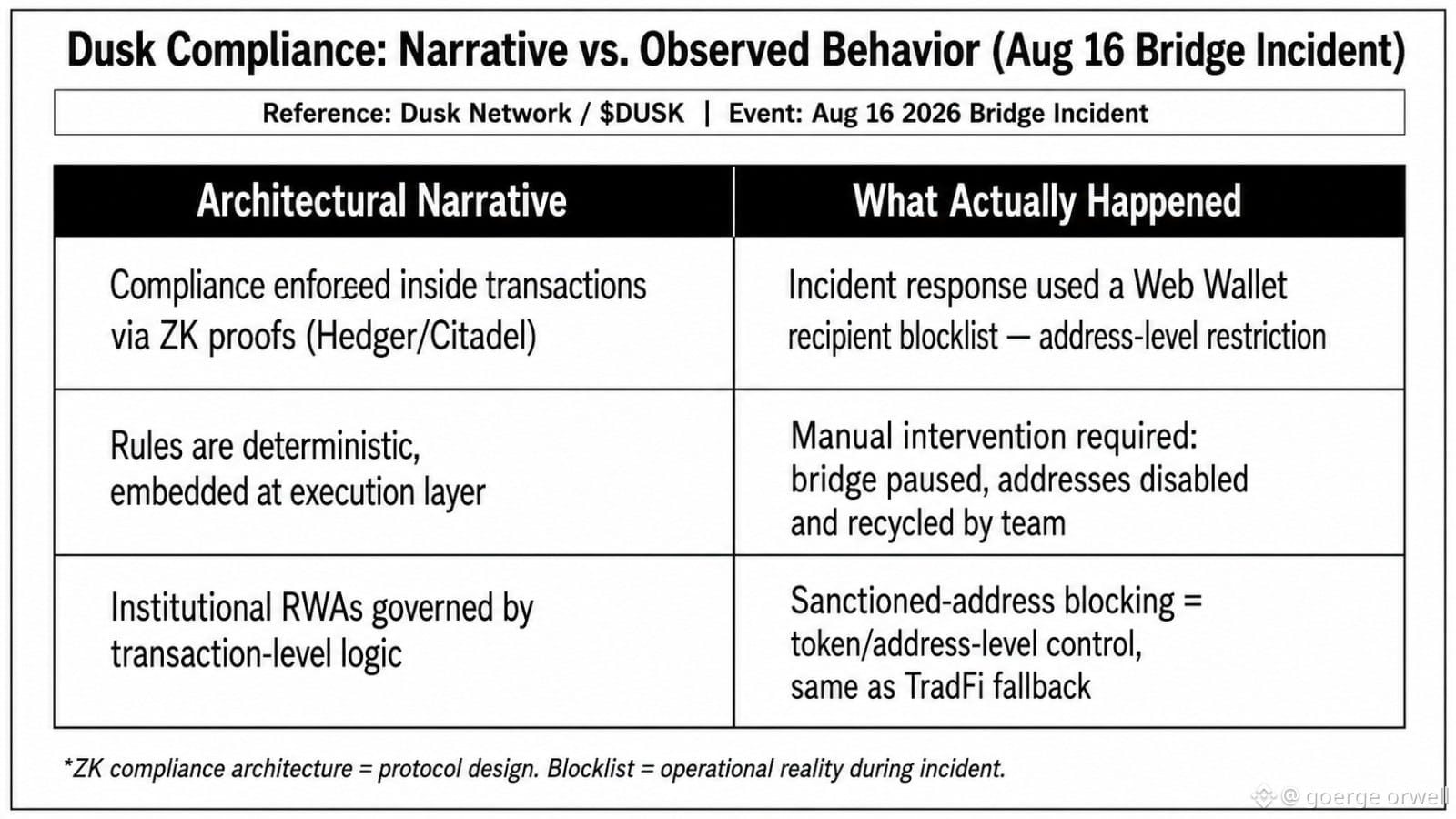
Been spending time with Dusk Network's compliance layer this week — specifically what $DUSK actually enables when you push past the pitch deck. The architectural argument is real: Citadel handles ZK-KYC at onboarding, Hedger enforces rule sets at execution. #dusk @Dusk The claim is that compliance lives inside the transaction, not around it. That's the whole distinction from every other RWA chain.
Then the August 16 bridge incident hit. Suspicious activity on a team-managed wallet, bridge paused, no user funds lost — they moved fast. But the remediation that stood out: a Web Wallet recipient blocklist, deployed to block transfers to flagged addresses. Address-level restriction. The same blunt instrument TradFi has used for decades. Block the address, not verify the transaction.
Which isn't a knock. Crisis response defaults to the fastest available tool, and a blocklist is exactly that. But it's a precise illustration of what the whole project is trying to escape. Token-level ownership is solved. Address-level blocking is solved. What's genuinely unsolved — and what the institutional RWA pitch depends on — is rules enforcing themselves at execution, inside every transaction, deterministically, without someone flipping a switch.
Dusk's architecture is pointed at that problem correctly. The question I keep turning over is whether the ZK compliance layer matures before the institutions it's courting need to actually use it under pressure...
Then the August 16 bridge incident hit. Suspicious activity on a team-managed wallet, bridge paused, no user funds lost — they moved fast. But the remediation that stood out: a Web Wallet recipient blocklist, deployed to block transfers to flagged addresses. Address-level restriction. The same blunt instrument TradFi has used for decades. Block the address, not verify the transaction.
Which isn't a knock. Crisis response defaults to the fastest available tool, and a blocklist is exactly that. But it's a precise illustration of what the whole project is trying to escape. Token-level ownership is solved. Address-level blocking is solved. What's genuinely unsolved — and what the institutional RWA pitch depends on — is rules enforcing themselves at execution, inside every transaction, deterministically, without someone flipping a switch.
Dusk's architecture is pointed at that problem correctly. The question I keep turning over is whether the ZK compliance layer matures before the institutions it's courting need to actually use it under pressure...