

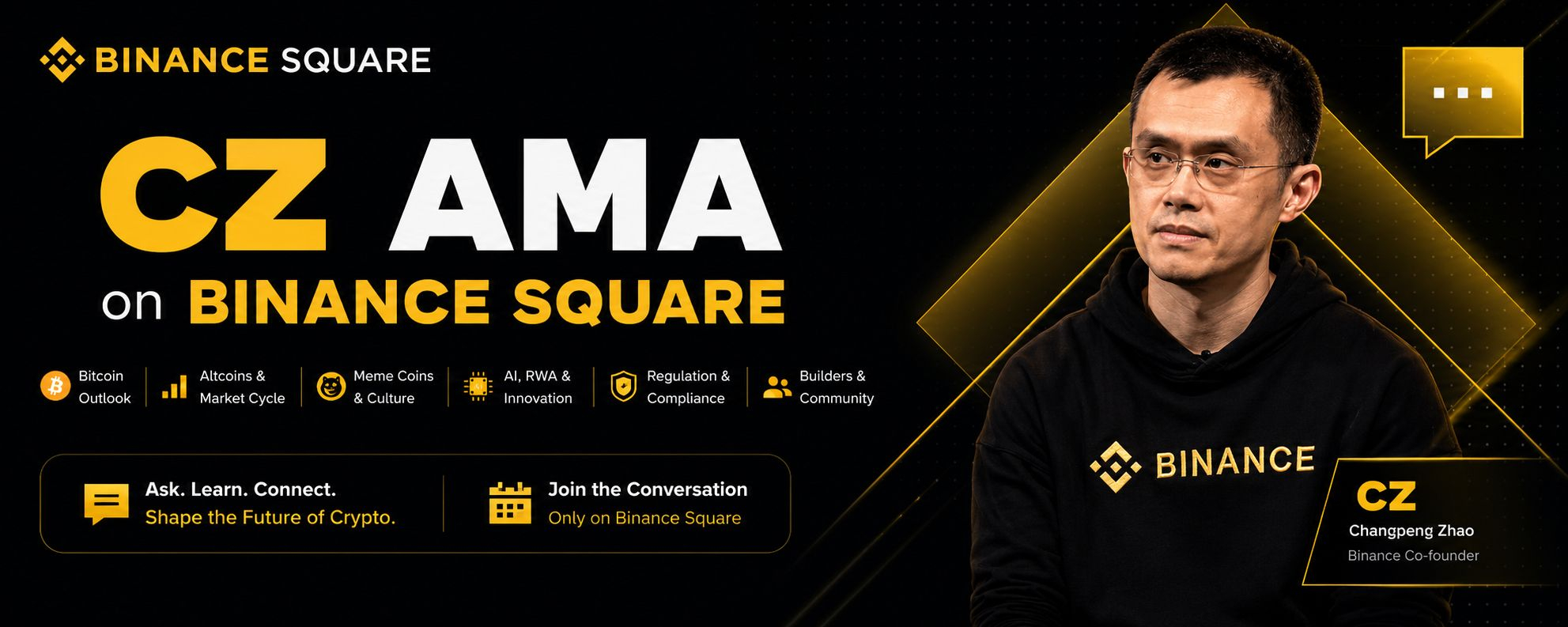


I went through the Binance Square material around CZ’s recent AMAs, and what caught my attention was that the conversation was not really about one coin or one market cycle. It was about where crypto is heading next, how people should navigate the noise, and what needs to happen for the industry to mature.
Changpeng Zhao, widely known as CZ, continues to attract enormous attention whenever he speaks about crypto. Even after stepping away from Binance’s executive role, his comments still influence discussions across the market. His Binance Square appearances have covered Bitcoin, altcoins, meme coins, regulation, AI, real-world assets, prediction markets, developers, education and even the future direction of Binance Square itself.
One of the biggest talking points surrounding CZ has been Bitcoin. His long-term view remains bullish, with Binance Square coverage highlighting his belief that Bitcoin reaching $200,000 is ultimately possible or inevitable, while the difficult question is when that level could be reached. That distinction matters because a long-term price thesis is very different from a short-term trading call.
Crypto markets constantly encourage people to think in days or hours. CZ’s comments point in the opposite direction. Bitcoin can experience major corrections, periods of low liquidity and extended consolidation without necessarily changing the larger adoption story. Anyone looking at his comments should therefore separate a long-term thesis from an immediate market prediction.
The same thinking applies to altcoins. CZ has indicated that another strong altcoin phase could eventually emerge, but he has also emphasized the difficulty of predicting exactly when it will happen and which projects will benefit. That is a more realistic way to look at market cycles. A broad altcoin rally does not automatically mean every token participates equally.
Liquidity, narratives, product development and user adoption can create very different outcomes between projects. During strong market conditions, hundreds of tokens can appear successful because liquidity is abundant. When conditions change, the difference between speculation and genuine usage becomes much clearer.
Meme coins are another area where CZ’s comments deserve more attention than the headlines usually give them.
Meme culture has become an undeniable part of crypto. Tokens can build communities extremely quickly, and social media can turn a joke into a tradable asset within a remarkably short period. But CZ has repeatedly warned users not to assume that a meme coin mentioned around his social activity is automatically endorsed by him. Binance’s AMA coverage also highlighted his view that most meme coins ultimately fail.
That warning is particularly relevant because crypto markets are heavily influenced by personalities.
When a well-known figure posts something, traders can immediately interpret it as a signal. But attention is not the same thing as endorsement, and a viral post is not the same thing as fundamental value. The distinction becomes especially important with low-liquidity assets, where social attention can produce large price movements in either direction.
CZ’s approach appears to be more interested in why a meme coin can maintain a community than simply how quickly its price rises. Cultural relevance, community identity and staying power can matter more than a short burst of speculation.
For beginners, his message is even more straightforward: learn before taking large risks.
Crypto makes leverage look attractive because a small amount of capital can control a much larger position. The problem is that leverage magnifies losses just as quickly as gains. CZ has advised newer users to start small, understand the market and avoid immediately jumping into complex leveraged products.
That is probably one of the most practical parts of the broader discussion.
The industry often focuses on finding the next big opportunity, but protecting capital is equally important. A trader who survives long enough to learn can participate in future opportunities. A trader who takes excessive leverage early can lose the ability to continue.
Another part of CZ’s outlook concerns developers.
There is a major difference between building a token and building a product. A token can attract attention immediately, but a useful application has to give people a reason to return. Developers therefore have to think beyond price charts and focus on usability, security, infrastructure and real demand.
That becomes increasingly important as the crypto industry becomes more competitive. There are now countless chains, protocols and applications competing for the same users and liquidity. A project cannot rely indefinitely on a launch narrative.
This is also where real-world assets, or RWAs, become interesting.
Tokenization is gradually becoming one of the major areas where traditional finance and blockchain technology intersect. The basic idea is to represent ownership or claims relating to real-world financial assets through blockchain infrastructure. But the real challenge is not simply putting an asset on-chain.
The difficult questions involve legal ownership, compliance, custody, settlement, liquidity and how tokenized assets interact with existing financial systems.
If those problems can be solved effectively, blockchain could become useful far beyond speculative token trading. That would represent a much broader form of adoption because the technology would be serving financial infrastructure rather than simply creating another category of digital assets.
AI is another area where CZ sees significant potential.
The relationship between AI and blockchain becomes particularly interesting when autonomous software agents begin interacting with financial systems. An AI agent can analyze information, make decisions and perform tasks, but eventually it may also need to pay for services or transfer value.
That creates a potential role for programmable digital payments.
The combination of AI agents, blockchain settlement and digital assets could produce new applications that are difficult to build using traditional financial infrastructure. But, just like RWA, this area is still developing. The biggest opportunities may not be obvious today.
Regulation is another unavoidable part of the conversation.
Crypto originally grew partly because it operated outside traditional financial structures. As the industry has expanded, however, regulation has become impossible to ignore. Exchanges, stablecoins, tokenized assets, payment systems and institutional products increasingly interact with traditional finance.
CZ’s comments have generally reflected the idea that regulatory clarity is better than complete uncertainty. Regulations can create restrictions, but they can also provide businesses and users with clearer rules about what is permitted.
For crypto companies, that means compliance is becoming part of the infrastructure rather than simply an administrative function.
The industry has also reached a point where centralized and decentralized platforms can coexist.
Centralized exchanges offer convenience, liquidity, customer support and familiar interfaces. Decentralized exchanges provide permissionless on-chain trading and different approaches to custody. Neither model necessarily has to eliminate the other.
The more likely outcome is a market where users choose between different systems depending on what they need.
CZ’s comments about Binance Square itself may be one of the most interesting parts of the entire AMA discussion.
Rather than viewing Square purely as a place where people post token updates, he has discussed the possibility of making it a broader information environment. The idea is that crypto users do not live inside a crypto-only world. Interest rates, AI developments, international events, regulation, taxation and macroeconomic decisions can all affect digital assets.
A platform that helps users connect those events could become more useful than one focused only on price movements.
This matters because information is becoming one of the most valuable assets in crypto.
There is already an enormous amount of content available. The problem is not finding information. The problem is identifying which information is useful, accurate and worth paying attention to.
That creates an opportunity for creators who can explain complicated developments without simply repeating headlines.
Binance Square is also developing an economic layer around content. Binance’s current Write to Earn program allows eligible creators to receive a share of trading fees when readers interact with eligible content and subsequently trade. Binance says creators start with a 20% commission, while top-ranked creators can reach a total commission of up to 50%.
That model changes the relationship between creator and platform.
A creator is no longer simply publishing for views. Useful content can potentially generate economic value when it leads to meaningful reader activity. At the same time, the system makes quality and trust more important because readers need a reason to interact with the content.
The program also shows how Binance Square is trying to connect social media with the trading environment instead of keeping the two completely separate.
But this creates an important responsibility for creators.
If content is produced only to generate clicks, the platform can quickly become saturated with low-quality predictions, recycled headlines and exaggerated claims. If creators focus on research, context and original observations, the same system can become much more useful.
This is where CZ’s broader message fits surprisingly well.
Build something useful.
Do not confuse attention with adoption.
Do not confuse a social post with an investment recommendation.
Do not confuse a short-term rally with a sustainable project.
And do not allow market noise to replace your own research.
There is another interesting development around Binance Square: the platform has been building tools that allow creators to publish content programmatically. Binance’s official Skills Hub describes a Square posting skill that can be connected to AI agents and used to automate publishing, while also emphasizing the importance of keeping a human review step for quality and compliance.
That development could become increasingly important as AI-generated content expands across crypto.
Automation can make publishing faster, but speed alone does not create value. If thousands of automated accounts produce similar posts, the amount of content increases while the amount of useful information may not.
Human judgment therefore becomes more valuable, not less.
The strongest creators will probably be the ones who use AI and automation as tools while still bringing their own research, interpretation and voice to the content.
That brings the CZ AMA discussion back to the larger question: what does the next stage of crypto actually look like?
It probably will not be defined by one narrative.
Bitcoin can continue developing as a major digital asset while stablecoins expand payments. Tokenized assets can connect blockchain with traditional finance. AI can create new demand for programmable payments. DeFi can continue experimenting with financial products. Centralized exchanges can provide liquidity and accessibility while decentralized protocols develop alternative infrastructure.
At the same time, social platforms such as Binance Square can become an increasingly important layer where users discover information about all of these developments.
The market will still have speculation. It will still have meme coins. It will still have dramatic pumps and painful corrections.
That is not going away.
What may change is the balance between speculation and utility.
As the industry becomes larger, projects will increasingly have to demonstrate why users need them. Creators will have to demonstrate why audiences should trust them. Exchanges will have to demonstrate that they can operate responsibly. And users will have to become better at separating information from promotion.
That is ultimately what makes the CZ AMA discussion interesting.
The most valuable takeaway is not a single Bitcoin price target, an altcoin prediction or a meme-coin opinion. It is the broader philosophy behind the conversation.
Crypto is becoming an ecosystem rather than a single market.
Bitcoin remains important, but it is only one part of the story. The next phase also involves AI, tokenization, payments, regulation, decentralized infrastructure, content and education.
For Binance Square creators, that creates a clear opportunity. Instead of chasing every headline, there is room to build a reputation around useful research and original thinking. Instead of simply asking what coin will pump next, creators can explain why a development matters, what could change and what risks users should understand.
And for readers, the lesson is equally important: do not outsource your judgment to personalities, influencers or viral posts.
CZ can share his perspective, but every market participant still has to make their own decisions.
The future of crypto will ultimately be decided by what people actually use, what developers continue building, what financial institutions adopt and what users are willing to trust.
That is the bigger story behind #CZAMAonBinanceSquare.
Not one prediction.
Not one token.
Not one market cycle.
It is a conversation about where crypto goes when the noise becomes less important than the infrastructure being built underneath it.
And that may be the most useful way to read CZ’s message: think beyond the next candle, look beyond the next trend, and pay attention to what could still matter when today’s narrative has disappeared.