I've watched enough crypto cycles to know that decentralization usually comes with an asterisk somewhere. You just have to read far enough to find it.
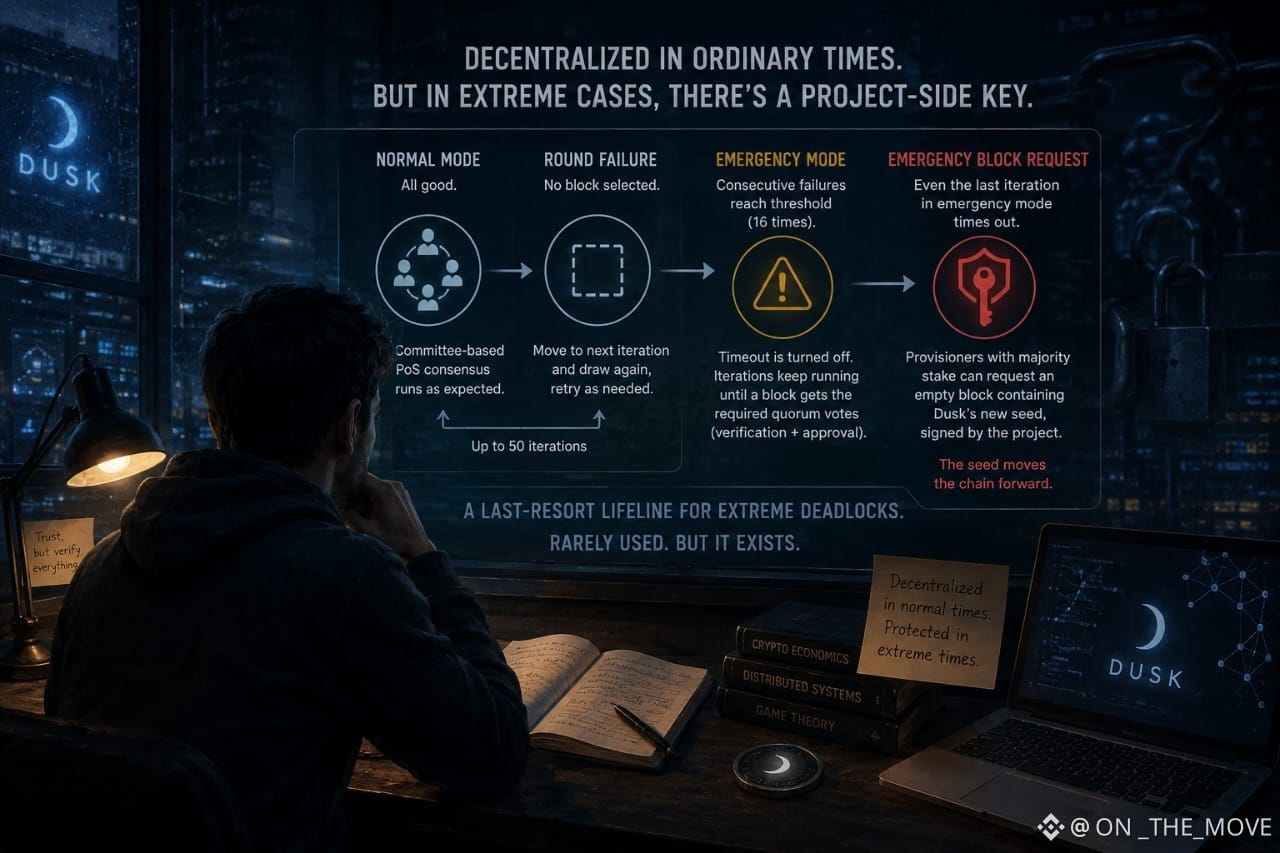
That’s what caught my attention with Dusk. I started looking at its consensus design expecting the usual story: if a round fails, you just try again. And yes, that happens. But after enough consecutive failures, the protocol enters emergency mode and keeps the iterations going until a block finally gets the quorum it needs. The interesting part is what happens when even that fails.
The final fallback is an emergency block. Provisioners holding a majority of stake can request it, and the empty block carries a new seed signed by Dusk itself, verifiable through a global public key.
I’ve seen this kind of compromise before. People call systems decentralized when everything works normally, then quietly accept a special escape hatch for the moment when everything breaks. I don’t automatically think that makes Dusk centralized. Honestly, refusing to have a last-resort mechanism could be worse.
But I’m not sure yet how comfortable I am with that boundary. Who controls the emergency path in practice? How transparent are those requests? Can outsiders independently audit when and why it was triggered?
That’s where my skepticism starts. Not because the fallback exists, but because the most important part of decentralization is often what happens when the normal rules stop working.
And that’s exactly when I start paying closer attention.
@Dusk #dusk $DUSK
That’s what caught my attention with Dusk. I started looking at its consensus design expecting the usual story: if a round fails, you just try again. And yes, that happens. But after enough consecutive failures, the protocol enters emergency mode and keeps the iterations going until a block finally gets the quorum it needs. The interesting part is what happens when even that fails.
The final fallback is an emergency block. Provisioners holding a majority of stake can request it, and the empty block carries a new seed signed by Dusk itself, verifiable through a global public key.
I’ve seen this kind of compromise before. People call systems decentralized when everything works normally, then quietly accept a special escape hatch for the moment when everything breaks. I don’t automatically think that makes Dusk centralized. Honestly, refusing to have a last-resort mechanism could be worse.
But I’m not sure yet how comfortable I am with that boundary. Who controls the emergency path in practice? How transparent are those requests? Can outsiders independently audit when and why it was triggered?
That’s where my skepticism starts. Not because the fallback exists, but because the most important part of decentralization is often what happens when the normal rules stop working.
And that’s exactly when I start paying closer attention.
@Dusk #dusk $DUSK