I had a landlord who refused rent by check — cash only, no paper trail, "it avoids disputes." Worked fine until a tenant claimed they'd paid when they hadn't, and there was nothing to check it against. No record cuts both ways.
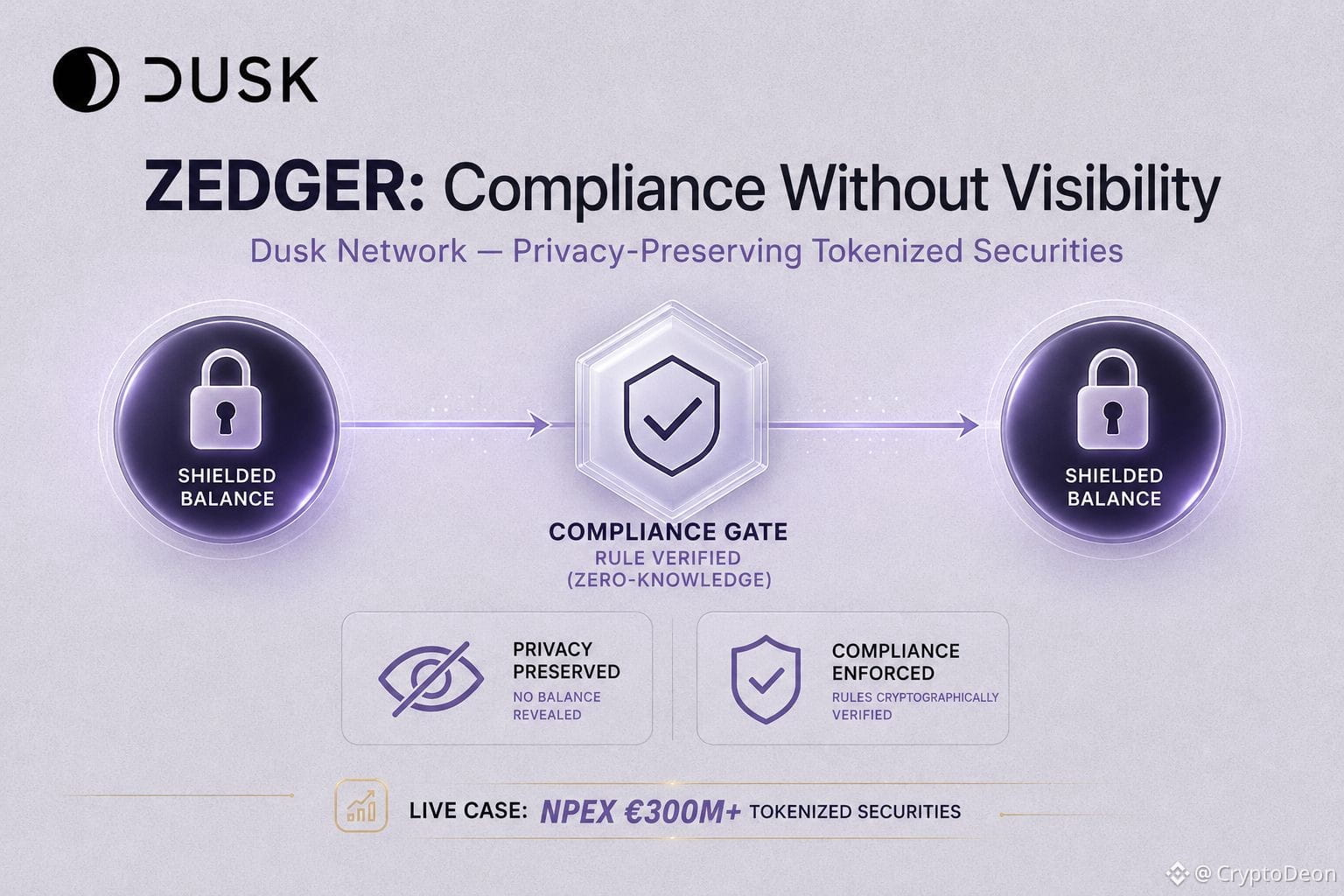
That came back to me reading about Zedger, Dusk's model for tokenized securities. Most "compliant" standards handle rules the landlord's way — either everything's visible so disputes get settled by looking, or things are hidden and you're trusting the issuer's word. Zedger enforces the rule cryptographically before the transfer happens. If an asset caps ownership, requires pre-approved investors, or restricts someone to one account, that check is built into the transfer itself — it goes through or it doesn't, balances still shielded the whole time. No one needs to see your holdings to confirm you're not breaking the rule. The math confirms it for them.
That's a real answer to the landlord's problem — provable without being visible, instead of trading one for the other.
Where I'm less sure: this only covers transfer-level rules — caps, eligibility, account limits. It doesn't resolve disputes about intent or fraud sitting outside the rule itself, the way a "did you actually pay" fight still needs some external record.
DUSK sits around $0.0605 today, market cap near $30M, with Zedger's live use case running through NPEX's €300M+ in tokenized securities — infrastructure the market hasn't repriced around yet.
Does enforcing compliance at the protocol level close every dispute a regulator might raise, or does something always end up needing a human outside the code?
$DUSK #dusk #BinanceSquare @Dusk
That came back to me reading about Zedger, Dusk's model for tokenized securities. Most "compliant" standards handle rules the landlord's way — either everything's visible so disputes get settled by looking, or things are hidden and you're trusting the issuer's word. Zedger enforces the rule cryptographically before the transfer happens. If an asset caps ownership, requires pre-approved investors, or restricts someone to one account, that check is built into the transfer itself — it goes through or it doesn't, balances still shielded the whole time. No one needs to see your holdings to confirm you're not breaking the rule. The math confirms it for them.
That's a real answer to the landlord's problem — provable without being visible, instead of trading one for the other.
Where I'm less sure: this only covers transfer-level rules — caps, eligibility, account limits. It doesn't resolve disputes about intent or fraud sitting outside the rule itself, the way a "did you actually pay" fight still needs some external record.
DUSK sits around $0.0605 today, market cap near $30M, with Zedger's live use case running through NPEX's €300M+ in tokenized securities — infrastructure the market hasn't repriced around yet.
Does enforcing compliance at the protocol level close every dispute a regulator might raise, or does something always end up needing a human outside the code?
$DUSK #dusk #BinanceSquare @Dusk