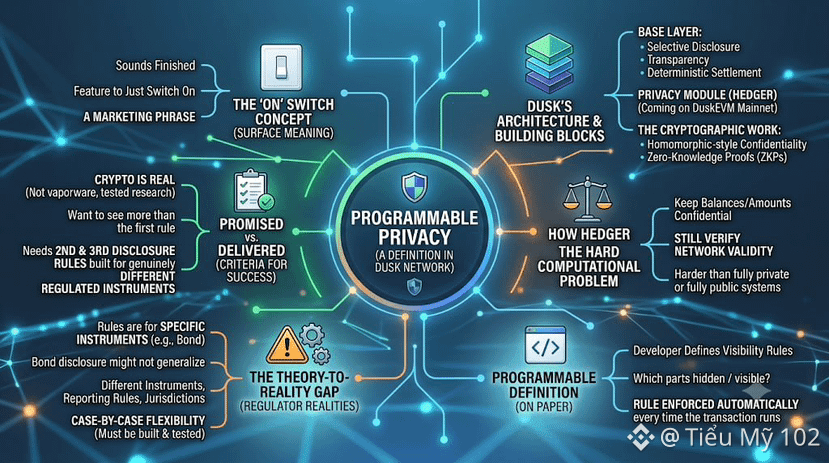
Programmable privacy is a phrase that sounds finished the moment you read it, like a feature you can just switch on. Dusk Network uses language close to this to describe what its architecture delivers for regulated markets, and I wanted to check what is actually sitting underneath the phrase before repeating it myself.
On paper, programmable privacy means a developer can define exactly which parts of a transaction stay hidden and which parts stay visible, then have that rule enforced automatically every time the transaction runs. Dusk's version rests on selective disclosure, one piece of a base layer that also includes transparency and deterministic settlement, combined with Hedger, the privacy module doing the actual cryptographic work on the coming DuskEVM mainnet. Hedger has to keep balances and transfer amounts confidential while still letting the network verify that a transaction is valid, a harder computational problem than either fully private or fully public systems have to solve.
The theory-to-reality gap shows up in the specifics regulators actually ask for. A rule that works cleanly for one type of instrument, a bond with a fixed set of disclosure requirements, might not generalize automatically to a different instrument with different reporting rules in a different jurisdiction. Programmable suggests flexibility that has to be built and tested case by case, not assumed from the architecture alone.
I take the underlying cryptography seriously. Homomorphic-style confidentiality combined with proof systems is real, tested territory in research, not vaporware. What I would want to see before calling programmable privacy delivered, rather than promised, is a second and third disclosure rule built for a genuinely different regulated instrument, not just the first one that shipped.
@Dusk $DUSK #dusk
On paper, programmable privacy means a developer can define exactly which parts of a transaction stay hidden and which parts stay visible, then have that rule enforced automatically every time the transaction runs. Dusk's version rests on selective disclosure, one piece of a base layer that also includes transparency and deterministic settlement, combined with Hedger, the privacy module doing the actual cryptographic work on the coming DuskEVM mainnet. Hedger has to keep balances and transfer amounts confidential while still letting the network verify that a transaction is valid, a harder computational problem than either fully private or fully public systems have to solve.
The theory-to-reality gap shows up in the specifics regulators actually ask for. A rule that works cleanly for one type of instrument, a bond with a fixed set of disclosure requirements, might not generalize automatically to a different instrument with different reporting rules in a different jurisdiction. Programmable suggests flexibility that has to be built and tested case by case, not assumed from the architecture alone.
I take the underlying cryptography seriously. Homomorphic-style confidentiality combined with proof systems is real, tested territory in research, not vaporware. What I would want to see before calling programmable privacy delivered, rather than promised, is a second and third disclosure rule built for a genuinely different regulated instrument, not just the first one that shipped.
@Dusk $DUSK #dusk