
$AAOI

Посты


Binance News
·
--
Market News: AI Hardware Complex Sells Off in Pre-Market — Optical Communication Leads Declines With AAOI Down 11.66%
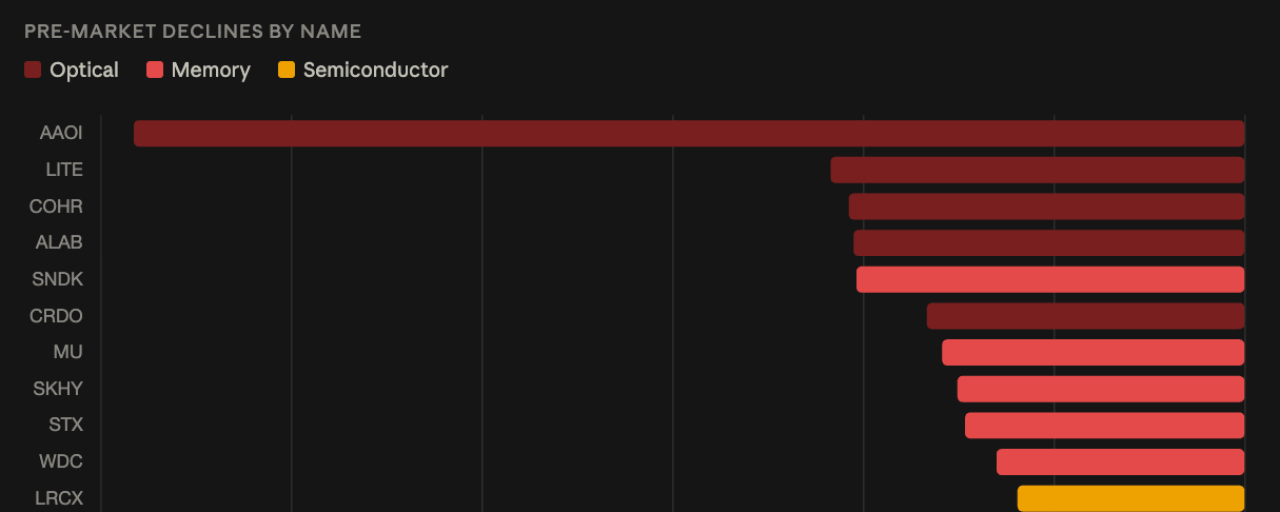
US semiconductor, memory and optical communication stocks weakened across the board in Monday pre-market trading, according to data from BIT. Optical communication names led the declines, with Applied Optoelectronics falling 11.66% — by a wide margin the session's largest single-stock move — alongside Lumentum down 4.35%, Coherent down 4.16%, Astera Labs down 4.11%, and Credo down 3.34%. Memory stocks followed, with SanDisk down 4.08%, Micron down 3.18%, SK Hynix down 3.02%, Seagate down 2.94%, and Western Digital down 2.61%. Semiconductor names declined more modestly: Lam Research down 2.39%, Applied Materials down 2.05%, Arm down 1.96%, and Intel down 1.7%.
The Three-Tier Selloff Pattern
The decline's structure is analytically informative. Optical communication — the connectivity layer that links GPUs within and between AI data centers — fell hardest, averaging roughly 4-5% excluding AAOI's outlier move. Memory followed at roughly 3%. Core semiconductor equipment and design names declined least, around 2%.
That ordering is the inverse of how the AI infrastructure trade rallied. Optical and memory are the highest-beta expressions of AI buildout expectations — smaller companies, more concentrated customer bases, and revenue that depends almost entirely on data center capital expenditure continuing at current rates. Core semiconductor names like Lam Research and Applied Materials have diversified end markets that cushion AI-specific sentiment shifts. When AI capex expectations wobble, the highest-beta names move first and furthest.
AAOI's 11.66% Drop — Well Outside the Sector Pattern
Applied Optoelectronics falling 11.66% is nearly three times the next-largest optical decline. A move of that magnitude against a 4% sector backdrop typically reflects company-specific news — a guidance revision, a customer concentration issue, an analyst downgrade, or a supply agreement change — rather than sector sentiment alone. AAOI's business is heavily weighted toward transceivers for hyperscale data centers, making it particularly exposed to any single customer's order timing.
The Context — Nvidia Earnings and a Fragile AI Trade
The selloff arrives at a specific moment in the AI infrastructure narrative. August has been a whipsaw month for the sector: SK Hynix missed consensus despite 257% year-over-year revenue growth, China's DUV lithography breakthrough drove the Kospi down 40% from its June peak, and the Nasdaq fell roughly 2% last week with the semiconductor sector dropping more than 4%. Against that, Amazon posted 37% AWS growth — its fastest in 18 quarters — CoreWeave surged 16% after hours on stronger-than-expected sales, HIVE announced a $350 million GPU cloud deal, and SK Hynix committed $38 billion to memory capacity expansion.
The demand data has been unambiguously strong. The equity performance has not. That gap is the setup for Nvidia's earnings this week, which the market has framed as the AI trade's verdict: analysts see a strong report and guidance as the potential catalyst for the S&P 500 to break 8,000, and a miss as the trigger for broader technology sector pressure. Monday's pre-market weakness reads as positioning ahead of that binary rather than a response to new information.
The Crypto Read-Through
For crypto, the AI hardware complex matters through two channels. The first is correlation: Bitcoin's chip-selloff sessions in July and August saw meaningful spillover as the AI trade repriced. That channel has weakened — Bitcoin gained 23.6% last week while the Nasdaq fell 2%, with crypto and gold rallying together as equities lagged, the relative performance signature of a debasement trade rather than general risk-on.
The second channel is more direct. Bitcoin miners that pivoted to AI compute — IREN with $2.8 billion in contracts across Microsoft, Nvidia, Perplexity and Figure AI, Hut 8 with its $9.8 billion Beacon Point lease, Ionic Digital with 234MW leased to Nscale, and HIVE with $180 million in contracted annual recurring revenue — have valuations built on AI infrastructure demand persisting. IREN reports Thursday post-market. If Nvidia's report and guidance confirm that hyperscaler capex is accelerating, the contracted revenue frameworks these companies have built become considerably more credible. If it disappoints, the entire crypto-adjacent AI infrastructure cohort reprices alongside the optical and memory names that led Monday's decline.
The Three-Tier Selloff Pattern
The decline's structure is analytically informative. Optical communication — the connectivity layer that links GPUs within and between AI data centers — fell hardest, averaging roughly 4-5% excluding AAOI's outlier move. Memory followed at roughly 3%. Core semiconductor equipment and design names declined least, around 2%.
That ordering is the inverse of how the AI infrastructure trade rallied. Optical and memory are the highest-beta expressions of AI buildout expectations — smaller companies, more concentrated customer bases, and revenue that depends almost entirely on data center capital expenditure continuing at current rates. Core semiconductor names like Lam Research and Applied Materials have diversified end markets that cushion AI-specific sentiment shifts. When AI capex expectations wobble, the highest-beta names move first and furthest.
AAOI's 11.66% Drop — Well Outside the Sector Pattern
Applied Optoelectronics falling 11.66% is nearly three times the next-largest optical decline. A move of that magnitude against a 4% sector backdrop typically reflects company-specific news — a guidance revision, a customer concentration issue, an analyst downgrade, or a supply agreement change — rather than sector sentiment alone. AAOI's business is heavily weighted toward transceivers for hyperscale data centers, making it particularly exposed to any single customer's order timing.
The Context — Nvidia Earnings and a Fragile AI Trade
The selloff arrives at a specific moment in the AI infrastructure narrative. August has been a whipsaw month for the sector: SK Hynix missed consensus despite 257% year-over-year revenue growth, China's DUV lithography breakthrough drove the Kospi down 40% from its June peak, and the Nasdaq fell roughly 2% last week with the semiconductor sector dropping more than 4%. Against that, Amazon posted 37% AWS growth — its fastest in 18 quarters — CoreWeave surged 16% after hours on stronger-than-expected sales, HIVE announced a $350 million GPU cloud deal, and SK Hynix committed $38 billion to memory capacity expansion.
The demand data has been unambiguously strong. The equity performance has not. That gap is the setup for Nvidia's earnings this week, which the market has framed as the AI trade's verdict: analysts see a strong report and guidance as the potential catalyst for the S&P 500 to break 8,000, and a miss as the trigger for broader technology sector pressure. Monday's pre-market weakness reads as positioning ahead of that binary rather than a response to new information.
The Crypto Read-Through
For crypto, the AI hardware complex matters through two channels. The first is correlation: Bitcoin's chip-selloff sessions in July and August saw meaningful spillover as the AI trade repriced. That channel has weakened — Bitcoin gained 23.6% last week while the Nasdaq fell 2%, with crypto and gold rallying together as equities lagged, the relative performance signature of a debasement trade rather than general risk-on.
The second channel is more direct. Bitcoin miners that pivoted to AI compute — IREN with $2.8 billion in contracts across Microsoft, Nvidia, Perplexity and Figure AI, Hut 8 with its $9.8 billion Beacon Point lease, Ionic Digital with 234MW leased to Nscale, and HIVE with $180 million in contracted annual recurring revenue — have valuations built on AI infrastructure demand persisting. IREN reports Thursday post-market. If Nvidia's report and guidance confirm that hyperscaler capex is accelerating, the contracted revenue frameworks these companies have built become considerably more credible. If it disappoints, the entire crypto-adjacent AI infrastructure cohort reprices alongside the optical and memory names that led Monday's decline.
Отказ от ответственности. Содержит мнения третьих сторон. Не является рекомендацией. Binance AI не предоставляет гарантий. См. Правила и условия.