

Bitcoin started as an idea that challenged one of the oldest assumptions in finance: that money must always depend on a central authority.
Today, Bitcoin has grown far beyond that original concept. It has become one of the most discussed digital assets in the world, attracting investors, institutions, developers, businesses, and millions of individuals who are interested in the future of money.
But understanding Bitcoin is about more than watching its price move up or down.
What Makes Bitcoin Different?
Bitcoin operates on a decentralized blockchain network. Instead of relying on a single institution to maintain the system, transactions are verified and recorded across a distributed network of participants.
This structure gives Bitcoin several unique characteristics:
- A fixed maximum supply of 21 million BTC
- Decentralized transaction verification
- Transparent blockchain records
- Global accessibility
- The ability to transfer value without traditional banking infrastructure
These characteristics have helped Bitcoin develop a unique position within the digital economy.
Bitcoin and Scarcity
One of Bitcoin’s most important features is its limited supply.
Unlike currencies that can have their supply expanded through monetary policy, Bitcoin’s protocol has a predetermined maximum supply of 21 million coins.
This scarcity is one reason Bitcoin is often compared to digital gold.
However, scarcity alone does not create value. Bitcoin’s long-term significance also depends on adoption, security, liquidity, network activity, regulation, and how people choose to use it.
The Role of Bitcoin in a Changing Financial System
Financial markets are becoming increasingly digital.
People can transfer money across borders almost instantly, access financial information from their phones, and participate in global markets without being physically present in a financial center.
Bitcoin fits naturally into this broader digital transformation.
For some people, it represents an alternative form of money.
For others, it is a long-term asset.
For others still, Bitcoin represents an experiment in decentralized financial infrastructure.
The important point is that Bitcoin can mean different things to different participants.
Bitcoin Is More Than a Price Chart
Crypto markets often focus heavily on price.
A green candle can create excitement, while a sharp correction can create fear. Social media can quickly turn a small move into a major narrative.
But Bitcoin’s development cannot be measured only through daily price movements.
The bigger story includes network security, adoption, infrastructure, institutional participation, regulation, custody solutions, payment technology, and the continued development of the broader blockchain ecosystem.
Price is only one part of the Bitcoin story.
The Importance of Bitcoin Adoption
Every major technology goes through different stages of adoption.
At first, new technology is usually understood by a relatively small group of early users. Over time, infrastructure improves, education expands, and more people begin to understand its potential.
Bitcoin has already moved far beyond its earliest community.
Today, discussions around Bitcoin involve individual investors, financial institutions, technology companies, policymakers, payment providers, and businesses.
That growing participation has made Bitcoin an important part of conversations about the future of finance.
Bitcoin and Financial Freedom
Another important idea connected to Bitcoin is financial accessibility.
Traditional financial systems can sometimes create barriers based on geography, banking access, transfer infrastructure, or operating hours.
Bitcoin operates on a global network that is available around the clock.
This does not mean Bitcoin solves every financial problem, nor does it eliminate the need for traditional financial institutions.
Instead, it provides another way of thinking about how value can be stored and transferred in a digital world.
The Risks Matter Too
Bitcoin should not be viewed as a guaranteed path to wealth.
Its price can be highly volatile, and investors can experience significant gains as well as significant losses.
There are also risks involving security, scams, private-key management, regulation, liquidity, and market sentiment.
That is why understanding Bitcoin is more important than simply buying it because the market is moving higher.
A responsible approach starts with education.
Understand what you are buying, understand the risks, and never invest more than you can afford to lose.
Looking Toward the Future
The future of Bitcoin will likely depend on several factors.
Regulation will influence how businesses and financial institutions interact with digital assets.
Technology will continue improving the infrastructure surrounding Bitcoin.
Institutional participation could influence liquidity and market structure.
At the same time, ordinary users will continue determining whether Bitcoin becomes a meaningful part of everyday financial activity.
Nobody can predict exactly where Bitcoin will be years from now.
But one thing is clear: the conversation around decentralized digital money is no longer limited to a small group of technology enthusiasts.
Final Thoughts
Bitcoin represents one of the most interesting financial experiments of the digital age.
Its value proposition is built around decentralization, scarcity, transparency, and a global network that operates without a central monetary authority.
Whether someone views Bitcoin as digital gold, a technological innovation, an investment asset, or an alternative financial network, understanding its fundamentals is becoming increasingly important.
The biggest lesson is simple:
Bitcoin is not just about the next price target.
It is about a broader question: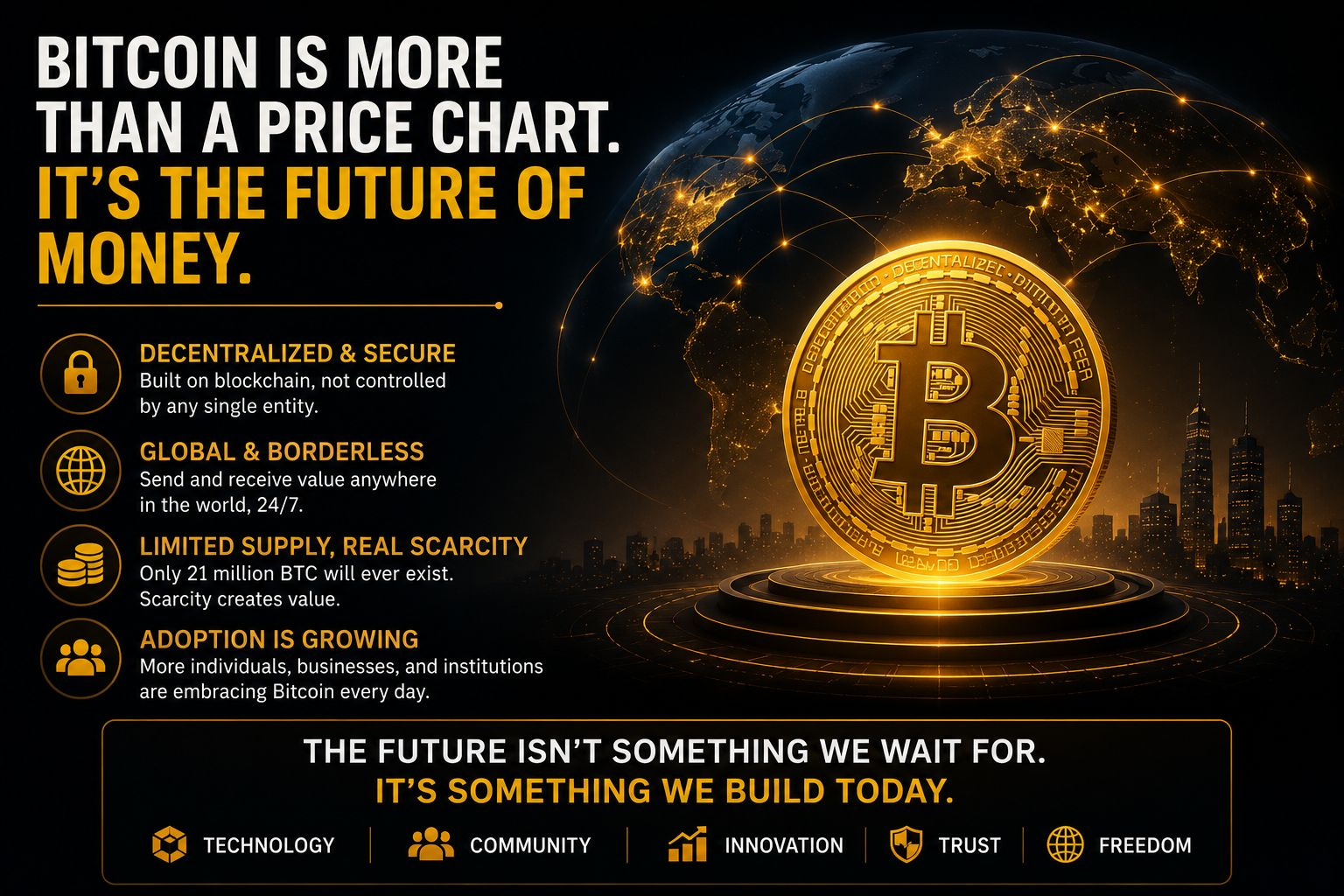
What should money look like in a world that is becoming increasingly digital, global, and connected?
That question is still being explored, and Bitcoin remains at the center of the conversation.#BTC走势分析