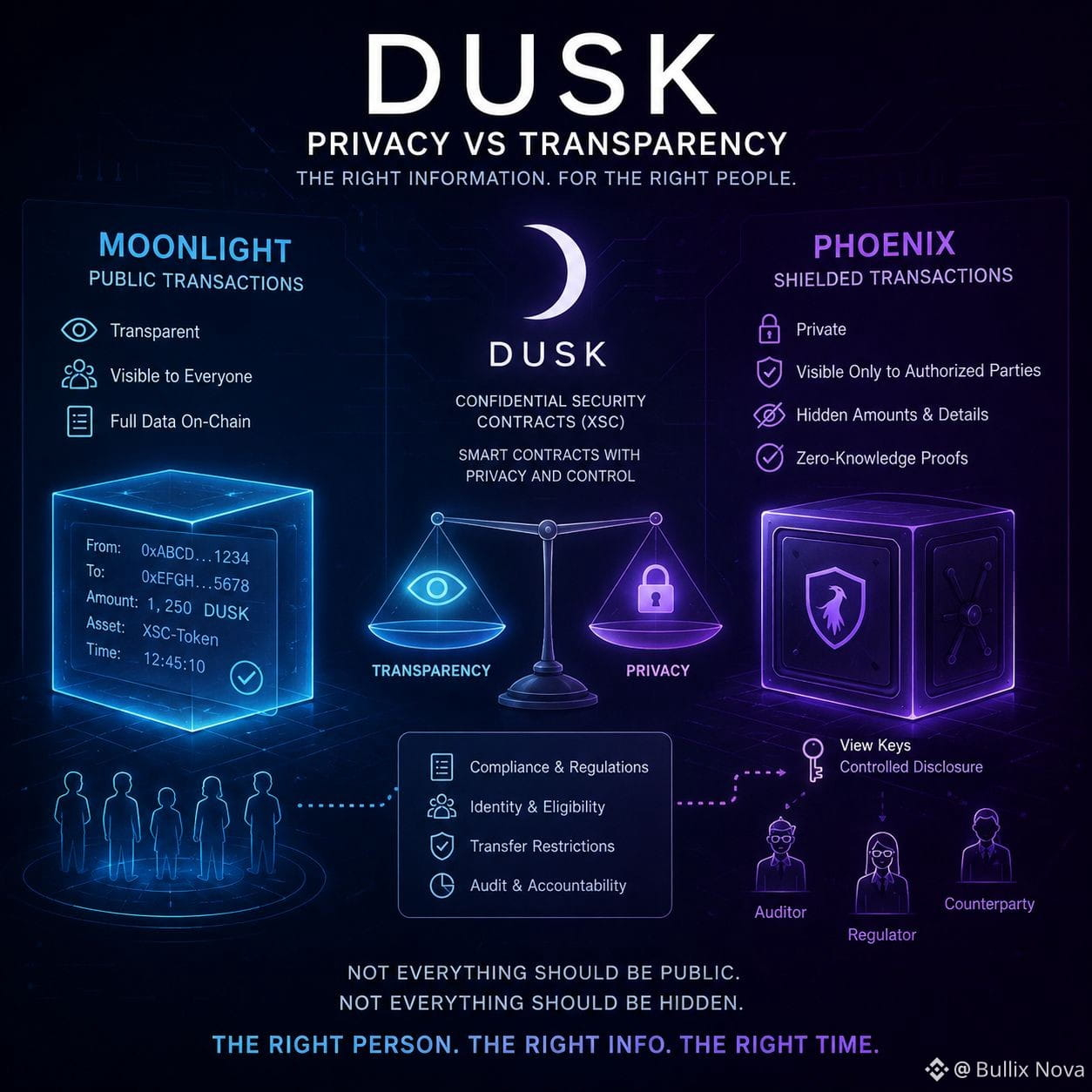
I keep coming back to DUSK for one simple reason:
privacy on a financial blockchain is not as simple as “hide everything.”
A trader may not want the whole world seeing how much they bought.
An issuer may not want every wallet watching every movement of an asset.
But an auditor still needs to check something.
That tension is where Dusk gets interesting.
Dusk has public transactions through Moonlight, and shielded transactions through Phoenix.
With Phoenix, the point isn't to make the transaction disappear.
The network still needs to know it is valid.
It just doesn't need to broadcast all the sensitive details to everyone.
And honestly, that feels much closer to how real finance works.
Your bank doesn't publish your account balance on a billboard.
But it can still prove that a payment happened.
That's the part crypto often misses.
Privacy isn't necessarily the opposite of transparency.
The better question is:
who gets to see what, and when?
That's also why Dusk's work around confidential securities is more interesting than simply calling it a “privacy chain.”
A security has rules.
Who can hold it.
Who can transfer it.
What information has to be disclosed.
What an auditor needs to verify.
You can't just add zero-knowledge proofs and call the problem solved.
You need privacy, but you also need accountability.
And there's a real trade-off.
The more private a system becomes, the less raw data is available for explorers, analytics and apps.
That means more proofs, permissions and selective disclosure.
That's the cost.
So the question I'm watching isn't:
“Can Dusk hide transactions?”
We already know cryptography can do that.
The harder question is whether Dusk can make financial information private without making the financial system blind.
Maybe the future isn't everything public.
And maybe it isn't everything hidden either.
Maybe it's simply:
the right person sees the right information, for the right reason, at the right time.
#dusk $DUSK @Dusk