Anyone who has traded any real size knows the discomfort of a public order book. Your position, your timing, your accumulation pattern, all visible to anyone watching, all usable against you. I do not think most onchain finance projects have taken that problem seriously. Dusk might be an exception.
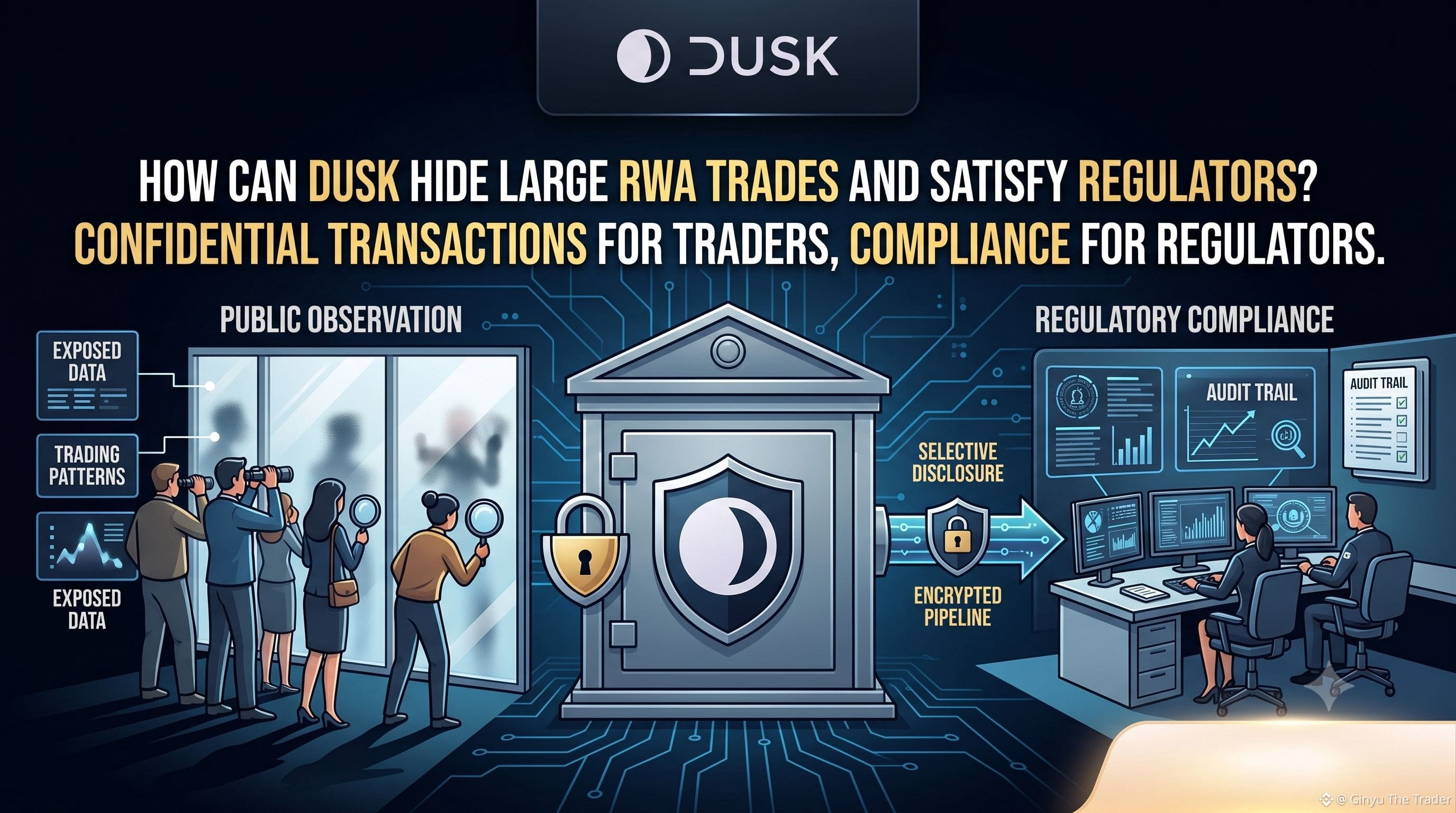
Hedger, the confidential transaction module built for DuskEVM, uses homomorphic encryption and zero knowledge proofs to keep balances and transfer amounts hidden while still letting the network verify every transaction is valid. Layered onto Dusk Trade, the neobroker Dusk is building for tokenized money market funds, ETFs, and bonds, that same confidentiality could extend to actual trading activity around real world assets, not just simple token transfers between two wallets. A large redemption or a fund rebalancing would not need to broadcast its size to every observer on chain the moment it happens, the way a fully transparent ledger forces it to today.
That is the appealing version of the story. The harder question is how much of that privacy regulators actually tolerate once real securities and real market surveillance requirements are involved. Public markets built their transparency rules for a reason, catching manipulation, insider trading, and settlement fraud, and selective disclosure has to satisfy those same concerns even while hiding information from ordinary observers. Dusk's answer is letting regulators see what they are entitled to see through disclosure mechanisms while the public sees less. Whether regulators accept that tradeoff at scale, for real securities rather than pilot programs, is not something engineering alone decides, no matter how elegant the cryptography underneath it is.
I think this is one of the more interesting open questions around Dusk Trade, not a settled feature.
@Dusk $DUSK #dusk
Hedger, the confidential transaction module built for DuskEVM, uses homomorphic encryption and zero knowledge proofs to keep balances and transfer amounts hidden while still letting the network verify every transaction is valid. Layered onto Dusk Trade, the neobroker Dusk is building for tokenized money market funds, ETFs, and bonds, that same confidentiality could extend to actual trading activity around real world assets, not just simple token transfers between two wallets. A large redemption or a fund rebalancing would not need to broadcast its size to every observer on chain the moment it happens, the way a fully transparent ledger forces it to today.
That is the appealing version of the story. The harder question is how much of that privacy regulators actually tolerate once real securities and real market surveillance requirements are involved. Public markets built their transparency rules for a reason, catching manipulation, insider trading, and settlement fraud, and selective disclosure has to satisfy those same concerns even while hiding information from ordinary observers. Dusk's answer is letting regulators see what they are entitled to see through disclosure mechanisms while the public sees less. Whether regulators accept that tradeoff at scale, for real securities rather than pilot programs, is not something engineering alone decides, no matter how elegant the cryptography underneath it is.
I think this is one of the more interesting open questions around Dusk Trade, not a settled feature.
@Dusk $DUSK #dusk