

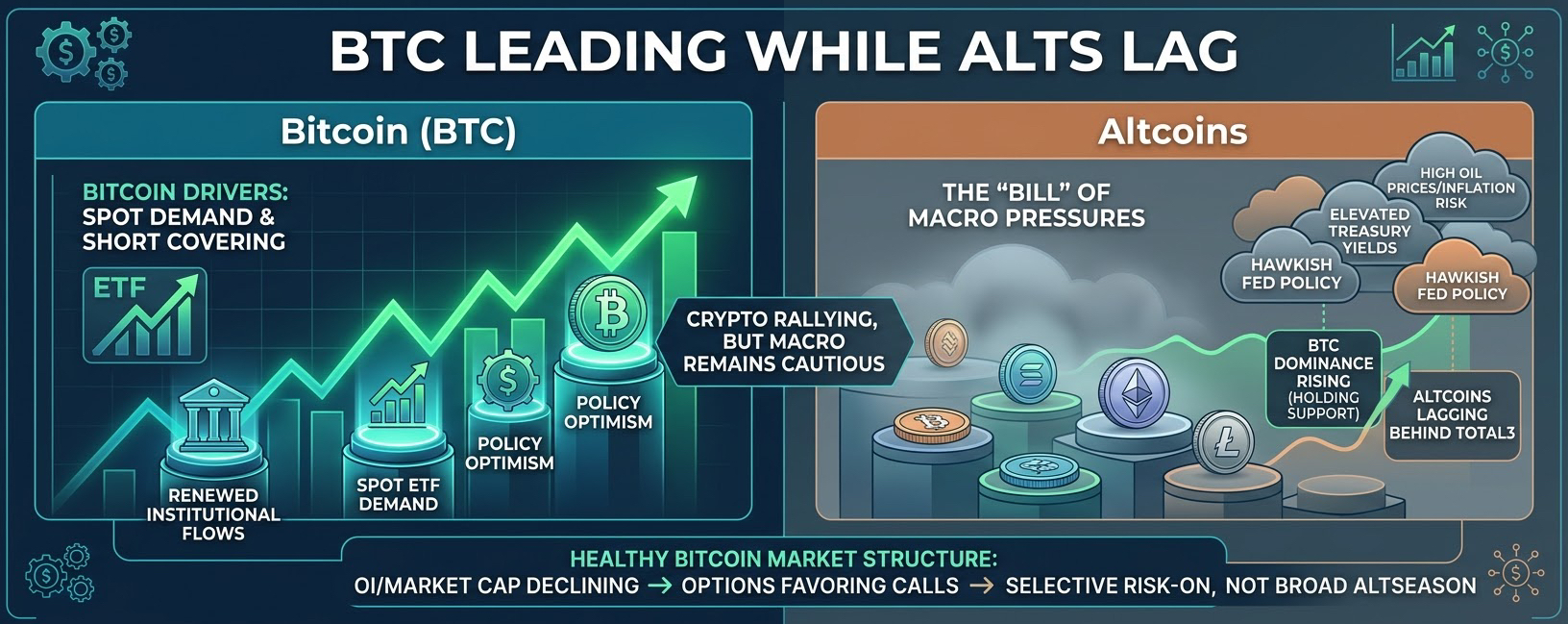

The crypto market has delivered a strong rebound, but the underlying story is more complicated than simply saying “risk is back.”
Bitcoin has pushed higher on renewed institutional flows, short covering, and optimism around U.S. crypto regulation. Yet at the same time, the macro environment remains challenging: oil is elevated, long-term Treasury yields are high, and the Federal Reserve has not opened a clear path toward rate cuts.
That creates an important distinction:
Crypto is rallying, but the broader macro environment has not fully turned bullish.
The current move looks more like a policy-driven repricing supported by spot demand and short liquidations, rather than a full-blown leverage-fueled bull phase.
1. Macro Still Looks Uncomfortable for Risk Assets
One of the biggest developments is the combination of higher oil prices and rising long-term Treasury yields.
The Hormuz supply situation has increased concerns about energy prices and inflation. At the same time, the July FOMC minutes were relatively hawkish, with several Fed officials keeping the possibility of future rate hikes on the table if inflation stops improving.
Earlier weak jobs, retail sales and CPI data reduced the probability of an immediate hike.
But that does not automatically mean the Fed is preparing to cut rates.
That distinction is extremely important for Bitcoin and other high-beta assets.
What is happening in simple terms?
Think of it this way:
Higher oil → higher inflation risk → higher bond yields → higher discount rates → pressure on risky assets.
Long-term Treasury yields briefly moved above 4.70%, before retreating toward roughly 4.64%.
The Treasury's decision to increase long-duration bond buybacks can help improve liquidity and auction absorption, but it doesn't directly remove the bigger structural pressures coming from:
Energy-related inflation risk
Large government deficits
Heavy Treasury issuance
Elevated term premium
So the bond-market problem isn't necessarily solved by buybacks.
The key macro signal
The important observation is that:
Yields were rising while equities were falling.
That points more toward a discount-rate shock than a growth-driven risk-on environment.
Crude oil and gold also outperforming the S&P 500 reinforces the same message.
For crypto traders, this means the macro backdrop still deserves respect.
2. Bitcoin Is Moving Against the Macro Trend
This is where the crypto story becomes interesting.
Bitcoin reacted strongly to the recent White House crypto summit, where President Trump pushed Congress toward advancing market-structure legislation and major U.S. regulators were present.
The market interpreted this as a potentially important step toward clearer crypto regulation.
But there is one major problem:
The legislation is not yet delivered.
The CLARITY Act remains stuck in the Senate, with the next major procedural checkpoint expected around September 15.
So the market is currently pricing an expectation, not a confirmed outcome.
That explains why Bitcoin can rally even while traditional risk markets remain under pressure.
Crypto has temporarily created its own catalyst.
3. Spot Demand Is More Important Than Leverage Right Now
One of the healthiest parts of this rally is the composition of the move.
Approximately $1 billion of spot Bitcoin ETF inflows arrived during the week, reversing the previous week's outflows.
At the same time, August 18 saw almost $2.7 billion in short liquidations.
That tells us something important.
The initial move was heavily supported by short sellers being forced out of their positions.
But then spot buyers and ETFs absorbed the move.
This is much healthier than a rally driven purely by aggressive futures leverage.
Why does that matter?
Imagine two rallies:
Rally A
Price rises → traders aggressively open leveraged longs → OI explodes → funding becomes expensive.
This rally can eventually become fragile.
Rally B
Price rises → shorts get liquidated → spot buyers step in → ETFs absorb supply → leverage remains relatively controlled.
The current Bitcoin move looks much closer to Rally B.
That is why the direction remains constructive.
4. Falling OI/Market Cap Ratio Is a Positive Signal
Open Interest increased as Bitcoin moved higher, but the OI-to-market-cap ratio declined.
At first glance, rising OI might sound dangerous.
But context matters.
If price rises much faster than leverage, the market is not becoming excessively dependent on derivatives.
That creates an interesting structure:
Price ↑
OI ↑
But OI/Market Cap ↓
This suggests that the rally is being supported more by actual market demand than by excessive leverage.
It also means that if Bitcoin experiences a pullback, there may be less fuel for a massive long-liquidation cascade.
So for now, the market looks less crowded on the long side.
5. Options Market Is Starting to Confirm the Upside
The derivatives market is providing another important clue.
Seven-day at-the-money implied volatility increased by roughly 7 volatility points, while DVOL moved toward 37.4.
More importantly, call wings have been outperforming put wings across short- and medium-term maturities.
Front-end risk reversals also turned positive.
In simple language:
Options traders are starting to pay more for upside exposure.
This is important because the earlier volatility increase could have simply represented uncertainty.
Now we're seeing something different:
Volatility + upside call demand = growing expectation of an upside move.
That gives the Bitcoin rally more credibility.
However, it is still not definitive confirmation of a sustained bull market.
6. The Biggest Weakness: Altcoins Are Not Following
This may be the most important part of the entire market structure.
Bitcoin is recovering.
Ethereum is also showing strength.
But the broader altcoin market has not followed with the same consistency.
Last week's test was simple:
Can TOTAL3 outperform or at least keep pace when Bitcoin rallies?
Can Bitcoin dominance break its previous low?
The answer to both was essentially no.
This tells us that capital is moving selectively rather than broadly across crypto.
Where is the money going?
The current hierarchy looks roughly like:
BTC → ETH → selected high-quality catalysts → broader alts
rather than:
BTC → ETH → large caps → mid caps → small caps → meme coins
That second structure is what we normally associate with a stronger altseason environment.
We aren't seeing that yet.
7. BTC Dominance Is Sending an Important Warning
Bitcoin dominance recovered roughly 0.4 percentage points from its intrawEEK low, while the previous low held.
That means BTC.D is currently behaving like it has found support.
If Bitcoin dominance continues higher, it would suggest that capital is still concentrating in Bitcoin rather than flowing aggressively into altcoins.
For traders, this creates a simple rule:
If BTC rises + BTC.D rises:
Bitcoin is probably the safer beta trade.
If BTC rises + BTC.D falls:
Capital is beginning to rotate into altcoins.
If BTC falls + BTC.D rises:
Risk is concentrating in BTC while alts remain vulnerable.
The third scenario is especially dangerous for altcoin traders.
8. ETH Is Currently the Bridge Between BTC and Alts
Ethereum is showing better relative strength than the broader altcoin market.
ETH/BTC gained roughly 9% over the week and reached a 14-day high.
This suggests that some capital is moving beyond Bitcoin, but it is stopping primarily at Ethereum rather than spreading across the entire altcoin market.
That is why the current environment can be described as:
Selective risk-on, not broad risk-on.
For now, BTC and ETH remain the strongest places to express crypto beta.
9. HYPE Is Different Because It Has a Specific Catalyst
Hyperliquid's HYPE token is an interesting exception.
The recent White House summit directly highlighted Hyperliquid, with discussion around a compliant U.S. access route involving the CFTC.
That gives HYPE something most altcoins currently don't have:
a clear regulatory catalyst.
And this catalyst potentially extends beyond HYPE itself.
If regulators establish a framework for compliant access to on-chain perpetual DEXs, other projects in the same sector could benefit.
That creates potential spillover into names such as Lighter (LIT) and other on-chain derivatives platforms.
However, traders should separate sector-wide regulatory opportunity from short-term price momentum.
A strong narrative can push a token higher quickly, but expectations can also become extremely crowded.
10. What Could Happen Next?
The market now has several important checkpoints.
🟢 Bullish scenario
If:
BTC continues holding higher levels
ETF inflows remain positive
OI grows gradually rather than explosively
Funding stays relatively mild
Options continue favoring calls
BTC dominance starts falling
ETH continues outperforming BTC
Then the rally could transition from a short-covering event into a more sustainable risk-on move.
That would eventually create better conditions for altcoins.
🟡 Neutral scenario
Bitcoin continues grinding higher, but:
ETF inflows slow
Stablecoin liquidity remains weak
BTC dominance stays elevated
OI/market-cap remains subdued
Altcoins continue lagging
In that situation, BTC and ETH could continue performing while the broader altcoin market remains stuck.
This would be a selective crypto rally, not an altseason.
🔴 Bearish scenario
The bullish structure becomes questionable if:
OI starts rolling over sharply
ETF inflows reverse
Front-end implied volatility collapses
Call demand disappears
BTC loses its breakout structure
Oil continues climbing
Treasury yields rise further
The September regulatory catalyst disappoints
Then the market could revert to the original macro narrative:
higher inflation → higher yields → tighter financial conditions → weaker high-beta assets.
In that scenario, altcoins would likely feel the pressure first.
11. What Traders Should Watch
Rather than focusing only on Bitcoin's price, watch the relationship between price, liquidity and leverage.
Bitcoin
Is BTC making higher highs and higher lows?
ETF flows
Are institutional spot flows continuing?
Open Interest
Is OI increasing gradually or becoming excessive?
Funding
Are traders becoming aggressively long?
BTC Dominance
Is capital staying in BTC or rotating into alts?
ETH/BTC
Is Ethereum beginning to attract meaningful relative strength?
TOTAL3
Is the broader altcoin market finally confirming Bitcoin's move?
Options
Are calls continuing to outperform puts?
Oil + Treasury yields
Is the macro environment becoming less hostile?
These indicators together are much more useful than watching any single chart.
Final Takeaway
The current crypto rally is encouraging, but it should not be confused with a complete macro regime change.
Bitcoin is buying the podium, but the macro market is still sending the bill.
The rally has several healthy characteristics: strong spot ETF inflows, significant short covering, controlled leverage, improving options sentiment and growing institutional participation.
But the missing piece is broad participation.
Altcoins have not convincingly confirmed the move, Bitcoin dominance has recovered, and macro conditions remain complicated because of oil, inflation risk and elevated long-term Treasury yields.
So the current strategy is relatively straightforward:
Stay constructive on BTC and ETH, remain selective with alts, and don't mistake a policy-driven rally for a confirmed altseason.
The next major test is the period leading into the September 15 Senate procedural vote.
If Bitcoin and Ethereum can hold their gains while leverage remains controlled and BTC dominance finally starts falling, the market structure could become much more bullish.
Until then:
Like the direction. Respect the risk. Don't chase the pace.