
#dusk $DUSK @Dusk .....I wasn’t looking for a Dusk update about Macs.
I was digging through Piecrust, and one tiny CI change made me stop.
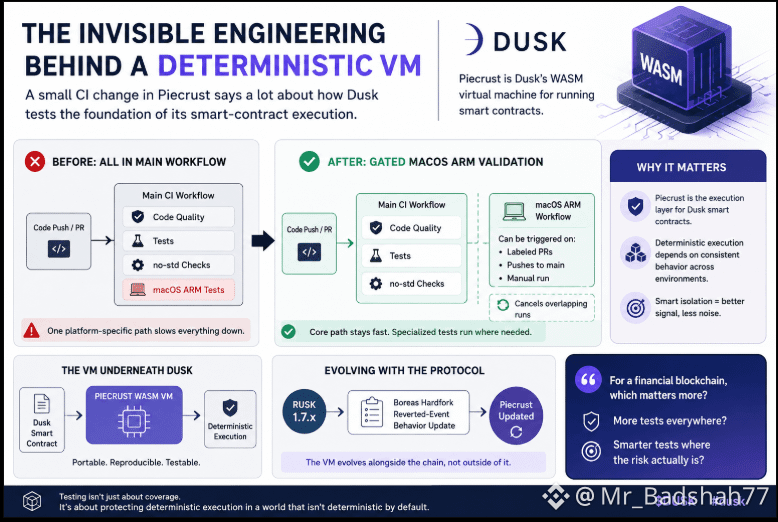
@dusk moved macOS ARM validation out of the main workflow and into a separate gated path....
At first, that sounds like boring engineering housekeeping.
Then I remembered what Piecrust actually is.
It’s the WASM virtual machine underneath Dusk smart contracts. So the interesting question becomes: how do you test a critical execution layer without letting every platform-specific edge case slow down the whole development pipeline?
Think of it like inspecting an aircraft...
The standard checks happen every time.
A special configuration gets its own test procedure when the hardware demands it...
That’s basically what this change does.
The regular pipeline stays focused on core validation, while macOS ARM testing can run separately on specific triggers instead of becoming a mandatory path for everything..
And that distinction matters more as the protocol evolves.
Rusk’s 1.7.x work has already been touching VM behavior around the Boreas hardfork, including changes involving reverted events and historical replay behavior. Piecrust is clearly still part of an actively changing execution stack.
What I find interesting isn’t “Dusk supports another machine.”
It’s the engineering trade-off...
You can make every test run everywhere, every time.
Or you can keep the critical path tight and isolate platform-specific validation where it actually adds signal..
Neither approach is automatically better..
But for a smart-contract VM, I’d rather see testing organized around where execution risk exists than around one giant checklist.
That’s the invisible part of infrastructure people rarely notice.
The quality of a blockchain isn’t only decided by what reaches mainnet.
It’s also decided by how carefully the software underneath it is being challenged before it gets there.
So what would you optimize first?
More tests on every change, or more targeted tests for the execution paths most likely to fail?
$ACE $TRUMP
I was digging through Piecrust, and one tiny CI change made me stop.
@dusk moved macOS ARM validation out of the main workflow and into a separate gated path....
At first, that sounds like boring engineering housekeeping.
Then I remembered what Piecrust actually is.
It’s the WASM virtual machine underneath Dusk smart contracts. So the interesting question becomes: how do you test a critical execution layer without letting every platform-specific edge case slow down the whole development pipeline?
Think of it like inspecting an aircraft...
The standard checks happen every time.
A special configuration gets its own test procedure when the hardware demands it...
That’s basically what this change does.
The regular pipeline stays focused on core validation, while macOS ARM testing can run separately on specific triggers instead of becoming a mandatory path for everything..
And that distinction matters more as the protocol evolves.
Rusk’s 1.7.x work has already been touching VM behavior around the Boreas hardfork, including changes involving reverted events and historical replay behavior. Piecrust is clearly still part of an actively changing execution stack.
What I find interesting isn’t “Dusk supports another machine.”
It’s the engineering trade-off...
You can make every test run everywhere, every time.
Or you can keep the critical path tight and isolate platform-specific validation where it actually adds signal..
Neither approach is automatically better..
But for a smart-contract VM, I’d rather see testing organized around where execution risk exists than around one giant checklist.
That’s the invisible part of infrastructure people rarely notice.
The quality of a blockchain isn’t only decided by what reaches mainnet.
It’s also decided by how carefully the software underneath it is being challenged before it gets there.
So what would you optimize first?
More tests on every change, or more targeted tests for the execution paths most likely to fail?
$ACE $TRUMP