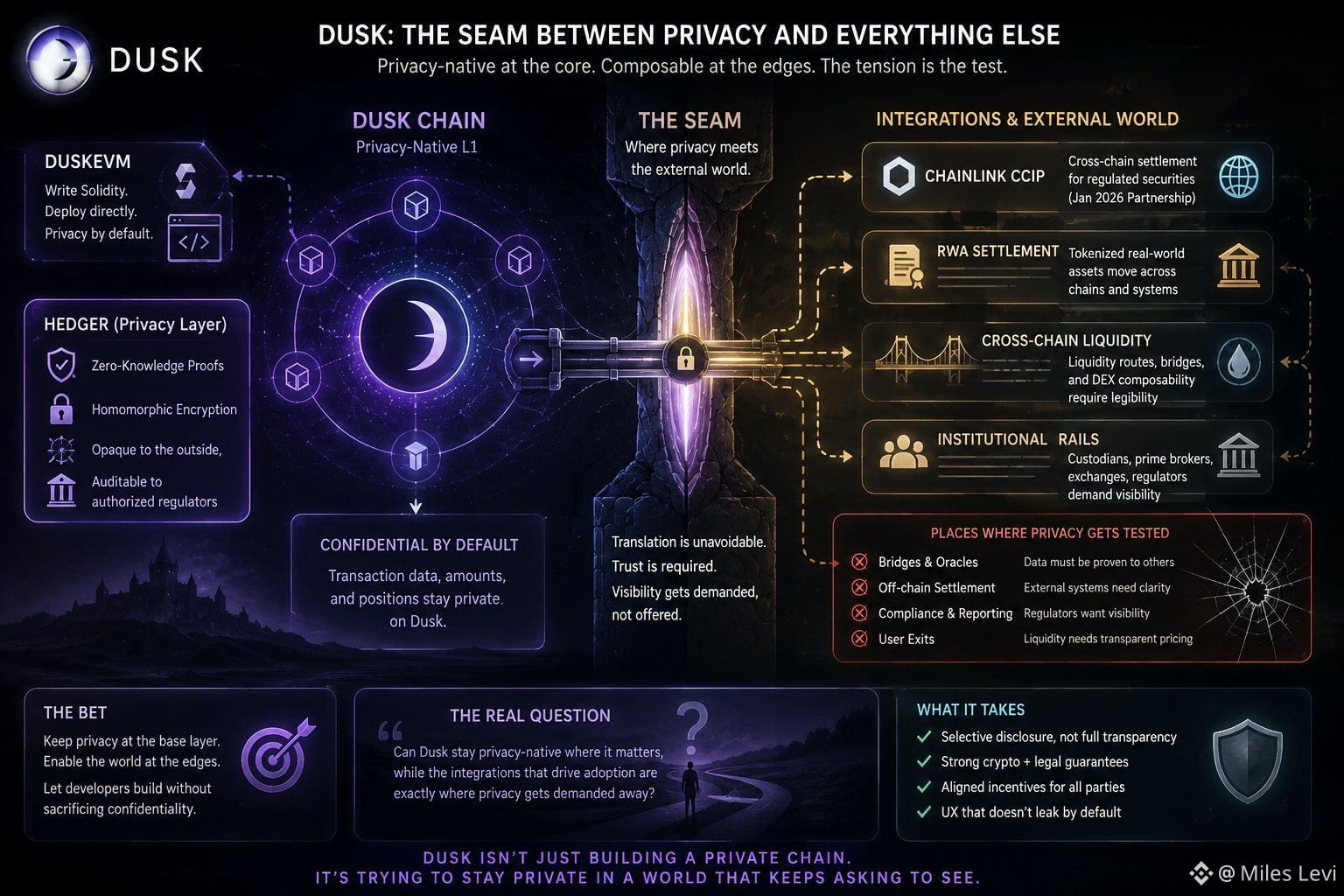
The thing I keep coming back to with Dusk isn't the privacy math anymore — it's the seam where that privacy meets everything else it's trying to plug into. DuskEVM lets developers write and deploy Solidity contracts directly, inheriting Dusk's underlying privacy and consensus without rewriting their code (Gate) . That's a genuinely clever distribution strategy — instead of asking the Ethereum ecosystem to migrate to a new privacy-native chain, you let it walk in through a familiar door.
But composability and confidentiality pull in opposite directions almost by design. The Hedger component uses zero-knowledge proofs and homomorphic encryption to keep transaction data opaque externally while still letting authorized regulators audit it (Gate) — fine, that's the core Dusk bet working as intended. The harder question shows up at the edges: Dusk's January 2026 Chainlink partnership enables cross-chain settlement of regulated securities via CCIP (RocketX Exchange) . Every bridge like that is a place where a private position has to get translated into a format an external chain, an external oracle, or an external counterparty can trust — and trust, historically, means visibility.
So the question isn't "does the ZK math hold." It's whether Dusk can stay privacy-native at the base layer while its most important integrations — RWA settlement, cross-chain liquidity, institutional rails — are exactly the places where legibility gets demanded from outside the system, not offered on its own terms.
#dusk $DUSK @Dusk
But composability and confidentiality pull in opposite directions almost by design. The Hedger component uses zero-knowledge proofs and homomorphic encryption to keep transaction data opaque externally while still letting authorized regulators audit it (Gate) — fine, that's the core Dusk bet working as intended. The harder question shows up at the edges: Dusk's January 2026 Chainlink partnership enables cross-chain settlement of regulated securities via CCIP (RocketX Exchange) . Every bridge like that is a place where a private position has to get translated into a format an external chain, an external oracle, or an external counterparty can trust — and trust, historically, means visibility.
So the question isn't "does the ZK math hold." It's whether Dusk can stay privacy-native at the base layer while its most important integrations — RWA settlement, cross-chain liquidity, institutional rails — are exactly the places where legibility gets demanded from outside the system, not offered on its own terms.
#dusk $DUSK @Dusk