Nobody told me the 2027 DuskEVM mainnet date comes with a prerequisite that almost nobody is talking about.
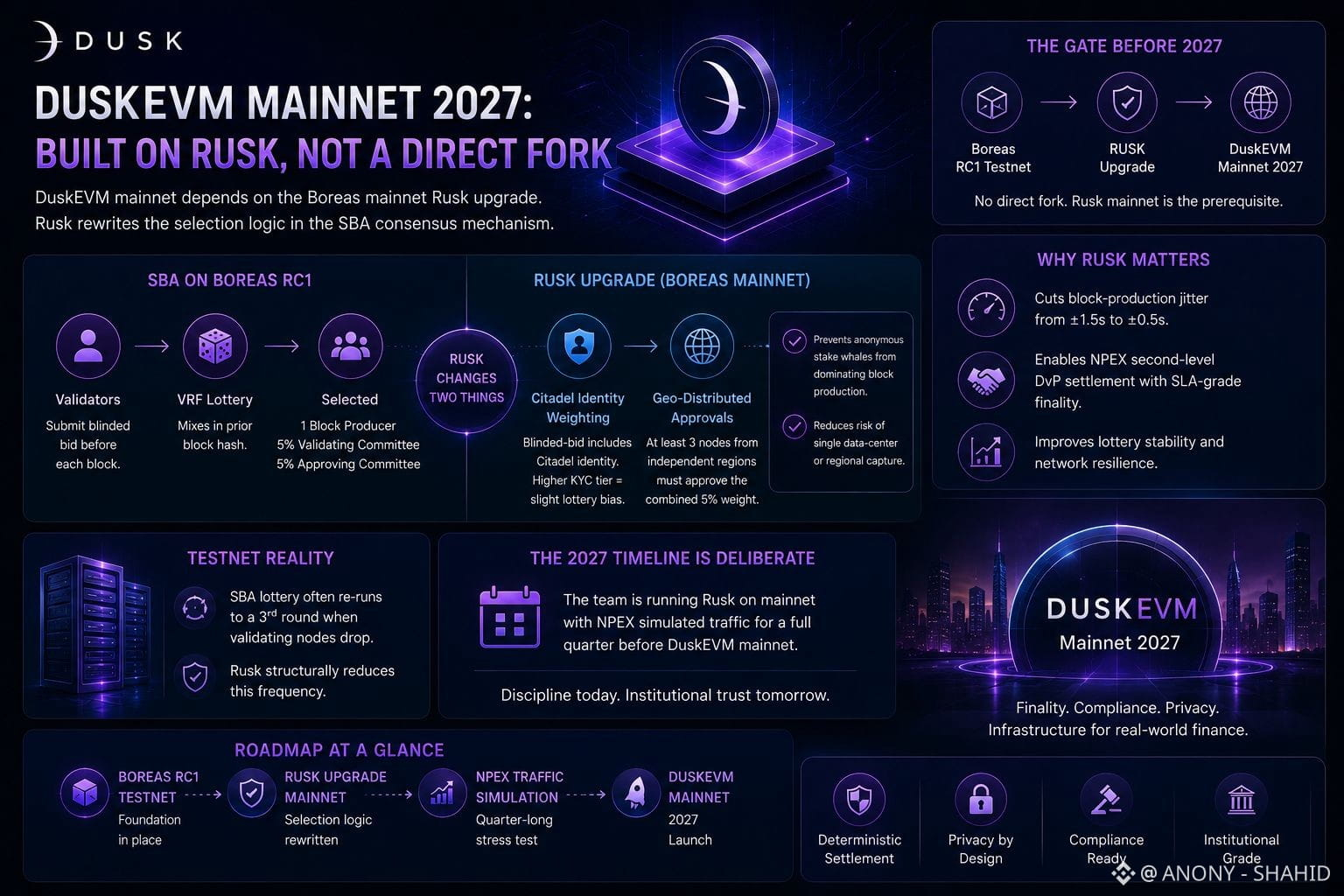
I was going through the roadmap fine print this morning when it clicked. DuskEVM mainnet cannot fork directly from the Boreas RC1 testnet. It has to wait for the Boreas mainnet Rusk upgrade first. And Rusk is not a version bump. It rewrites the selection logic inside the SBA consensus mechanism.
SBA on Boreas RC1 works like this. Validators submit a blinded bid before each block. A VRF mixes in the prior block hash to select the block producer, validating committee members at 5% reward, and approving committee members at another 5%.
Rusk changes two things specifically.
First, Citadel identity weighting gets added to the blinded-bid commitment phase. The lottery offset coefficient adjusts slightly so higher KYC-tier nodes carry a small bias. This prevents anonymous nodes that never passed the AFM channel from dominating block production purely through staking size.
Second, the approving committee signature threshold shifts from collective 5% weight signing to requiring at least 3 nodes from independent geographical regions signing for that combined 5% weight. Single data-center capture becomes structurally harder.
DuskEVM state root finality anchors to DuskDS. If Rusk cuts block-production jitter from plus minus 1.5 seconds to plus minus 0.5 seconds, NPEX second-level DvP settlement becomes something you can actually write into an SLA.
Running testnet nodes myself, I watched the SBA lottery re-run to a third round multiple times when validating committee members went offline. After Rusk that becomes structurally less frequent.
The 2027 date is not a delay. It is the team waiting for Rusk to run selection logic through a full quarter of NPEX simulated traffic before touching mainnet. That discipline is worth more than a faster launch date.
#dusk $DUSK @Dusk
I was going through the roadmap fine print this morning when it clicked. DuskEVM mainnet cannot fork directly from the Boreas RC1 testnet. It has to wait for the Boreas mainnet Rusk upgrade first. And Rusk is not a version bump. It rewrites the selection logic inside the SBA consensus mechanism.
SBA on Boreas RC1 works like this. Validators submit a blinded bid before each block. A VRF mixes in the prior block hash to select the block producer, validating committee members at 5% reward, and approving committee members at another 5%.
Rusk changes two things specifically.
First, Citadel identity weighting gets added to the blinded-bid commitment phase. The lottery offset coefficient adjusts slightly so higher KYC-tier nodes carry a small bias. This prevents anonymous nodes that never passed the AFM channel from dominating block production purely through staking size.
Second, the approving committee signature threshold shifts from collective 5% weight signing to requiring at least 3 nodes from independent geographical regions signing for that combined 5% weight. Single data-center capture becomes structurally harder.
DuskEVM state root finality anchors to DuskDS. If Rusk cuts block-production jitter from plus minus 1.5 seconds to plus minus 0.5 seconds, NPEX second-level DvP settlement becomes something you can actually write into an SLA.
Running testnet nodes myself, I watched the SBA lottery re-run to a third round multiple times when validating committee members went offline. After Rusk that becomes structurally less frequent.
The 2027 date is not a delay. It is the team waiting for Rusk to run selection logic through a full quarter of NPEX simulated traffic before touching mainnet. That discipline is worth more than a faster launch date.
#dusk $DUSK @Dusk