


They said it was impossible to use blockchain in regulated areas. They were wrong. While public crypto focuses on trendy memes and influencer driven money grabs, a huge revolution is taking place in the most secure places in world finance. With a name as simple as Dusk Protocol, there is a breakthrough that is more advanced than anything ever seen and is solving the greatest paradox of our digital world. How can you create a financial system that is both fully private and fully compliant? Financial institutions have always been forced to choose between transparency when it comes to regulators, or confidentiality when it comes to clients. Now, Dusk has changed that. This is the story of the Dusk System, and why it is critical that all financial institutions use it, or else they will become irrelevant.
Let's consider the board room of a large European exchange. The presentation is good. “Tokenization will unlock trillions value.” The heads around the table look skeptical. The head of compliance gives the same answer that has stalled blockchain for a decade. “We can’t put regulated securities on a public ledger.”
“It would expose our clients’ trading patterns to the world.” It wasn’t one institution’s hesitancy; it was the entire financial system’s impasse.
The Secret Pilots That Failed
From London to Singapore to New York, institutions closed doors and ran what they called “blockchain theater.” They created elaborate proofs-of-concept with no intention of moving to production. The post-mortem reports read the same: technology promising, privacy insufficient, regulatory risk unacceptable. “We’ve had working tokenization prototypes for three years. We can’t deploy a single one because the infrastructure exposes what must remain confidential,” a managing director at a global custodian bank said.
This was the status quo until institutions discovered the secret that was already transforming their peers.
Case Study 1: NPEX - The Regulated Exchange That Cracked the Code
Before: “Innovation or Compliance - Pick One”
NPEX, as a Dutch regulated stock exchange, had to deal with brutal trade-offs. The traditional systems were slow, expensive, and opaque, but compliant. On the other hand, blockchain could provide speed, efficiency, and transparency, but at the risk of exposing sensitive trading data and violating client confidentiality and privacy laws in Europe. They were stuck.
The Breakthrough
NPEX hasn't just embraced Dusk; they've teamed up to create something transformative: the first-ever confidential securities exchange. Here’s what the partnership has achieved:
The Changes:
From T+2 settlement to instant finality with complete counterparty anonymity.
From manual compliance checks to automated proof of compliance without revealing transactional information.
From dread of front-running to the elimination of front-running through transactional confidentiality.
From servicing only liquid assets to the unlocking of illiquid markets made possible by privacy-preserving price discovery.
The New Opportunity:
NPEX didn’t just enhance their existing business; they developed an entirely new business model. They opened a secondary market for SME bonds that were too illiquid to trade. “We’re not digitizing old markets, ” their CTO said, “We’re creating markets that couldn't exist before.”
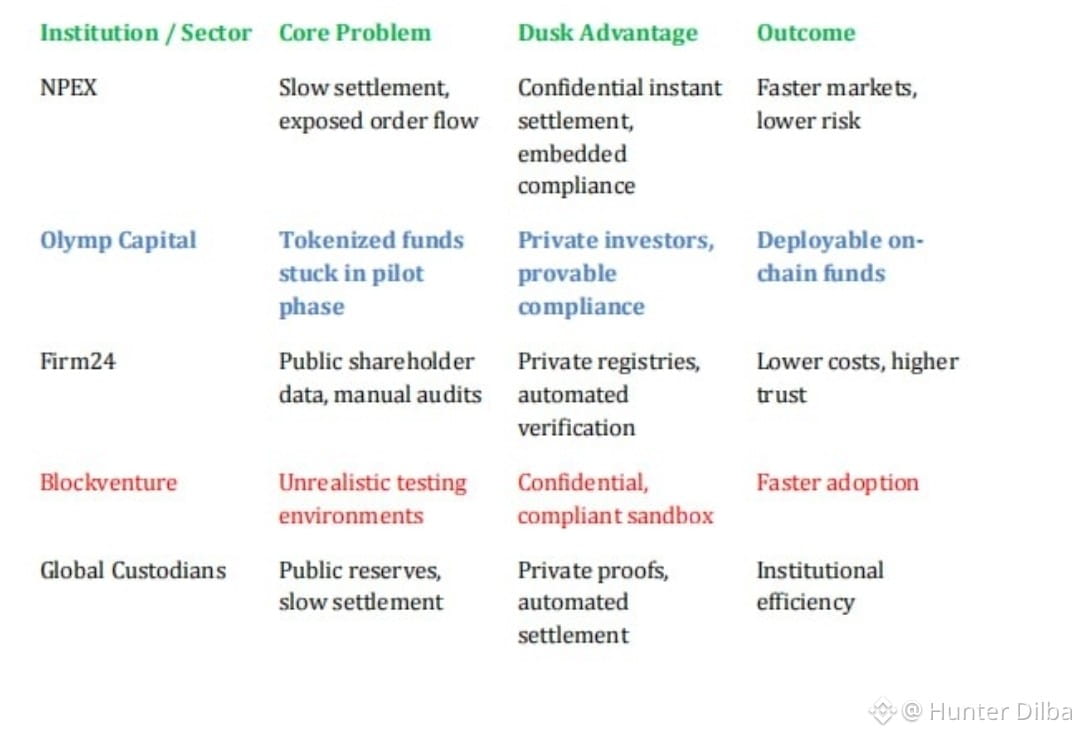
Dusk Network — Institutional Use Cases Overview Table
Case Study 2: The Asset Manager Who Stopped Experimenting and Started Deploying
Before: The Billion-Dollar Prototype
A major European asset manager who requested anonymity had what their tech team dubbed "the museum of blockchain pilots"—gorgeous and functioning prototypes of tokenized funds that never had a real investor. Why? “Our lawyers wouldn't let us show our investment strategies, and they would not let us show our clients on a public chain.”
The Shift to Dusk Productions
With Dusk, she created her first “compliance-native fund.” The magic here isn’t in the tokenization; it’s in the unexplained mystery.
The Confidential Architecture:
Investors: Vertified, but not revealed.
Portfolio Diversity: Provably diversified, but not disclosed.
Automated Strategies: Present, but not visible.
Regulatory Boundaries: Enforced, but not disclosed.
The Head of Digital Assets was straightforward. “This moved blockchain from a compliance problem to our greatest compliance advantage.”
The Domino Effect: Explosive Adoption Is Coming
The Tokenization Tsunami Is Here.
Analysts expect $4 to $16 Trillion in tokenized real world assets by 2030. This is not speculation. We are already seeing it with treasury bonds, real estate, and private equity. There is a problem, however. The current champions are leveraging a timeframe which is not sustainable. When the regulation catches up (see Europe's MiCA), the only options will be the ones built on privacy-preserving, compliance-embedded structures.
The Institutions That Must Act NOW
Global Custodians (BNY Mellon, State Street):
Current Reality: Watching assets digitize while their traditional custody business faces disintermediation.
With Dusk: They become the trusted gatekeepers of the digital age, offering proof-of-reserves without exposure, cross-institutional settlement with privacy, and automated compliance at scale.
Risk of Delay: Becoming irrelevant as assets move to more efficient, confidential infrastructure.
Traditional Exchanges (NYSE, LSE, Deutsche Börse):
Current Reality: Tokenization is happening—with or without them.
With Dusk: They become the regulated portals to digital assets, offering confidential order matching, jurisdictional compliance, and access to previously untradeable assets.
Risk of Delay: Being bypassed as trading moves to more flexible, private venues.
Big Four Audit Firms (Deloitte, EY, PwC, KPMG):
Current Reality: Their audit methodologies are collapsing under digital asset complexity.
With Dusk: They pioneer continuous, privacy-preserving assurance, reducing audit costs by 40-60% while offering new blockchain compliance services.
Risk of Delay: Losing relevance as auditing becomes automated through cryptographic proofs.
The Need to Integrate Strategic Whys: If it isn’t about the tech you’re adopting, what is it about? Survival.
Why A ‘Wait And See’ Approach Is Strategic Suicide
The history of infrastructure transition is the same, creating a permanent set of winners and losers. For instance, consider:
NASDAQ now dominates electronic trading because they were the first to move.
SWIFT became the world standard because they were first to build the network.
DTCC monopolized custody because they were the first to build the settlement rails.
In every instance, late arrivals.were too late to catch up. The same phenomenon is now repeating, except this time, the stakes are much higher because it is not about simply ideal efficiencies, but also about relevance in the world of tokens.
The Network Effect Accelerator
Every institution that Integrates Dusk not only shoots itself in the arm but also builds an ecosystem for everyone else. This gives rise to what economists best describe as increasing returns to adoption:
Setting the Regulatory Framework: First movers shape the rest of the followers
Setting the Technical Framework: Subsequent implementations become the infrastructure.
Setting Interoperability: Value is cemented through integrated cross-discipline workflows.
Setting the Talent Framework: Innovators congregate to the front runners.
To parody an investment bank’s digital assets lead: “We’re not evaluating a network. We’re determining if we want a position in the network, or we want to be disconnected from the network. The latter is an indefensible position to be in.
The Inevitable Future: What Happens when the two ends of the spectrum of privacy and compliance meet?
In five years, we will have a new financial system where:
Every asset has a digital twin, but private ownership.
Every transaction settles instantly, but details are private.
Every automated compliance check won’t share unnecessary info.
Every audit is perpetual, but client privacy is protected.
This is not a utopian vision. It is the logical endpoint of Dusk’s NPEX architecture and other early adopters.
The Institutions that Will Define This Future
There are three common denominators:
They understand this is not about crypto. This is a vertical play: financial infrastructure.
They get that privacy and compliance are not mutually exclusive. They both are prerequisites.
They are not tweaking with the proof of concept. They are deploying it.
The Dusk Transformation
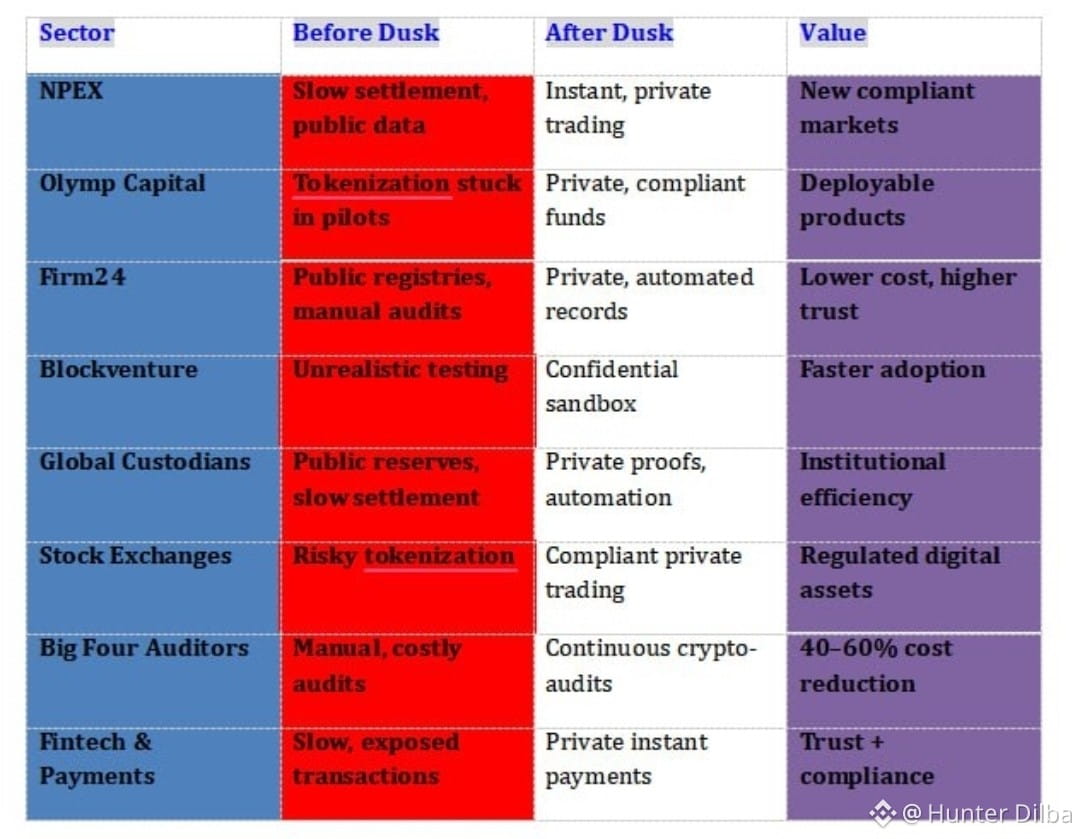
This Table presents a concise before-and-after view of how Dusk Network transforms institutional blockchain use cases through privacy-first, compliance-native infrastructure.
Conclusion: The Choice is Binary; Lead or Be Led
The evidence is overwhelming and the trajectory has been mapped. Early adopters are not just gaining efficiency. They are
Identifying new revenue streams from products that no one thought possible.
Securing a first-mover advantage from the regulatory no man’s land that will become permanent.
This will build the defining network effects of the new era of finance.
Positioning themselves as the innovators in a laggard sea.
The managing director who once called blockchain pilots “the museum of failed experiments” now says: “We’ve found the infrastructure that makes the impossible inevitable. Our only question now is how fast we can transition our entire business.”
The revolution isn’t coming from Silicon Valley crypto startups. It’s coming from the most regulated institutions in the world. They’ve found their infrastructure. The question is: Have you found yours?
Bottom Line: This isn’t about adopting new technology. it is about choosing your place in the financial system of the future. Dusk Protocol has built the bridge from yesterday’s limitations to tomorrow’s opportunities. The institutions crossing it will define finance for the next generation. Those waiting on the shore will watch them to a more efficient, more private, more compliant future — without them.