
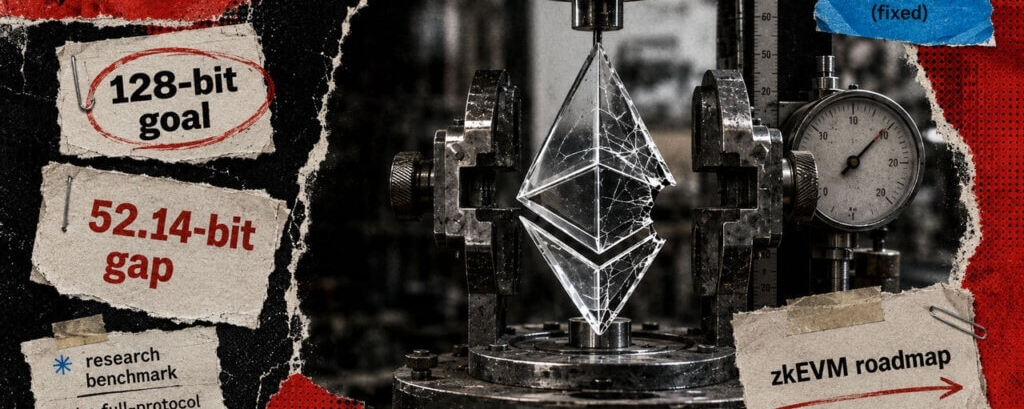


I recently came across Ethereum’s better.codes contest, which is giving researchers a public and reproducible way to measure a cryptographic proof gap in koalaIRS12.
As of 15:44:47 UTC on August 21, the live leaderboard showed a 63.99-bit lower certificate and a 116.13-bit upper certificate, leaving 52.14 bits unresolved after nine promoted submissions from seven solvers.
What caught my attention is that koalaIRS12 is a fixed parameter profile for an interleaved Reed–Solomon reduction used in proof-system research. The challenge repository is also careful to define its score as a “spot-check quantity” and explicitly warns against interpreting it as the negative logarithm of whole-system soundness or as full-protocol security.
The contest attacks the gap from two directions.
On the soundness track, researchers try to raise the lower certificate. A successful submission proves that the benchmark’s executable reduction-error bound meets the encoded target and then maps that certified radius to the leaderboard score.
On the attack track, researchers try to lower the upper certificate. Its theorem identifies an unsafe suffix under the benchmark’s winning-set-density condition. The repository covers that suffix directly because its formalization assumes “no monotonicity theorem for winning-set density.”
For me, the important distinction is that the upper certificate describes a formal boundary for koalaIRS12, not an Ethereum attack cost. Turning that result into a statement about a production system would require a separate whole-system security analysis.
The Ethereum Foundation says the theorem statement, parameter point, and verification harness are pinned. Each submission exports the required theorem, a comparator checks it against the target, and the Lean kernel verifies the proof before the result is promoted.
That makes each accepted result meaningful: it proves the submitted theorem inside the pinned environment. But production assurance still requires checking the model’s completeness, the assumptions built into its definitions, implementation fidelity, and the composition of separately analyzed components.
The Foundation’s May review of an SP1 formal-verification effort highlights why those layers matter. Specifications and theorem statements are themselves code, inputs and versions need reproducible pinning, and component-level proofs need broader reasoning before they can support conclusions about an entire system.
I also found an academic paper by Gal Arnon, Dan Boneh, and Giacomo Fenzi that identifies list decoding, Reed–Solomon proximity gaps, correlated agreement, and mutual correlated agreement as open questions for succinct proof systems. The paper predates the current leaderboard snapshot, so it does not evaluate today’s scores, but it helps explain why this research area matters.
Ultimately, I see better.codes as a machine-checked research path toward stronger hash-based SNARK security. Improving the koalaIRS12 certificates would sharpen one reduction within that broader agenda.
The 116.13-bit certificate has a specific scope: it applies to the parameter point encoded in the challenge. Other parameter choices, constructions, and system components remain separate research questions.
What makes the current leaderboard especially interesting to me is the two-sided movement. Every promotion changes a checkable boundary, while the pinned theorem keeps successive results comparable. That turns an abstract cryptographic gap into something researchers can attack, verify, and measure in public.
